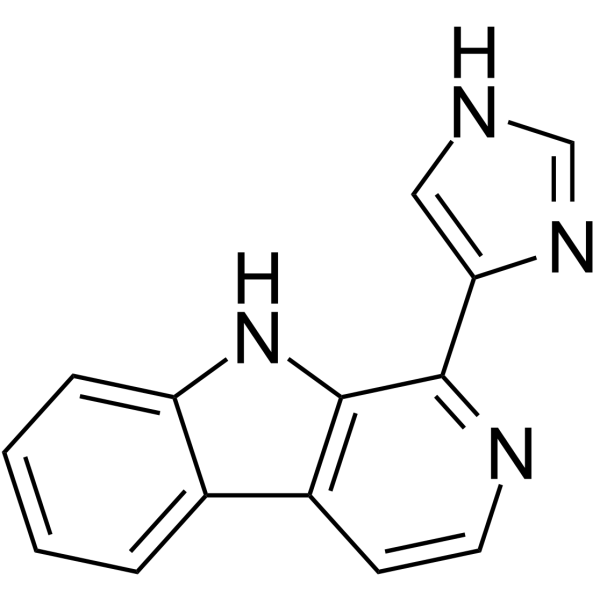
IDO1/TDO-IN-4 is a novel dual IDO1/TDO inhibitor, with IC50 values of 3.53 μM (IDO1) and 1.15 μM (TDO). It has the potential to be used in the treatment of depression, and depression-induced infectious, metabolic, and autoimmune disorders.
Physicochemical Properties
| Molecular Formula | C14H10N4 |
| Molecular Weight | 234.26 |
| Exact Mass | 234.09 |
| CAS # | 461424-21-5 |
| PubChem CID | 44269517 |
| Appearance | Yellow to brown solid powder |
| LogP | 2.2 |
| Hydrogen Bond Donor Count | 2 |
| Hydrogen Bond Acceptor Count | 2 |
| Rotatable Bond Count | 1 |
| Heavy Atom Count | 18 |
| Complexity | 308 |
| Defined Atom Stereocenter Count | 0 |
| SMILES | C1C=C2C(NC3C2=CC=NC=3C2=CN=CN2)=CC=1 |
| InChi Key | HUTBKGSJEGKJBG-UHFFFAOYSA-N |
| InChi Code | InChI=1S/C14H10N4/c1-2-4-11-9(3-1)10-5-6-16-14(13(10)18-11)12-7-15-8-17-12/h1-8,18H,(H,15,17) |
| Chemical Name | 1-(1H-imidazol-5-yl)-9H-pyrido[3,4-b]indole |
| HS Tariff Code | 2934.99.9001 |
| Storage |
Powder-20°C 3 years 4°C 2 years In solvent -80°C 6 months -20°C 1 month |
| Shipping Condition | Room temperature (This product is stable at ambient temperature for a few days during ordinary shipping and time spent in Customs) |
Biological Activity
| ln Vitro | According to morphological alterations, LPS-induced BV2 microglial activation is inhibited by IDO1/TDO-IN-4 (Compound 28, 0-2 μM, 1 hour) [1]. IDO1/TDO-IN-4 (0-2 μM, 1 h) stimulates the expression of IL-10 while suppressing the synthesis of pro-inflammatory factors [1]. IDO1/TDO-IN-4 (0-2 μM, 1 hour) inhibits the over-degradation of tryptophan via the kynurenine pathway and lowers IDO1 expression [1]. |
| ln Vivo | Compound 28, administered intraperitoneally at a dose of 20 mg/kg on days 1, 2, and 3, has the ability to rescue mice from LPS-induced neuroinflammation and depressive-like behavior [1]. In normal mice, the intravenous injection (20 mg/kg) of IDO1/TDO-IN-4 shows a high steady-state volume of distribution and high exposure [1]. |
| Cell Assay |
RT-PCR[1] Cell Types: 100 ng/mL LPS-induced BV2 microglia Tested Concentrations: 0, 0.25, 0.5, 1, 2 μM Incubation Duration: 1 h Experimental Results: Inhibition of COX2, iNOS, TNF-α, and IL-1β. IL-10 levels are elevated. |
| Animal Protocol |
Animal/Disease Models: 2 mg/kg LPS-induced depression in mice [1] Doses: 20 mg/kg Route of Administration: intraperitoneal (ip) injection, days 1, 2, and 3. Experimental Results: Microglial activation was Dramatically attenuated. Hippocampal inflammatory factors were diminished, such as TNF-α, IL-1β, and iNOS. Downregulates LPS-induced IDO1 overexpression. Animal/Disease Models: Male C57BL/6J mice (pharmacokinetic/PK/PK determination) [1] Doses: 20 mg/kg Route of Administration: intraperitoneal (ip) injection and intravenous (iv) (iv)injection Experimental Results: IDO1/TDO-IN-4 (compound 28) pharmacokinetic/PK/PKs Chemical properties T1/2 (h) Tmax (h) Cmax (ng/mL) Bioavailability F (%) iv/ip 2.31/0.77 0.25 5543.99/3878 52.55 |
| References |
[1]. B Discovery of 1-(Hetero)aryl-β-carboline Derivatives as IDO1/TDO Dual Inhibitors with Antidepressant Activity. J Med Chem. 2022 Aug 7. |
Solubility Data
| Solubility (In Vitro) |
DMSO : ~125 mg/mL (~533.60 mM) MEthanol : ~16.67 mg/mL (~71.16 mM) |
| Solubility (In Vivo) |
Solubility in Formulation 1: 2.08 mg/mL (8.88 mM) in 10% DMSO + 90% (20% SBE-β-CD in Saline) (add these co-solvents sequentially from left to right, and one by one), suspension solution; with sonication. For example, if 1 mL of working solution is to be prepared, you can add 100 μL of 20.8 mg/mL clear DMSO stock solution to 900 μL of 20% SBE-β-CD physiological saline solution and mix evenly. Preparation of 20% SBE-β-CD in Saline (4°C,1 week): Dissolve 2 g SBE-β-CD in 10 mL saline to obtain a clear solution. (Please use freshly prepared in vivo formulations for optimal results.) |
| Preparing Stock Solutions | 1 mg | 5 mg | 10 mg | |
| 1 mM | 4.2688 mL | 21.3438 mL | 42.6876 mL | |
| 5 mM | 0.8538 mL | 4.2688 mL | 8.5375 mL | |
| 10 mM | 0.4269 mL | 2.1344 mL | 4.2688 mL |