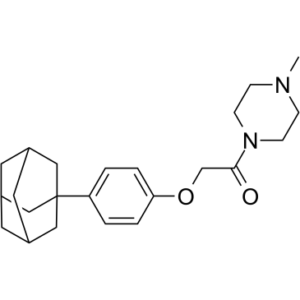
IDF-11774 (IDF11774) is a novel, potent, and orally bioavailable HIF-1α (hypoxia-inducible factor 1α) inhibitor with anticancer activity. It inhibits HIF-1α with an IC50 of 3.65 μM. HIF-1 is associated with poor prognoses and therapeutic resistance in cancer patients. IDF-11774 inhibited the accumulation of HIF-1α in vitro and in vivo in colorectal carcinoma HCT116 cells under hypoxic conditions. Moreover, IDF-11774 treatment suppressed angiogenesis of cancer cells by reducing the expression of HIF-1 target genes, reduced glucose uptake, thereby sensitizing cells to growth under low glucose conditions, and decreased the extracellular acidification rate (ECAR) and oxygen consumption rate of cancer cells. Metabolic profiling of IDF-11774-treated cells revealed low levels of NAD+, NADP+, and lactate, as well as of intermediates in glycolysis and the tricarboxylic acid cycle. In addition, elevated AMP and diminished ATP levels were observed, resulting in a high AMP/ATP ratio. The level of AMP-activated protein kinase phosphorylation also increased, leading to inhibition of mTOR signaling in treated cells. In vivo xenograft assays demonstrated that IDF-11774 exhibited substantial anticancer efficacy in mouse models containing KRAS, PTEN, or VHL mutations, which often occur in malignant cancers. Collectively, these data indicate that IDF-11774 suppressed hypoxia-induced HIF-1α accumulation and repressed tumor growth by targeting energy production-related cancer metabolism.
Physicochemical Properties
| Molecular Formula | C23H32N2O2 |
| Molecular Weight | 368.512386322021 |
| Exact Mass | 368.246 |
| CAS # | 1429054-28-3 |
| PubChem CID | 71542096 |
| Appearance | White to off-white solid powder |
| LogP | 4.6 |
| Hydrogen Bond Donor Count | 0 |
| Hydrogen Bond Acceptor Count | 3 |
| Rotatable Bond Count | 4 |
| Heavy Atom Count | 27 |
| Complexity | 505 |
| Defined Atom Stereocenter Count | 0 |
| SMILES | O(CC(N1CCN(C)CC1)=O)C1C=CC(=CC=1)C12CC3CC(CC(C3)C1)C2 |
| InChi Key | QGBBBLPWBSWERZ-KIOFGVERSA-N |
| InChi Code | InChI=1S/C23H32N2O2/c1-24-6-8-25(9-7-24)22(26)16-27-21-4-2-20(3-5-21)23-13-17-10-18(14-23)12-19(11-17)15-23/h2-5,17-19H,6-16H2,1H3/t17-,18-,19-,23? |
| Chemical Name | 2-(4-((3r,5r,7r)-adamantan-1-yl)phenoxy)-1-(4-methylpiperazin-1-yl)ethan-1-one |
| Synonyms | IDF11774; IDF 11774; IDF-11774 |
| HS Tariff Code | 2934.99.9001 |
| Storage |
Powder-20°C 3 years 4°C 2 years In solvent -80°C 6 months -20°C 1 month |
| Shipping Condition | Room temperature (This product is stable at ambient temperature for a few days during ordinary shipping and time spent in Customs) |
Biological Activity
| Targets |
|
|
| ln Vitro | In cancer cell lines, IDF-11774 is a new inhibitor of hypoxia-inducible factor (HIF)-1, having an IC50 of 3.65 μM. A Phase I study has approved IDF-11774 as a therapeutic medication candidate. IDF-11774 treatment of human umbilical cord vascular endothelial cells (HUVEC) resulted in less capillary network development on Matrigel. Treatment with IDF-11774 led to a reduction in GLUT1 and pyruvate dehydrogenase kinase 1 (PDK1) mRNA expression. Moreover, intracellular ATP levels were considerably lowered when IDF-11774 was present, and the effects were more pronounced when low glucose levels (5.5 mM) were present [1]. | |
| ln Vivo | When mice treated with oral IDF-11774 had tumors, luciferase activity and HIF-1α accumulation were significantly reduced in comparison to controls. Oral IDF-11774 treatment for two weeks resulted in significant dose-dependent tumor shrinkage in mice models [1]. | |
| References |
[1]. The novel hypoxia-inducible factor-1α inhibitor IDF-11774 regulates cancer metabolism, thereby suppressing tumor growth. Cell Death Dis. 2017 Jun 1;8(6):e2843. |
Solubility Data
| Solubility (In Vitro) | DMSO : ~60 mg/mL (~162.82 mM) |
| Solubility (In Vivo) |
Solubility in Formulation 1: ≥ 1.67 mg/mL (4.53 mM) (saturation unknown) in 10% DMSO + 40% PEG300 + 5% Tween80 + 45% Saline (add these co-solvents sequentially from left to right, and one by one), clear solution. For example, if 1 mL of working solution is to be prepared, you can add 100 μL of 16.7 mg/mL clear DMSO stock solution to 400 μL PEG300 and mix evenly; then add 50 μL Tween-80 to the above solution and mix evenly; then add 450 μL normal saline to adjust the volume to 1 mL. Preparation of saline: Dissolve 0.9 g of sodium chloride in 100 mL ddH₂ O to obtain a clear solution. Solubility in Formulation 2: ≥ 1.67 mg/mL (4.53 mM) (saturation unknown) in 10% DMSO + 90% (20% SBE-β-CD in Saline) (add these co-solvents sequentially from left to right, and one by one), clear solution. For example, if 1 mL of working solution is to be prepared, you can add 100 μL of 16.7 mg/mL clear DMSO stock solution to 900 μL of 20% SBE-β-CD physiological saline solution and mix evenly. Preparation of 20% SBE-β-CD in Saline (4°C,1 week): Dissolve 2 g SBE-β-CD in 10 mL saline to obtain a clear solution. Solubility in Formulation 3: ≥ 1.67 mg/mL (4.53 mM) (saturation unknown) in 10% DMSO + 90% Corn Oil (add these co-solvents sequentially from left to right, and one by one), clear solution. For example, if 1 mL of working solution is to be prepared, you can add 100 μL of 16.7 mg/mL clear DMSO stock solution to 900 μL of corn oil and mix evenly. (Please use freshly prepared in vivo formulations for optimal results.) |
| Preparing Stock Solutions | 1 mg | 5 mg | 10 mg | |
| 1 mM | 2.7136 mL | 13.5682 mL | 27.1363 mL | |
| 5 mM | 0.5427 mL | 2.7136 mL | 5.4273 mL | |
| 10 mM | 0.2714 mL | 1.3568 mL | 2.7136 mL |