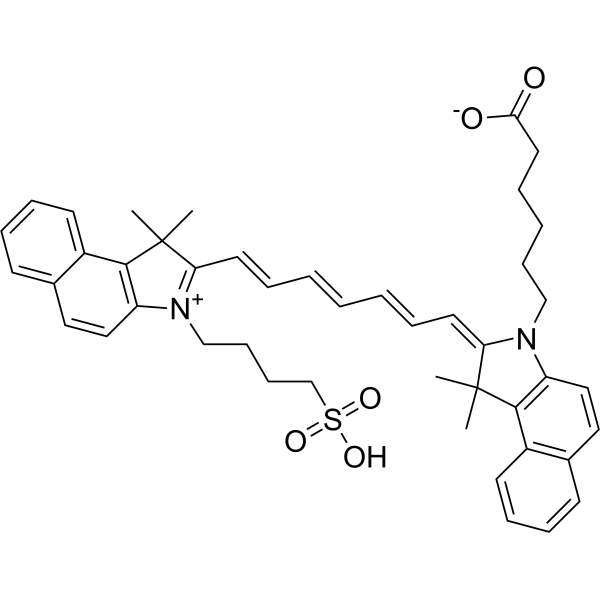
Physicochemical Properties
| Molecular Formula | C45H50N2O5S |
| Molecular Weight | 730.953911304474 |
| Exact Mass | 730.344 |
| CAS # | 181934-09-8 |
| PubChem CID | 145710953 |
| Appearance | Brown to black solid powder |
| LogP | 9.4 |
| Hydrogen Bond Donor Count | 1 |
| Hydrogen Bond Acceptor Count | 6 |
| Rotatable Bond Count | 14 |
| Heavy Atom Count | 53 |
| Complexity | 1530 |
| Defined Atom Stereocenter Count | 0 |
| SMILES | S(CCCCN1C2C=CC3C=CC=CC=3C=2C(C)(C)/C/1=C/C=C/C=C/C=C/C1C(C)(C)C2C3C=CC=CC=3C=CC=2[N+]=1CCCCCC(=O)O)(=O)(=O)[O-] |
| InChi Key | HIBVKROMGIHYKL-UHFFFAOYSA-N |
| InChi Code | InChI=1S/C45H50N2O5S/c1-44(2)39(46(30-16-8-11-25-41(48)49)37-28-26-33-19-12-14-21-35(33)42(37)44)23-9-6-5-7-10-24-40-45(3,4)43-36-22-15-13-20-34(36)27-29-38(43)47(40)31-17-18-32-53(50,51)52/h5-7,9-10,12-15,19-24,26-29H,8,11,16-18,25,30-32H2,1-4H3,(H-,48,49,50,51,52) |
| Chemical Name | 4-[(2Z)-2-[(2E,4E,6E)-7-[3-(5-carboxypentyl)-1,1-dimethylbenzo[e]indol-3-ium-2-yl]hepta-2,4,6-trienylidene]-1,1-dimethylbenzo[e]indol-3-yl]butane-1-sulfonate |
| HS Tariff Code | 2934.99.9001 |
| Storage |
Powder-20°C 3 years 4°C 2 years In solvent -80°C 6 months -20°C 1 month Note: This product requires protection from light (avoid light exposure) during transportation and storage. |
| Shipping Condition | Room temperature (This product is stable at ambient temperature for a few days during ordinary shipping and time spent in Customs) |
Biological Activity
| ln Vitro | Because of its well-established fluorescent qualities, indocyanine green (ICG), a water-soluble chemical, is often and safely employed in medical diagnostics. It has been applied to the identification of important structures, such as intra-abdominal malignancies, during fluorescence-guided surgery [1]. |
| References |
[1]. Combined application of Indocyanine green (ICG) and laser lead to targeted tumor cell destruction. J Pediatr Surg. 2018;53(12):2475-2479. [2]. Spectral characteristics of voltage-sensitive indocyanine green fluorescence in the heart. Sci Rep. 2017;7(1):7983. Published 2017 Aug 11. |
Solubility Data
| Solubility (In Vitro) | DMSO : ~50 mg/mL (~68.40 mM) |
| Solubility (In Vivo) |
Solubility in Formulation 1: 2.5 mg/mL (3.42 mM) in 10% DMSO + 40% PEG300 +5% Tween-80 + 45% Saline (add these co-solvents sequentially from left to right, and one by one), suspension solution; with sonication. For example, if 1 mL of working solution is to be prepared, you can add 100 μL of 25.0 mg/mL clear DMSO stock solution to 400 μL PEG300 and mix evenly; then add 50 μL Tween-80 + to the above solution and mix evenly; then add 450 μL normal saline to adjust the volume to 1 mL. Preparation of saline: Dissolve 0.9 g of sodium chloride in 100 mL ddH₂ O to obtain a clear solution. (Please use freshly prepared in vivo formulations for optimal results.) |
| Preparing Stock Solutions | 1 mg | 5 mg | 10 mg | |
| 1 mM | 1.3681 mL | 6.8404 mL | 13.6808 mL | |
| 5 mM | 0.2736 mL | 1.3681 mL | 2.7362 mL | |
| 10 mM | 0.1368 mL | 0.6840 mL | 1.3681 mL |