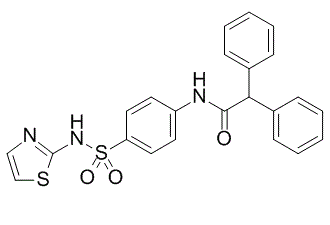
ICA-121431 is a potent, highly selective small molecule inhibitor of the human Nav1.3 and Nav1.1 voltage gated sodium channels with IC50 of 19 nM. It exhibit up to 1,000-fold selectivity for human Nav1.3/Nav1.1 (ICA-121431, IC50, 19 nM) vs. other TTX-sensitive or resistant (i.e., Nav1.5) sodium channels, in other words, it has little or no activity against human Nav1.5 or Nav1.7 channels. Voltage-gated sodium channels initiate action potentials in brain neurons, and sodium channel blockers are used in therapy of epilepsy.
Physicochemical Properties
| Molecular Formula | C23H19N3O3S2 | |
| Molecular Weight | 449.54 | |
| Exact Mass | 449.086 | |
| CAS # | 313254-51-2 | |
| Related CAS # |
|
|
| PubChem CID | 998021 | |
| Appearance | White to off-white solid powder | |
| Density | 1.4±0.1 g/cm3 | |
| Index of Refraction | 1.693 | |
| LogP | 3.89 | |
| Hydrogen Bond Donor Count | 2 | |
| Hydrogen Bond Acceptor Count | 6 | |
| Rotatable Bond Count | 7 | |
| Heavy Atom Count | 31 | |
| Complexity | 659 | |
| Defined Atom Stereocenter Count | 0 | |
| InChi Key | URSQNPPONHUJDL-UHFFFAOYSA-N | |
| InChi Code | InChI=1S/C23H19N3O3S2/c27-22(21(17-7-3-1-4-8-17)18-9-5-2-6-10-18)25-19-11-13-20(14-12-19)31(28,29)26-23-24-15-16-30-23/h1-16,21H,(H,24,26)(H,25,27) | |
| Chemical Name | 2,2-diphenyl-N-[4-(1,3-thiazol-2-ylsulfamoyl)phenyl]acetamide | |
| Synonyms |
|
|
| HS Tariff Code | 2934.99.9001 | |
| Storage |
Powder-20°C 3 years 4°C 2 years In solvent -80°C 6 months -20°C 1 month |
|
| Shipping Condition | Room temperature (This product is stable at ambient temperature for a few days during ordinary shipping and time spent in Customs) |
Biological Activity
| Targets |
ICA-121431 targets voltage-gated sodium channels, with high selectivity for human Nav1.3 (IC50 = 18 ± 5 nM) and negligible inhibition of human Nav1.5 (IC50 >10 µM) and human Nav1.7 (IC50 >10 µM) [1] |
||
| ln Vitro |
Human Nav1.3 and the amino acid residues that might determine this channel's selectivity over other related Nav channels, such as Nav1.7 and Nav1.5, are interacting with ICA-121431. Data produced with a pulse protocol that involves an 8-s step to a voltage that inactivates half of the channels before a 20-ms test pulse using traditional patch clamp electrophysiological recording[1]. ICA-121431 exhibits IC50s of 0.013 µM, >30 µM, and 12 µM for Wild type hNav1.3, hNav1.5, and hNav1.7, respectively[1]. hNav1.3 M1 (S1510Y), hNav1.3 M2 (R1511W), hNav1.3 M3 (E1559D), hNav1.3 M1, 3 (S1510Y/E1559D), hNav1.3 M2, 3 (R1511W/E1559D), hNav1.3 M1, 2, 3 (S1510Y/R1511W/E1559D), and hNav1.7 M1, 2, 3 (Y1537S/W1538R/D1586E) have IC50 values of 0.1 µM, 0.37 µM, 1.1 µM, 1.3 µM, 11.6 µM, and 0.032 µM, respectively[1]. hNav1.3/hNav1.5 S1-S4, hNav1.3/hNav1.5 S3-S4, hNav1.3/hNav1.5 S5-S6, hNav1.3/hNav1.7 S1, hNav1.3/hNav1.7 S2, and hNav1.3/hNav1 are among the hNav channels that ICA-121431 is against. The IC50 values of hNav1.3/hNav1.7 S5-S6, 7 S3-S4, 1.2 µM, 11 µM, 2.0 µM, 0.045 µM, 0.030 µM, 0.30 µM, 1.0 µM, and 0.024 µM, respectively, were reported[1]. 1. ICA-121431 (1 µM) reduced the amplitude of human Nav1.3 current elicited by a 20-ms voltage step to 0 mV from −120 mV; after an 8-s conditioning voltage step to −60 mV (to inactivate ~50% of available channels), the inhibitor still exhibited inhibitory effects on Nav1.3 current. Current traces were normalized to ensure control traces had the same relative amplitude [1] 2. The voltage dependence of human Nav1.3 inactivation was altered by ICA-121431: the half-inactivation voltage (Vh) of Nav1.3 was −67 ± 2 mV under control conditions, while in the presence of 0.01 µM, 0.1 µM, and 1 µM ICA-121431, the Vh shifted to −78 ± 2 mV, −86 ± 2 mV, and −93 ± 2 mV, respectively. Peak current amplitudes were measured during test pulses to 0 mV after an 8-s conditioning depolarization to different potentials, and values were normalized to the largest amplitude current after a prepulse to −120 mV, with inactivation curves fitted by the Boltzmann equation [1] 3. ICA-121431 (1 µM) showed use-dependent inhibition of human Nav1.3: when a train of 20-ms voltage steps from −120 mV to 0 mV was applied at 10 Hz, the current amplitude (normalized to control) of Nav1.3 was progressively reduced, which was different from the inhibition pattern of 10 nM TTX [1] 4. ICA-121431 (1 µM) had no significant inhibitory effect on human Nav1.5 and Nav1.7 currents elicited by a 20-ms voltage step to 0 mV after an 8-s conditioning voltage step to inactivate ~50% of available channels [1] 5. Chimeric sodium channel experiments demonstrated that potent inhibition by ICA-121431 was only observed in chimeras containing Nav1.3 Domain 4; substitution of subregions of Nav1.3 Domain 4 with equivalent regions from Nav1.5 or Nav1.7 significantly reduced the inhibitory potency of ICA-121431 [1] 6. Mutagenesis studies identified three key residues (M1: S1510Y, M2: R1511W, M3: E1559D) in the S1-S4 voltage-sensor region of Nav1.3 Domain 4 that determine the selectivity of ICA-121431; single or combined mutations of these residues in Nav1.3 to the corresponding residues of Nav1.7 altered the IC50 of ICA-121431 inhibition, while amitriptyline (a local anesthetic) showed different sensitivity patterns to these mutations [1] 7. The triple mutant (S1510Y/R1511W/E1559D) of Nav1.3 and the reverse triple mutant (Y1537S/W1538R/D1586E) of Nav1.7 altered the inhibitory effects of ICA-121431 and tetracaine, and also affected biophysical properties (current-voltage relationships, voltage dependence of inactivation, time course of recovery from inactivation) of Nav1.3 and Nav1.7 channels [1] |
||
| ln Vivo |
|
||
| Cell Assay |
1. PatchXpress automated electrophysiology assay: Human Nav1.3, Nav1.5, and Nav1.7 currents were recorded using PatchXpress. For Nav1.3, current traces were measured during a 20-ms voltage step to 0 mV from a holding potential (HP) of −120 mV, or after an 8-s conditioning voltage step to −60 mV (to inactivate ~50% of available channels). The effect of ICA-121431 (1 µM) on current amplitude was evaluated, and current traces were normalized to control traces [1] 2. IonWorks Quattro assay: Inhibition of sodium currents by ICA-121431 was assessed using a protocol consisting of a 500-ms step from −120 mV to 0 mV to inactivate channels, followed by a 100-ms recovery at −100 mV and a 20-ms test pulse to 0 mV to determine inhibition. This assay was used to measure the concentration dependence of ICA-121431 inhibition on Nav1.3 (IC50 = 18 ± 5 nM, n=6), Nav1.5 (IC50 >10 µM, n=4), and Nav1.7 (IC50 >10 µM, n=6) [1] 3. Conventional patch clamp assay: This assay was used to measure the concentration dependence of ICA-121431 inhibition on Nav1.3 chimeras (with subregions of Domain 4 replaced by Nav1.5/Nav1.7 sequences) and Nav1.3 mutants. The protocol included an 8-s conditioning voltage step from −120 mV to a potential producing half-maximal inactivation, followed by a 20-ms recovery at −100 mV and a 20-ms test pulse to 0 mV to measure inhibition. IC50 values for chimeras and mutants were calculated and compared with wild-type Nav1.3, Nav1.5, and Nav1.7 [1] 4. Biophysical property assessment using PatchXpress: Peak current amplitudes of wild-type and mutant Nav1.3/Nav1.7 were measured during 500-ms voltage steps to various membrane potentials from a holding potential of −120 mV (for current-voltage relationships); peak current amplitudes were also measured during test pulses to −20 mV after 500-ms conditioning depolarizations to different potentials (for voltage dependence of inactivation, fitted by Boltzmann equation: 1/1+exp[(Vh − V)/k]); recovery from inactivation was assessed by measuring peak current amplitudes during test pulses to −20 mV after a variable recovery time following a 500-ms conditioning depolarization to 0 mV (fitted by two-phase exponential association equation) [1] |
||
| Animal Protocol |
|
||
| References |
[1]. Voltage sensor interaction site for selective small molecule inhibitors of voltage-gated sodium channels.Proc Natl Acad Sci U S A. 2013 Jul 16;110(29):E2724-32. |
||
| Additional Infomation |
1. ICA-121431 is a nanomolar potent small molecule inhibitor of voltage-gated sodium channels, belonging to a unique class of inhibitors that interact with the S1-S4 voltage sensor segment of homologous Domain 4 of Nav channels, distinct from the pore region and binding sites of other small molecule inhibitors (e.g., local anesthetics, TTX) [1] 2. The interaction region of ICA-121431 on Nav1.3 Domain 4 includes the amino acid residue E1559, which is also important for Site 3 α-scorpion and anemone polypeptide toxin modulators of Nav channel inactivation [1] 3. Amino acid residues in the extracellular-facing regions of the S2 and S3 transmembrane segments of Nav1.3 are major determinants of subtype selectivity and species sensitivity to ICA-121431 [1] 4. ICA-121431 and PF-04856264 (a Nav1.7-selective inhibitor) are structurally related, and both interact with the Domain 4 voltage sensor of Nav channels, providing a framework for developing subtype-selective Nav channel inhibitors targeting non-pore regions [1] |
Solubility Data
| Solubility (In Vitro) |
|
|||
| Solubility (In Vivo) |
Solubility in Formulation 1: ≥ 2.5 mg/mL (5.56 mM) (saturation unknown) in 10% DMSO + 40% PEG300 + 5% Tween80 + 45% Saline (add these co-solvents sequentially from left to right, and one by one), clear solution. For example, if 1 mL of working solution is to be prepared, you can add 100 μL of 25.0 mg/mL clear DMSO stock solution to 400 μL PEG300 and mix evenly; then add 50 μL Tween-80 to the above solution and mix evenly; then add 450 μL normal saline to adjust the volume to 1 mL. Preparation of saline: Dissolve 0.9 g of sodium chloride in 100 mL ddH₂ O to obtain a clear solution. Solubility in Formulation 2: 2.5 mg/mL (5.56 mM) in 10% DMSO + 90% (20% SBE-β-CD in Saline) (add these co-solvents sequentially from left to right, and one by one), suspension solution; with ultrasonication. For example, if 1 mL of working solution is to be prepared, you can add 100 μL of 25.0 mg/mL clear DMSO stock solution to 900 μL of 20% SBE-β-CD physiological saline solution and mix evenly. Preparation of 20% SBE-β-CD in Saline (4°C,1 week): Dissolve 2 g SBE-β-CD in 10 mL saline to obtain a clear solution. Solubility in Formulation 3: ≥ 2.5 mg/mL (5.56 mM) (saturation unknown) in 10% DMSO + 90% Corn Oil (add these co-solvents sequentially from left to right, and one by one), clear solution. For example, if 1 mL of working solution is to be prepared, you can add 100 μL of 25.0 mg/mL clear DMSO stock solution to 900 μL of corn oil and mix evenly. (Please use freshly prepared in vivo formulations for optimal results.) |
| Preparing Stock Solutions | 1 mg | 5 mg | 10 mg | |
| 1 mM | 2.2245 mL | 11.1225 mL | 22.2450 mL | |
| 5 mM | 0.4449 mL | 2.2245 mL | 4.4490 mL | |
| 10 mM | 0.2224 mL | 1.1122 mL | 2.2245 mL |