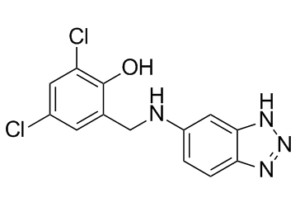
IC87201 is an inhibitor of PSD95-nNOS protein-protein interactions. It suppresses NMDAR-dependent NO and cGMP formation. In vitro, IC87201 does not interact with the PDZ domains of nNOS or PSD-95, nor inhibit the nNOS-PDZ/PSD-95-PDZ interface by interacting with the β-finger of nNOS-PDZ. IC87201 binds to the β-finger of nNOS-PDZ and allosterically inhibits the nNOS-PDZ/PSD-95-PDZ interactions. IC87201 also shows high degree of fluorescence-based artefactual signal when using TAMRA-nNOS as probe. IC87201 (10 and 100 nM) attenuats NMDA/glycine-induced decreases in neurite outgrowth. IC87201 dose-dependently reduces NMDA-induced cGMP production in primary hippocampal neurons (DIV 14-21) with an IC50 of 2.7 μM. IC87201 increases the number of branches at 10-30 μM when compared to control-treated neurons.
Physicochemical Properties
| Molecular Formula | C₁₃H₁₀CL₂N₄O | |
| Molecular Weight | 309.15 | |
| Exact Mass | 308.023 | |
| CAS # | 866927-10-8 | |
| Related CAS # |
|
|
| PubChem CID | 11771269 | |
| Appearance | Pink to red solid powder | |
| Density | 1.6±0.1 g/cm3 | |
| Boiling Point | 525.0±60.0 °C at 760 mmHg | |
| Flash Point | 271.3±32.9 °C | |
| Vapour Pressure | 0.0±1.4 mmHg at 25°C | |
| Index of Refraction | 1.786 | |
| LogP | 2.83 | |
| Hydrogen Bond Donor Count | 3 | |
| Hydrogen Bond Acceptor Count | 4 | |
| Rotatable Bond Count | 3 | |
| Heavy Atom Count | 20 | |
| Complexity | 336 | |
| Defined Atom Stereocenter Count | 0 | |
| InChi Key | QEHVTUCLCBXQIC-UHFFFAOYSA-N | |
| InChi Code | InChI=1S/C13H10Cl2N4O/c14-8-3-7(13(20)10(15)4-8)6-16-9-1-2-11-12(5-9)18-19-17-11/h1-5,16,20H,6H2,(H,17,18,19) | |
| Chemical Name | 2-[(2H-benzotriazol-5-ylamino)methyl]-4,6-dichlorophenol | |
| Synonyms |
|
|
| HS Tariff Code | 2934.99.9001 | |
| Storage |
Powder-20°C 3 years 4°C 2 years In solvent -80°C 6 months -20°C 1 month |
|
| Shipping Condition | Room temperature (This product is stable at ambient temperature for a few days during ordinary shipping and time spent in Customs) |
Biological Activity
| Targets |
IC-87201 targets the protein-protein interaction between neuronal nitric oxide synthase PDZ domain (nNOS-PDZ) and postsynaptic density protein 95 PDZ domain (PSD-95-PDZ) with a Ki value of 0.5 μM (HTRF assay) [1] IC-87201 shows no significant binding to other PDZ domain-containing proteins (e.g., PSD-93, SAP97) at concentrations up to 10 μM [1] |
| ln Vitro |
IC87201 (500-1800 μM) does not bind the canonical PDZ ligand binding sites or inhibit any of the probe-PDZ interactions involving PSD-95's PDZ1, PDZ2, or PDZ3 or nNOS-PDZ. By binding to the β-finger of nNOS-PDZ, IC87201 allosterically inhibits the interactions between nNOS-PDZ and PSD-95-PDZ. When TAMRA-nNOS is used as the probe, IC87201 exhibits a high degree of fluorescence-based artefactual signal[1]. In cultured hippocampal neurons, IC87201 (20 μM) suppresses NMDA-stimulated cGMP formation in comparison to vehicle[2]. Ten and 100 nM of IC87201 attenuate decreases in neurite outgrowth caused by NMDA and glycine. With an IC50 of 2.7 μM, IC87201 dose-dependently lowers the production of cGMP induced by NMDA in primary hippocampal neurons (DIV 14-21). Compared to neurons treated with control, IC87201 causes an increase in branches at concentrations of 10–30 μM[3]. In HTRF-based protein-protein interaction assays, IC-87201 (0.1-10 μM) dose-dependently inhibited the interaction between nNOS-PDZ and PSD-95-PDZ, with a Ki of 0.5 μM and IC50 of 0.8 μM (p < 0.001) [1] - In primary rat cortical neurons exposed to glutamate (100 μM), IC-87201 (1-10 μM) dose-dependently protected against neuronal atrophy; 10 μM increased neurite length by 43% and reduced soma shrinkage by 38% compared to glutamate-treated control (p < 0.01) [3] - IC-87201 (1-10 μM) reduced glutamate-induced reactive oxygen species (ROS) production in cortical neurons by 45% at 10 μM (DCFH-DA assay, p < 0.05) and inhibited caspase-3 activation by 39% (western blot, p < 0.05) [3] - IC-87201 (0.1-10 μM) did not affect NMDA receptor-mediated currents in cortical neurons, confirming selectivity for nNOS-PDZ/PSD-95-PDZ interaction over NMDA receptor function [2] |
| ln Vivo |
Neither spatial working memory nor source memory are affected by IC87201 (1, 4 and 10 mg/kg, ip)[2]. Mice with NMDA-induced thermal hyperalgesia can be effectively treated with IC87201 (1 mg/kg), which has a corresponding peak plasma level of 55 ng/mL (or 0.2 μM)[3]. In male Wistar rats subjected to source memory testing, intraperitoneal administration of IC-87201 (3, 10 mg/kg) 30 minutes before training did not impair source memory (p > 0.05), in contrast to the NMDA receptor antagonist MK-801 which significantly disrupted source memory [2] - IC-87201 (10 mg/kg, i.p.) did not alter locomotor activity or anxiety-like behavior in rats (open field test, p > 0.05), indicating no nonspecific behavioral effects [2] |
| Enzyme Assay |
HTRF assay for nNOS-PDZ/PSD-95-PDZ interaction: Recombinant nNOS-PDZ domain labeled with a donor fluorophore and PSD-95-PDZ domain labeled with an acceptor fluorophore were mixed in assay buffer; IC-87201 (0.01-10 μM) was added, and the mixture was incubated at 25°C for 60 minutes; HTRF signal was measured, and inhibition curves were generated to calculate Ki and IC50 values [1] - PDZ domain selectivity assay: The same HTRF protocol was applied to pairs of recombinant PDZ domains (PSD-93-PDZ/nNOS-PDZ, SAP97-PDZ/nNOS-PDZ); IC-87201 (0.1-10 μM) was tested to assess cross-inhibition, and selectivity ratios were determined relative to PSD-95-PDZ/nNOS-PDZ [1] |
| Cell Assay |
Primary cortical neuron culture and glutamate-induced atrophy assay: Cortices from embryonic day 18 rat embryos were dissected, mechanically dissociated, and plated on poly-L-lysine-coated coverslips; neurons were cultured for 7 days, pretreated with IC-87201 (1-10 μM) for 1 hour, then exposed to 100 μM glutamate for 24 hours; neurons were fixed, immunostained for β-tubulin III, and neurite length/soma area were quantified by image analysis [3] - ROS and caspase-3 activation assay: Cortical neurons were seeded in 24-well plates, pretreated with IC-87201 (1-10 μM) for 1 hour, then treated with glutamate (100 μM) for 12 hours; ROS levels were detected by DCFH-DA fluorescence, and caspase-3 activation was analyzed by western blot using a cleaved caspase-3 antibody [3] - NMDA receptor current assay: Whole-cell patch-clamp recordings were performed on cortical neurons; IC-87201 (10 μM) was applied via perfusion, followed by NMDA (100 μM); currents were recorded to assess effects on NMDA receptor function [2] |
| Animal Protocol |
1, 4 and 10 mg/kg, i.p. Mice with NMDA-induced thermal hyperalgesia Rat source memory assay: 3-month-old male Wistar rats were randomly divided into 3 groups (n=10 per group): vehicle control, IC-87201 3 mg/kg, IC-87201 10 mg/kg; a fourth group received MK-801 (0.1 mg/kg) as positive control [2] - IC-87201 was formulated in 10% DMSO, 40% polyethylene glycol 400, and 50% saline; administered via intraperitoneal injection 30 minutes before training [2] - Source memory training: Rats were trained in a Morris water maze with two distinct platforms (location and visual cue); 24 hours later, a probe trial assessed their ability to discriminate the training platform (source memory); locomotor activity was measured in an open field arena (40×40×30 cm) for 10 minutes [2] |
| Toxicity/Toxicokinetics |
In primary rat cortical neurons, IC-87201 showed no cytotoxicity at concentrations up to 100 μM after 72-hour incubation (cell viability > 90% by MTT assay) [3] - In rats treated with IC-87201 (10 mg/kg, i.p.), no significant changes in body weight, food intake, or clinical chemistry parameters (ALT, AST, creatinine) were observed [2] - No histopathological abnormalities were detected in major organs (brain, liver, kidney) of treated rats [2] |
| References |
[1]. Biochemical investigations of the mechanism of action of small molecules ZL006 and IC87201 as potential inhibitors of the nNOS-PDZ/PSD-95-PDZ interactions. Sci Rep. 2015 Jul 16;5:12157. [2]. Source memory in rats is impaired by an NMDA receptor antagonist but not by PSD95-nNOS protein-protein interaction inhibitors. Behav Brain Res. 2016 May 15;305:23-9. [3]. Small-molecule inhibitors at the PSD-95/nNOS interface protect against glutamate-induced neuronal atrophy in primary cortical neurons. Neuroscience. 2015 Aug 20;301:421-38. |
| Additional Infomation |
IC-87201 is a small-molecule inhibitor of the nNOS-PDZ/PSD-95-PDZ protein-protein interaction, developed for the treatment of neurological disorders [1][2][3] - Its mechanism of action involves blocking the association of nNOS with PSD-95, thereby reducing excessive nitric oxide (NO) production in excitotoxic conditions and protecting neurons from glutamate-induced damage [1][3] - IC-87201 exhibits high selectivity for the nNOS-PDZ/PSD-95-PDZ interaction, with no significant effects on other PDZ domains or NMDA receptors [1][2] - The compound demonstrates neuroprotective activity in vitro and lacks nonspecific behavioral effects in vivo, supporting its potential for treating excitotoxicity-related diseases (e.g., stroke, Alzheimer's disease) [2][3] |
Solubility Data
| Solubility (In Vitro) |
|
|||
| Solubility (In Vivo) |
Solubility in Formulation 1: 2.5 mg/mL (8.09 mM) in 10% DMSO + 40% PEG300 + 5% Tween80 + 45% Saline (add these co-solvents sequentially from left to right, and one by one), suspension solution; with sonication. For example, if 1 mL of working solution is to be prepared, you can add 100 μL of 25.0 mg/mL clear DMSO stock solution to 400 μL PEG300 and mix evenly; then add 50 μL Tween-80 to the above solution and mix evenly; then add 450 μL normal saline to adjust the volume to 1 mL. Preparation of saline: Dissolve 0.9 g of sodium chloride in 100 mL ddH₂ O to obtain a clear solution. Solubility in Formulation 2: 2.5 mg/mL (8.09 mM) in 10% DMSO + 90% (20% SBE-β-CD in Saline) (add these co-solvents sequentially from left to right, and one by one), suspension solution; with ultrasonication. For example, if 1 mL of working solution is to be prepared, you can add 100 μL of 25.0 mg/mL clear DMSO stock solution to 900 μL of 20% SBE-β-CD physiological saline solution and mix evenly. Preparation of 20% SBE-β-CD in Saline (4°C,1 week): Dissolve 2 g SBE-β-CD in 10 mL saline to obtain a clear solution. (Please use freshly prepared in vivo formulations for optimal results.) |
| Preparing Stock Solutions | 1 mg | 5 mg | 10 mg | |
| 1 mM | 3.2347 mL | 16.1734 mL | 32.3468 mL | |
| 5 mM | 0.6469 mL | 3.2347 mL | 6.4694 mL | |
| 10 mM | 0.3235 mL | 1.6173 mL | 3.2347 mL |