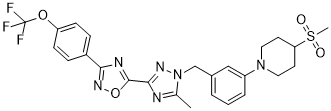
IACS-10759 (IACS10759) is a potent and orally bioavailable inhibitor of OXPHOS (complex I of oxidative phosphorylation) with antitumor effects. In isolated mitochondria or permeabilized cells, ATP production or oxygen consumption was inhibited at single digit nM concentrations in the presence of malate/glutamate, but not succinate. More directly, IACS-10759 inhibited the conversion of NADH to NAD+ in an immunoprecipitated complex I assay at low nM concentrations. Using genetic and pharmacological approaches, the specific complex I subunit inhibited by IACS-10759 has been identified and the mechanism of complex I inhibition is being investigated. Importantly, IACS-10759 is orally bioavailable with excellent physicochemical properties in preclinical species and achieved significant in vivo efficacy with daily oral dosing of 10-25 mg/kg. Specifically, there was a >50 day extension of median survival in an orthotopic AML cell line xenograft and robust regression in DLBCL and GBM xenograft models. In light of these results, as well as its drug like profile IACS-10759 has entered IND enabling studies with first-in-human studies targeted for third quarter of 2015.
Physicochemical Properties
| Molecular Formula | C25H25F3N6O4S | |
| Molecular Weight | 562.57 | |
| Exact Mass | 562.161 | |
| Elemental Analysis | C, 53.38; H, 4.48; F, 10.13; N, 14.94; O, 11.38; S, 5.70 | |
| CAS # | 1570496-34-2 | |
| Related CAS # | IACS-010759 hydrochloride;1807523-99-4; IACS-010759; 1570496-34-2; 1570496-34-2 (HCl); 1807524-00-0 (besylate); 1807524-05-5; 1807524-01-1 (mesylate) | |
| PubChem CID | 86711931 | |
| Appearance | Typically exists as white to off-white solids at room temperature | |
| Density | 1.5±0.1 g/cm3 | |
| Boiling Point | 768.0±70.0 °C at 760 mmHg | |
| Flash Point | 418.3±35.7 °C | |
| Vapour Pressure | 0.0±2.6 mmHg at 25°C | |
| Index of Refraction | 1.648 | |
| LogP | 3.91 | |
| Hydrogen Bond Donor Count | 0 | |
| Hydrogen Bond Acceptor Count | 12 | |
| Rotatable Bond Count | 7 | |
| Heavy Atom Count | 39 | |
| Complexity | 909 | |
| Defined Atom Stereocenter Count | 0 | |
| SMILES | S(C([H])([H])[H])(C1([H])C([H])([H])C([H])([H])N(C2=C([H])C([H])=C([H])C(C([H])([H])N3C(C([H])([H])[H])=NC(C4=NC(C5C([H])=C([H])C(=C([H])C=5[H])OC(F)(F)F)=NO4)=N3)=C2[H])C([H])([H])C1([H])[H])(=O)=O |
|
| InChi Key | HWJWNWZJUYCGKV-UHFFFAOYSA-N | |
| InChi Code | InChI=1S/C25H25F3N6O4S/c1-16-29-23(24-30-22(32-38-24)18-6-8-20(9-7-18)37-25(26,27)28)31-34(16)15-17-4-3-5-19(14-17)33-12-10-21(11-13-33)39(2,35)36/h3-9,14,21H,10-13,15H2,1-2H3 | |
| Chemical Name |
|
|
| Synonyms |
|
|
| HS Tariff Code | 2934.99.9001 | |
| Storage |
Powder-20°C 3 years 4°C 2 years In solvent -80°C 6 months -20°C 1 month |
|
| Shipping Condition | Room temperature (This product is stable at ambient temperature for a few days during ordinary shipping and time spent in Customs) |
Biological Activity
| Targets |
OXPHOS/mitochondrial complex I of oxidative phosphorylation
Mitochondrial electron transport chain complex I (no specific IC50, Ki, or EC50 values provided in the literature) [1] Mitochondrial oxidative phosphorylation complex I (inhibited ATP production and oxygen consumption at single-digit nM concentrations in the presence of malate/glutamate) [2] |
||
| ln Vitro |
IACS-010759 (10, 30, 100 nM; for 4 or 5 days) decreases viability and causes apoptosis in primary AML [1]. IACS-010759 (0.001, 0.01, 0.1, 1, 10, 100, 1000 nM; 72 hours) substantially suppresses OCR and galactose-dependent H460 cell survival with practically the same IC50 value of 1.4 nM [1]. IACS-010759 shows similar action in mouse (average IC50=5.6 nM), rat (IC50=12.2 nM) and cynomolgus monkey (IC50=8.7 nM) cell lines [1]. IACS-010759 (0.01-10 μM) produced maximal growth in most cancer cell lines (24 of 30 pancreatic (PDAC), 19 of 20 ovarian, 13 of 16 triple negative) >50% reduction in breast cancer (TNBC), 8 of 10 non-small cell lung cancer (NSCLC)) and a subset (11 of 30 PDAC, 10 of 20 ovarian, 16 of TNBC 5 cases, 2 out of 10 cases of NSCLC) showed >100% growth inhibition [1]. Treatment with IACS-010759 robustly inhibited proliferation and induced apoptosis in brain cancer and acute myeloid leukemia (AML) cell models that are reliant on oxidative phosphorylation (OXPHOS). The inhibitory effects are likely due to a combination of energy depletion and reduced aspartate production, which impairs nucleotide biosynthesis [1] In isolated mitochondria or permeabilized cells, IACS-010759 inhibited ATP production and oxygen consumption at single-digit nM concentrations when malate/glutamate was present, but not when succinate was present. Additionally, in an immunoprecipitated complex I assay, the compound inhibited the conversion of NADH to NAD+ at low nM concentrations [2] |
||
| ln Vivo |
Subcutaneous Xenografts of IACS-010759 (5, 10, 25 mg/kg/day; oral; for 21 days) in NB-1-bearing (PGD-null) mice resulted in tumor regression and negligible weight loss at dosages of 5 or 10 mg/kg. IACS-010759 intolerance at a dose of 25 mg/kg [1]. Less frequent dosage regimens (Q2D or Q3D) may somewhat enhance survival, whereas IACS-010759 HCl (10 mg/kg; PO; QD (daily) or QD × 5 (5 days on/2 days off); for 35 days) extended median survival from 28 days to >60 days [1]. Because of its high volume of distribution and poor plasma clearance, IACS-010759 (0.3 mg/kg IV; 1 mg/kg PO) has a prolonged terminal half-life (>24 hours) [1]. In in vivo models of brain cancer and AML, IACS-010759 potently inhibited tumor growth at well-tolerated doses [1] In an orthotopic AML cell line xenograft model, daily oral dosing of IACS-010759 at 10-25 mg/kg resulted in a >50-day extension of median survival. Robust tumor regression was observed in diffuse large B-cell lymphoma (DLBCL) and glioblastoma multiforme (GBM) xenograft models with the same dosing regimen [2] |
||
| Enzyme Assay |
Isolated mouse complex I assay[1] Complex I was isolated from mouse heart mitochondria using an adaptation of the method of Sharpley and colleagues. The concentration of IACS-010759 in Fig. 1f was 60 nM. The NADH:decylubiquinone assay is described in Sharpley et al, and the APAD+ and H2O2 assays are described in Birrell et al. An immunoprecipitated complex I assay was conducted to evaluate the effect of IACS-010759 on complex I activity. The assay focused on the conversion of NADH to NAD+, and the compound was found to inhibit this reaction at low nM concentrations [2] |
||
| Cell Assay |
Generation of clonal cell lines resistant to IACS-010759[1] H292 cells (1 × 10⁶ cells/plate) were seeded in 15-cm dishes in galactose growth medium and treated with 1 nM IACS-010759 (IC65) for 3 weeks, followed by exposure to 8 nM IACS-010759 (IC95) until resistant clones emerged. Twenty-six resistant clones were isolated from four independent experiments and were seeded at 5 × 10³ cells/well in 96-well plates in 100 µl galactose growth medium. After cells became fully attached, IACS-010759 or rotenone was added to a final concentration of 370 nM to 18 pM for 3 d. Plates were scanned in the IncuCyte live-cell analysis system before analysis via Hoechst and PI. Subsequently, both Hoechst and PI using an Operetta high-content imaging system. RNA-seq was conducted on the parental line and 12 resistant clones, uncovering a single nonsynonymous, heteroplasmic (35–50%), recurrent mutation in the mitochondrial-encoded gene MT-ND1 in 9 of the 12 resistant clones that conferred the L55F (T3469C) amino acid change. Paired-end reads were initially aligned to transcript sequences of complex I genes with Bowtie 2 (ref.53), and the aligned fragments were probabilistically assigned to transcripts using eXpress54. Variants from the reference genome were called using the ‘mpileup’ command in SAMtools. MutPred55 analysis of the L55F variant classifies the alteration as potentially pathogenic (MutPred score = 0.8); this alteration is found at a very low frequency in mtDNA sequences in Genebank (1:30,589 based on full-length mitochondrial genomes deposited in Genebank before 28 October 2015), suggesting it is unlikely to be a polymorphism. The mutation was confirmed in four of the resistant clones by cloning the MT-ND1 gene sequence and analyzing purified plasmid DNA via Sanger sequencing using the following primers: Forward: 5′-GTAAAACGACGGCCAGT-3′ and Reverse: 5′-AACAGCTATGACCATG-3′. Cancer cell lines (brain cancer and AML) reliant on OXPHOS were used to assess the in vitro activity of IACS-010759. Cells were treated with the compound, and proliferation was measured to determine inhibitory effects. Apoptosis induction was also evaluated in these cell models, with observations of robust apoptosis following treatment [1] Isolated mitochondria or permeabilized cells were exposed to IACS-010759 in the presence of either malate/glutamate or succinate. ATP production and oxygen consumption were then measured to assess the compound's impact on mitochondrial function and OXPHOS [2] |
||
| Animal Protocol |
|
||
| Toxicity/Toxicokinetics |
IACS-010759 was well-tolerated at the doses used in in vivo studies [1] |
||
| References |
[1]. An inhibitor of oxidative phosphorylation exploits cancer vulnerability. Nat Med. 2018 Jul;24(7):1036-1046. [2]. Protopopova M. IACS-10759: A novel OXPHOS inhibitor which selectively kill tumors with metabolic vulnerabilities. [abstract]. In: Proceedings of the 106th Annual Meeting of the American Association for Cancer Research; 2015 Apr 18-22; Philadelphia, PA. Philadelphia (PA): AACR; Cancer Res 2015;75(15 Suppl):Abstract nr 4380. doi:10.1158/1538-7445.AM2015-4380. |
||
| Additional Infomation |
Oxidative Phosphorylation Inhibitor IACS-010759 is an orally bioavailable oxidative phosphorylation (OxPhos) inhibitor, with potential antineoplastic activity. Upon administration of the OxPhos inhibitor IACS-010759, this agent binds to and inhibits complex I of the electron transport chain (NADH ubiquinone oxidoreductase), thereby selectively depriving tumor cells of nutrients, and energy, and inhibiting nucleotide and amino acid production, which induces autophagy, causes tumor cell death and inhibits cell proliferation. Mitochondrial complex I, which is hyperactivated in cancer cells to meet their increased demands for energy, plays a key role in the promotion of cancer cell proliferation. IACS-010759 is a clinical-grade small-molecule inhibitor of mitochondrial electron transport chain complex I. Metabolic reprogramming is a hallmark of tumor biology, and while therapeutic targeting of glycolysis has been extensively studied, drugging mitochondrial OXPHOS has been less explored. This compound exploits the metabolic vulnerability of tumors dependent on OXPHOS, making it a potential therapeutic agent for cancers such as brain cancer and AML [1] IACS-010759 was identified through an extensive medicinal chemistry campaign as a potent inhibitor of OXPHOS complex I. Genetic and pharmacological approaches were used to identify the specific complex I subunit targeted by the compound, and investigations into its mechanism of complex I inhibition are ongoing. The compound entered Investigational New Drug (IND)-enabling studies, with first-in-human trials targeted for the third quarter of 2015 [2] IACS-010759 is currently being evaluated in phase 1 clinical trials for relapsed/refractory AML and solid tumors [1] |
Solubility Data
| Solubility (In Vitro) |
|
|||
| Solubility (In Vivo) |
Solubility in Formulation 1: 2.08 mg/mL (3.70 mM) in 10% DMSO + 40% PEG300 + 5% Tween80 + 45% Saline (add these co-solvents sequentially from left to right, and one by one), suspension solution; with sonication. For example, if 1 mL of working solution is to be prepared, you can add 100 μL of 20.8 mg/mL clear DMSO stock solution to 400 μL PEG300 and mix evenly; then add 50 μL Tween-80 to the above solution and mix evenly; then add 450 μL normal saline to adjust the volume to 1 mL. Preparation of saline: Dissolve 0.9 g of sodium chloride in 100 mL ddH₂ O to obtain a clear solution. Solubility in Formulation 2: ≥ 2.08 mg/mL (3.70 mM) (saturation unknown) in 10% DMSO + 90% Corn Oil (add these co-solvents sequentially from left to right, and one by one), clear solution. For example, if 1 mL of working solution is to be prepared, you can add 100 μL of 20.8 mg/mL clear DMSO stock solution to 900 μL of corn oil and mix evenly. (Please use freshly prepared in vivo formulations for optimal results.) |
| Preparing Stock Solutions | 1 mg | 5 mg | 10 mg | |
| 1 mM | 1.7776 mL | 8.8878 mL | 17.7756 mL | |
| 5 mM | 0.3555 mL | 1.7776 mL | 3.5551 mL | |
| 10 mM | 0.1778 mL | 0.8888 mL | 1.7776 mL |