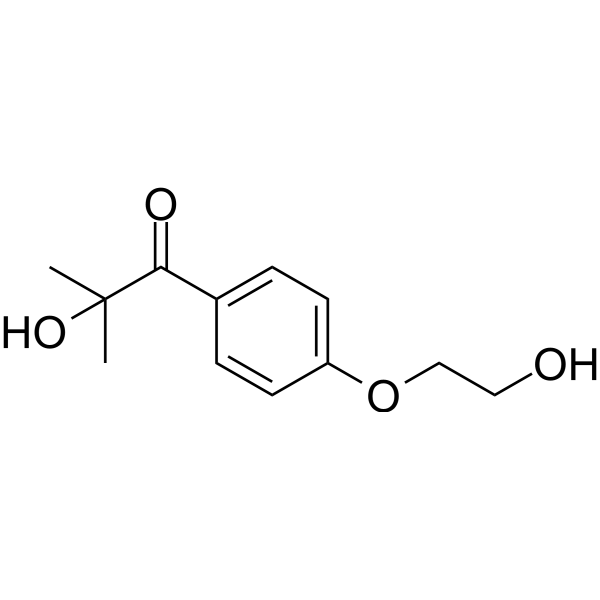
Physicochemical Properties
| Molecular Formula | C12H16O4 |
| Molecular Weight | 224.26 |
| CAS # | 106797-53-9 |
| PubChem CID | 86266 |
| Appearance | White to off-white solid powder |
| Density | 1.2±0.1 g/cm3 |
| Boiling Point | 405.0±25.0 °C at 760 mmHg |
| Melting Point | 88-90 °C(lit.) |
| Flash Point | 155.8±16.7 °C |
| Vapour Pressure | 0.0±1.0 mmHg at 25°C |
| Index of Refraction | 1.545 |
| LogP | 0.23 |
| Hydrogen Bond Donor Count | 2 |
| Hydrogen Bond Acceptor Count | 4 |
| Rotatable Bond Count | 5 |
| Heavy Atom Count | 16 |
| Complexity | 229 |
| Defined Atom Stereocenter Count | 0 |
| SMILES | O([H])C(C([H])([H])[H])(C([H])([H])[H])C(C1C([H])=C([H])C(=C([H])C=1[H])OC([H])([H])C([H])([H])O[H])=O |
| Synonyms | 106797-53-9; 2-Hydroxy-4'-(2-hydroxyethoxy)-2-methylpropiophenone; 2-Hydroxy-1-(4-(2-hydroxyethoxy)phenyl)-2-methylpropan-1-one; 2-hydroxy-1-[4-(2-hydroxyethoxy)phenyl]-2-methylpropan-1-one; Darocur 2959; Irgacure 2959; 2-Hydroxy-1-[4-(2-hydroxyethoxy)phenyl]-2-methyl-1-propanone; 1-Propanone, 2-hydroxy-1-[4-(2-hydroxyethoxy)phenyl]-2-methyl-; |
| HS Tariff Code | 2934.99.9001 |
| Storage |
Powder-20°C 3 years 4°C 2 years In solvent -80°C 6 months -20°C 1 month |
| Shipping Condition | Room temperature (This product is stable at ambient temperature for a few days during ordinary shipping and time spent in Customs) |
Biological Activity
| Targets | Photoinitiator |
| ln Vitro |
Method for encapsulating Saos-2 cells in photochemically cross-linked CMA hydrogels[1]: (1) The human osteosarcoma cell line (Saos-2 cells) was expanded in RPMI medium containing 15% FBS, 1% L-glutamine, and 1% penicillin/streptomycin. (2) Cells were suspended in a neutralized CMA solution (containing 0.02% or 0.1% I2959 concentration). (3) 45 µL of cell suspension was added to each well of a 96-well plate, followed by incubation at 37℃ for 30 min for gelation (5000 cells/gel). (4) The gels were exposed to ultraviolet light (365 nm) for two different durations (1 min or 10 min) for photo-crosslinking. Hydrogels not exposed to UV light served as controls for cellular studies. (5) Cell-laden hydrogels were cultured in α-MEM medium containing 50 µg/mL ascorbic acid, 10 mM β-glycerophosphate, 10% FBS, and 1% penicillin/streptomycin for up to 14 days. |
| Cell Assay |
Saos-2 Cell Encapsulation within Photochemically Crosslinked CMA Hydrogels:[1] Human osteosarcoma cell line (Saos-2 cells) were expanded in RPMI culture medium supplemented with 15% FBS, 1% L-glutamine, and 1% penicillin/streptomycin. To encapsulate Saos-2 cells (P32) within the CMA hydrogels, cells were first suspended in neutralized CMA solution (with I2959 or VA086 at desired concentrations – 0.02% or 0.1%). Forty five µl of cell suspension was added into each well of a 96-well plate and incubated at 37 °C for 30 min for gelation (5,000 cells/gel). Following this, gels were photocrosslinked by exposing them to UV light (365 nm) for two different times (i.e., 1 min or 10 min). Hydrogels not exposed to UV light were used as controls for cell studies. Cell encapsulated hydrogels were cultured in α-MEM medium supplemented with 50 µg/ml ascorbic acid, 10 mM β-glycerophosphate, 10% FBS, and 1% penicillin/streptomycin for up to 14 days. |
| Toxicity/Toxicokinetics | rat LD50 oral 4082 mg/kg SENSE ORGANS AND SPECIAL SENSES: CHROMODACYRORREA: EYE; BEHAVIORAL: CONVULSIONS OR EFFECT ON SEIZURE THRESHOLD; LUNGS, THORAX, OR RESPIRATION: DYSPNEA National Technical Information Service., OTS0533940 |
| References |
[1]. Thuy-Uyen Nguyen, et al. Photochemically crosslinked cell-laden methacrylated collagen hydrogels with high cell viability and functionality. J Biomed Mater Res A. 2019 Jul;107(7):1541-1550. |
| Additional Infomation | Irgacure 2959 (I2959) is widely used as a photoinitiator for photochemical crosslinking of hydrogels. However, the free radicals generated from I2959 have been reported to be highly cytotoxic. In this study, methacrylated collagen (CMA) hydrogels were photochemically crosslinked using two different photoinitiators (i.e., I2959 and VA086) and the effect of photoinitiator type, photoinitiator concentration (i.e., 0.02 and 0.1%) and crosslinking time (1 and 10 min) on gel morphology, compressive modulus, and stability were investigated. In addition, Saos-2 cells were encapsulated within the hydrogels and the effect of photochemical crosslinking conditions on cell viability, metabolic activity, and osteoblast functionality was assessed. Scanning electron microscopy imaging showed that photochemical crosslinking decreased the porosity of the hydrogels resulting in decrease in water retention ability compared to uncrosslinked hydrogels. On the other hand, photochemical crosslinking improved the stability of CMA hydrogels (p < 0.05). Uniaxial compression tests showed that increasing the photoinitiator concentration significantly improved the compressive modulus of CMA hydrogels (p < 0.05). Results from the live-dead assay showed that VA086 crosslinked hydrogels exhibited higher cell viability compared to I2959 (p < 0.05) crosslinked hydrogels indicating that VA086 is more cytocompatible compared to I2959. Furthermore, Alizarin Red S staining revealed a significantly more pronounced cell-mediated mineralization on VA086 crosslinked hydrogels (p < 0.05) indicating that Saos-2 cells retain their normal functionality in the presence of VA086. In summary, these results indicate that VA086 is a more biocompatible photoinitiator compared to I2959 for the generation of photochemically crosslinked CMA hydrogels for tissue engineering applications. [1] |
Solubility Data
| Solubility (In Vitro) | DMSO : ~100 mg/mL (~445.91 mM; with ultrasonication) |
| Solubility (In Vivo) |
Note: Listed below are some common formulations that may be used to formulate products with low water solubility (e.g. < 1 mg/mL), you may test these formulations using a minute amount of products to avoid loss of samples. Injection Formulations (e.g. IP/IV/IM/SC) Injection Formulation 1: DMSO : Tween 80: Saline = 10 : 5 : 85 (i.e. 100 μL DMSO stock solution → 50 μL Tween 80 → 850 μL Saline) *Preparation of saline: Dissolve 0.9 g of sodium chloride in 100 mL ddH ₂ O to obtain a clear solution. Injection Formulation 2: DMSO : PEG300 :Tween 80 : Saline = 10 : 40 : 5 : 45 (i.e. 100 μL DMSO → 400 μLPEG300 → 50 μL Tween 80 → 450 μL Saline) Injection Formulation 3: DMSO : Corn oil = 10 : 90 (i.e. 100 μL DMSO → 900 μL Corn oil) Example: Take the Injection Formulation 3 (DMSO : Corn oil = 10 : 90) as an example, if 1 mL of 2.5 mg/mL working solution is to be prepared, you can take 100 μL 25 mg/mL DMSO stock solution and add to 900 μL corn oil, mix well to obtain a clear or suspension solution (2.5 mg/mL, ready for use in animals). Injection Formulation 4: DMSO : 20% SBE-β-CD in saline = 10 : 90 [i.e. 100 μL DMSO → 900 μL (20% SBE-β-CD in saline)] *Preparation of 20% SBE-β-CD in Saline (4°C,1 week): Dissolve 2 g SBE-β-CD in 10 mL saline to obtain a clear solution. Injection Formulation 5: 2-Hydroxypropyl-β-cyclodextrin : Saline = 50 : 50 (i.e. 500 μL 2-Hydroxypropyl-β-cyclodextrin → 500 μL Saline) Injection Formulation 6: DMSO : PEG300 : castor oil : Saline = 5 : 10 : 20 : 65 (i.e. 50 μL DMSO → 100 μLPEG300 → 200 μL castor oil → 650 μL Saline) Injection Formulation 7: Ethanol : Cremophor : Saline = 10: 10 : 80 (i.e. 100 μL Ethanol → 100 μL Cremophor → 800 μL Saline) Injection Formulation 8: Dissolve in Cremophor/Ethanol (50 : 50), then diluted by Saline Injection Formulation 9: EtOH : Corn oil = 10 : 90 (i.e. 100 μL EtOH → 900 μL Corn oil) Injection Formulation 10: EtOH : PEG300:Tween 80 : Saline = 10 : 40 : 5 : 45 (i.e. 100 μL EtOH → 400 μLPEG300 → 50 μL Tween 80 → 450 μL Saline) Oral Formulations Oral Formulation 1: Suspend in 0.5% CMC Na (carboxymethylcellulose sodium) Oral Formulation 2: Suspend in 0.5% Carboxymethyl cellulose Example: Take the Oral Formulation 1 (Suspend in 0.5% CMC Na) as an example, if 100 mL of 2.5 mg/mL working solution is to be prepared, you can first prepare 0.5% CMC Na solution by measuring 0.5 g CMC Na and dissolve it in 100 mL ddH2O to obtain a clear solution; then add 250 mg of the product to 100 mL 0.5% CMC Na solution, to make the suspension solution (2.5 mg/mL, ready for use in animals). Oral Formulation 3: Dissolved in PEG400 Oral Formulation 4: Suspend in 0.2% Carboxymethyl cellulose Oral Formulation 5: Dissolve in 0.25% Tween 80 and 0.5% Carboxymethyl cellulose Oral Formulation 6: Mixing with food powders Note: Please be aware that the above formulations are for reference only. InvivoChem strongly recommends customers to read literature methods/protocols carefully before determining which formulation you should use for in vivo studies, as different compounds have different solubility properties and have to be formulated differently. (Please use freshly prepared in vivo formulations for optimal results.) |
| Preparing Stock Solutions | 1 mg | 5 mg | 10 mg | |
| 1 mM | 4.4591 mL | 22.2955 mL | 44.5911 mL | |
| 5 mM | 0.8918 mL | 4.4591 mL | 8.9182 mL | |
| 10 mM | 0.4459 mL | 2.2296 mL | 4.4591 mL |