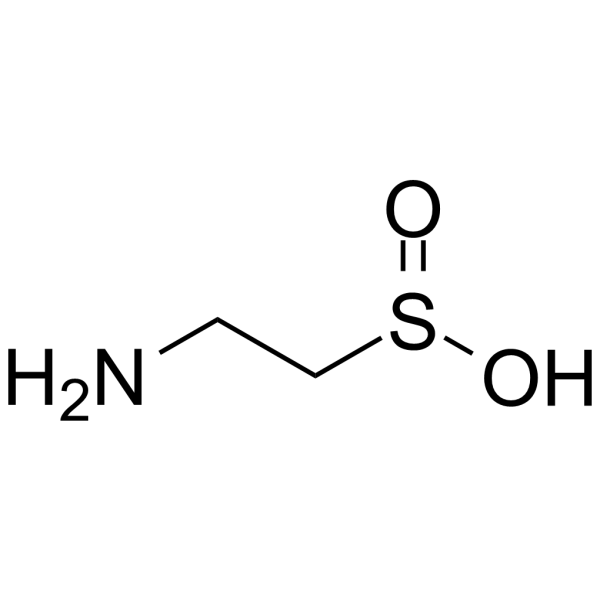
Physicochemical Properties
| Molecular Formula | C2H7NO2S |
| Molecular Weight | 109.14748 |
| Exact Mass | 109.019 |
| CAS # | 300-84-5 |
| PubChem CID | 107812 |
| Appearance | White to off-white solid powder |
| Density | 1.5±0.1 g/cm3 |
| Boiling Point | 354.9±44.0 °C at 760 mmHg |
| Flash Point | 168.5±28.4 °C |
| Vapour Pressure | 0.0±1.7 mmHg at 25°C |
| Index of Refraction | 1.616 |
| LogP | -2.03 |
| Hydrogen Bond Donor Count | 2 |
| Hydrogen Bond Acceptor Count | 4 |
| Rotatable Bond Count | 2 |
| Heavy Atom Count | 6 |
| Complexity | 55.5 |
| Defined Atom Stereocenter Count | 0 |
| InChi Key | VVIUBCNYACGLLV-UHFFFAOYSA-N |
| InChi Code | InChI=1S/C2H7NO2S/c3-1-2-6(4)5/h1-3H2,(H,4,5) |
| Chemical Name | 2-aminoethanesulfinic acid |
| HS Tariff Code | 2934.99.9001 |
| Storage |
Powder-20°C 3 years 4°C 2 years In solvent -80°C 6 months -20°C 1 month |
| Shipping Condition | Room temperature (This product is stable at ambient temperature for a few days during ordinary shipping and time spent in Customs) |
Biological Activity
| ln Vitro | Cells contain hypotaurine and taurine in their cytoplasmic compartment. Taurine to hypotaurine has a ratio of roughly 50:1. Taurine's cytoplasmic concentration is about. 50 mm. Hypotaurine concentrations are lowered by 80% when opsonized zymosan is applied to resting neutrophils, converting them into breathing cells [1]. By inhibiting prolyl hydroxylase domain 2 competitively, hypotaurine triggers hypoxia signaling. As a result, glioma cell invasion and proliferation are increased and hypoxia signaling is activated [2]. |
| ln Vivo | In the spinal cord, hypotaurine has antinociceptive effects on mechanical, chemical, and thermal nociception. Hypotaurine decreased thermal hyperalgesia and mechanical allodynia in CCI rats. Pain that is neuropathic, inflammatory, and acute is suppressed by intrathecal hypotaurine. By stimulating spinal cord glycine neurons, hypotaurine can modify nociceptive physiological transmission [3]. |
| References |
[1]. Green TR, et al. Antioxidant role and subcellular location of hypotaurine and taurine in human neutrophils. Biochim Biophys Acta. 1991 Jan 23;1073(1):91-7. https://www.ncbi.nlm.nih.gov/pubmed/1846756 [2]. Gao P, et al. Hypotaurine evokes a malignant phenotype in glioma through aberrant hypoxic signaling. Oncotarget. 2016 Mar 22;7(12):15200-14. [3]. Hara K, et al. Antinociceptive effect of intrathecal administration of hypotaurine in rat models of inflammatory and neuropathic pain. Amino Acids. 2012 Jul;43(1):397-404. Hara K, et al. Antinociceptive effect of intrathecal administration of hypotaurine |
| Additional Infomation |
Hypotaurine is an aminosulfinic acid comprising ethylamine having the sulfo group at the 2-position. It has a role as a metabolite, a human metabolite and a mouse metabolite. It is a conjugate acid of a hypotaurine(1-). It is a tautomer of a hypotaurine zwitterion. Hypotaurine is a metabolite found in or produced by Escherichia coli (strain K12, MG1655). Hypotaurine has been reported in Homo sapiens, Bos taurus, and other organisms with data available. |
Solubility Data
| Solubility (In Vitro) | H2O : ~125 mg/mL (~1145.21 mM) |
| Solubility (In Vivo) |
Solubility in Formulation 1: 100 mg/mL (916.17 mM) in PBS (add these co-solvents sequentially from left to right, and one by one), clear solution; with sonication. (Please use freshly prepared in vivo formulations for optimal results.) |
| Preparing Stock Solutions | 1 mg | 5 mg | 10 mg | |
| 1 mM | 9.1617 mL | 45.8085 mL | 91.6170 mL | |
| 5 mM | 1.8323 mL | 9.1617 mL | 18.3234 mL | |
| 10 mM | 0.9162 mL | 4.5809 mL | 9.1617 mL |