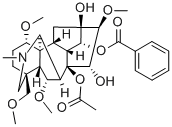
Physicochemical Properties
| Molecular Formula | C33H45NO10 |
| Molecular Weight | 615.7111 |
| Exact Mass | 615.304 |
| Elemental Analysis | C, 64.37; H, 7.37; N, 2.27; O, 25.98 |
| CAS # | 6900-87-4 |
| Related CAS # | 6900-87-4 |
| PubChem CID | 441737 |
| Appearance | White to off-white solid powder |
| Density | 1.4±0.1 g/cm3 |
| Boiling Point | 671.3±55.0 °C at 760 mmHg |
| Flash Point | 359.8±31.5 °C |
| Vapour Pressure | 0.0±2.2 mmHg at 25°C |
| Index of Refraction | 1.607 |
| LogP | 0.92 |
| Hydrogen Bond Donor Count | 2 |
| Hydrogen Bond Acceptor Count | 11 |
| Rotatable Bond Count | 10 |
| Heavy Atom Count | 44 |
| Complexity | 1160 |
| Defined Atom Stereocenter Count | 13 |
| SMILES | O(C(C([H])([H])[H])=O)[C@]12[C@]([H])([C@@]([H])(C3(C([H])([C@@]1([H])C([H])(C3([H])[H])[C@@]13[C@]([H])(C([H])([H])C([H])([H])[C@@]4(C([H])([H])OC([H])([H])[H])C([H])([H])N(C([H])([H])[H])[C@@]1([H])[C@]2([H])[C@@]([H])([C@@]34[H])OC([H])([H])[H])OC([H])([H])[H])OC(C1C([H])=C([H])C([H])=C([H])C=1[H])=O)O[H])OC([H])([H])[H])O[H] |
| InChi Key | FIDOCHXHMJHKRW-VHQVDBNASA-N |
| InChi Code | InChI=1S/C33H45NO10/c1-17(35)44-33-21-19(14-31(38,28(42-6)26(33)36)27(21)43-29(37)18-10-8-7-9-11-18)32-20(40-4)12-13-30(16-39-3)15-34(2)25(32)22(33)23(41-5)24(30)32/h7-11,19-28,36,38H,12-16H2,1-6H3/t19-,20+,21-,22+,23+,24-,25?,26+,27-,28+,30+,31-,32+,33-/m1/s1 |
| Chemical Name | [(1S,2R,3R,4R,5R,6S,7S,8R,9R,13S,16S,17R,18R)-8-acetyloxy-5,7-dihydroxy-6,16,18-trimethoxy-13-(methoxymethyl)-11-methyl-11-azahexacyclo[7.7.2.12,5.01,10.03,8.013,17]nonadecan-4-yl] benzoate |
| Synonyms | Hypaconitine |
| HS Tariff Code | 2934.99.9001 |
| Storage |
Powder-20°C 3 years 4°C 2 years In solvent -80°C 6 months -20°C 1 month |
| Shipping Condition | Room temperature (This product is stable at ambient temperature for a few days during ordinary shipping and time spent in Customs) |
Biological Activity
| References |
[1]. Microsomal cytochrome P450-mediated metabolism of hypaconitine, an active and highly toxic constituent derived from Aconitum species. Toxicology letters, 2011, 204 (1): 81-91 [2]. Difference of hypaconitine concentration in serum between cold-deficiency and normal mice. China Journal of Chinese Materia Medica, 2010-15. [3]. Compatibility Effect between Radix Aconiti Lateralis and Radix Glycyrrhizae on Pharmacokinetics of Hypaconitine in Rat Plasma by LC-MS/MS. World Science Technology-Modernization of Traditional Chinese Medicine, 2011-06. |
| Additional Infomation |
Hypaconitine is a diterpenoid. Hypaconitine has been reported in Aconitum japonicum, Aconitum, and other organisms with data available. See also: Hypaconitine (annotation moved to). |
Solubility Data
| Solubility (In Vitro) | DMSO: 50~100 mg/mL (81.2~162.4 mM) |
| Solubility (In Vivo) |
Solubility in Formulation 1: ≥ 2.5 mg/mL (4.06 mM) (saturation unknown) in 10% DMSO + 40% PEG300 + 5% Tween80 + 45% Saline (add these co-solvents sequentially from left to right, and one by one), clear solution. For example, if 1 mL of working solution is to be prepared, you can add 100 μL of 25.0 mg/mL clear DMSO stock solution to 400 μL PEG300 and mix evenly; then add 50 μL Tween-80 to the above solution and mix evenly; then add 450 μL normal saline to adjust the volume to 1 mL. Preparation of saline: Dissolve 0.9 g of sodium chloride in 100 mL ddH₂ O to obtain a clear solution. Solubility in Formulation 2: ≥ 2.5 mg/mL (4.06 mM) (saturation unknown) in 10% DMSO + 90% Corn Oil (add these co-solvents sequentially from left to right, and one by one), clear solution. For example, if 1 mL of working solution is to be prepared, you can add 100 μL of 25.0 mg/mL clear DMSO stock solution to 900 μL of corn oil and mix evenly. (Please use freshly prepared in vivo formulations for optimal results.) |
| Preparing Stock Solutions | 1 mg | 5 mg | 10 mg | |
| 1 mM | 1.6241 mL | 8.1207 mL | 16.2414 mL | |
| 5 mM | 0.3248 mL | 1.6241 mL | 3.2483 mL | |
| 10 mM | 0.1624 mL | 0.8121 mL | 1.6241 mL |