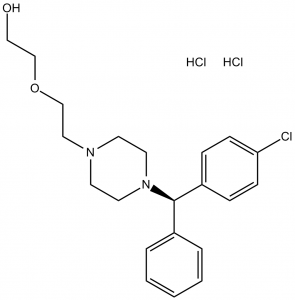
Hydroxyzine 2HCl (NSC-169188; NSC169188; Arcanax; Neurolax; Orgatrax; Pamoate, Hydroxyzine; Vistaril), the dihydrochloride salt of hydroxyzine, is a potent histamine H1-receptor antagonist and an antihistamine drug used in the treatment of itchiness, anxiety, and nausea. It has an IC50 of 10 nM/19 nM and inhibits the binding of [3H]pyrilamine/[3H]desloratadine to the human histamine H1 receptor. Hydroxyzine does make you sleepy, in contrast to its primary metabolite cetirizine.
Physicochemical Properties
| Molecular Formula | C21H29CL3N2O2 |
| Molecular Weight | 447.83 |
| Exact Mass | 446.129 |
| Elemental Analysis | C, 56.32; H, 6.53; Cl, 23.75; N, 6.26; O, 7.15 |
| CAS # | 2192-20-3 |
| Related CAS # | Hydroxyzine-d4 dihydrochloride;1219805-91-0;Hydroxyzine pamoate;10246-75-0;Hydroxyzine;68-88-2;Hydroxyzine-d4 dihydrochloride;Hydroxyzine-d8 dihydrochloride;1808202-93-8 |
| PubChem CID | 91513 |
| Appearance | White to off-white solid powder |
| Density | 1.182 g/cm3 |
| Boiling Point | 499.2ºC at 760 mmHg |
| Melting Point | 190-192°C |
| Flash Point | 255.7ºC |
| Vapour Pressure | 8.78E-11mmHg at 25°C |
| LogP | 4.535 |
| Hydrogen Bond Donor Count | 3 |
| Hydrogen Bond Acceptor Count | 4 |
| Rotatable Bond Count | 8 |
| Heavy Atom Count | 28 |
| Complexity | 376 |
| Defined Atom Stereocenter Count | 0 |
| SMILES | ClC1C([H])=C([H])C(=C([H])C=1[H])C([H])(C1C([H])=C([H])C([H])=C([H])C=1[H])N1C([H])([H])C([H])([H])N(C([H])([H])C([H])([H])OC([H])([H])C([H])([H])O[H])C([H])([H])C1([H])[H].Cl[H].Cl[H] |
| InChi Key | ANOMHKZSQFYSBR-UHFFFAOYSA-N |
| InChi Code | InChI=1S/C21H27ClN2O2.2ClH/c22-20-8-6-19(7-9-20)21(18-4-2-1-3-5-18)24-12-10-23(11-13-24)14-16-26-17-15-25;;/h1-9,21,25H,10-17H2;2*1H |
| Chemical Name | 2-[2-[4-[(4-chlorophenyl)-phenylmethyl]piperazin-1-yl]ethoxy]ethanol;dihydrochloride |
| Synonyms | Hydroxyzine dihydrochloride; NSC 169188; U.C.B 4492; Hydroxyzine hydrochloride; NSC-169188; NSC169188; trade names: Arcanax; Neurolax; Orgatrax; Pamoate, Hydroxyzine; Vistaril |
| HS Tariff Code | 2934.99.9001 |
| Storage |
Powder-20°C 3 years 4°C 2 years In solvent -80°C 6 months -20°C 1 month Note: Please store this product in a sealed and protected environment (e.g. under nitrogen), avoid exposure to moisture and light. |
| Shipping Condition | Room temperature (This product is stable at ambient temperature for a few days during ordinary shipping and time spent in Customs) |
Biological Activity
| Targets | Histamine H1 receptor ( IC50 = 10 nM-19 nM ) | ||
| ln Vitro |
|
||
| ln Vivo |
|
||
| Animal Protocol |
|
||
| References |
[1]. Hydroxyzine inhibits neurogenic bladder mast cell activation. Int J Immunopharmacol, 1998. 20(10): p. 553-63. [2]. A study of the influence of hydroxyzine and diazepam on morphine antinociceptoion in the rat. Pain, 1979. 7(2): p. 173-80. [3]. Evaluation of anxiolytic effects of aripiprazole and hydroxyzine as a combination in mice. J Basic Clin Pharm. 2016 Sep;7(4):97-104. |
||
| Additional Infomation |
Hydroxyzine Hydrochloride is the hydrochloride salt form of hydroxyzine, a piperazine histamine H1-receptor antagonist with anti-allergic, antispasmodic, sedative, anti-emetic and anti-anxiety properties. Hydroxyzine hydrochloride blocks the H1 histamine receptor and prevents the symptoms that are caused by histamine activity on capillaries, bronchial smooth muscle, and gastrointestinal smooth muscle, including vasodilatation, increased capillary permeability, bronchoconstriction, and spasmodic contraction of gastrointestinal smooth muscle. In addition, hydroxyzine hydrochloride crosses the blood-brain barrier and acts on the histamine H1-receptors in the central nervous system. (NCI05) A histamine H1 receptor antagonist that is effective in the treatment of chronic urticaria, dermatitis, and histamine-mediated pruritus. Unlike its major metabolite CETIRIZINE, it does cause drowsiness. It is also effective as an antiemetic, for relief of anxiety and tension, and as a sedative. See also: Hydroxyzine (annotation moved to). |
Solubility Data
| Solubility (In Vitro) |
|
|||
| Solubility (In Vivo) |
Solubility in Formulation 1: 100 mg/mL (223.30 mM) in PBS (add these co-solvents sequentially from left to right, and one by one), clear solution; with sonication. Solubility in Formulation 2: Saline: 30 mg/mL (Please use freshly prepared in vivo formulations for optimal results.) |
| Preparing Stock Solutions | 1 mg | 5 mg | 10 mg | |
| 1 mM | 2.2330 mL | 11.1650 mL | 22.3299 mL | |
| 5 mM | 0.4466 mL | 2.2330 mL | 4.4660 mL | |
| 10 mM | 0.2233 mL | 1.1165 mL | 2.2330 mL |