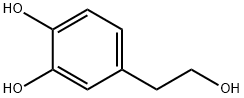
Physicochemical Properties
| Molecular Formula | C8H10O3 |
| Molecular Weight | 154.1632 |
| Exact Mass | 154.062 |
| CAS # | 10597-60-1 |
| Related CAS # | Hydroxytyrosol-d4;1330260-89-3;Hydroxytyrosol-d5 |
| PubChem CID | 82755 |
| Appearance | Light yellow to yellow solid powder |
| Density | 1.3±0.1 g/cm3 |
| Boiling Point | 355.4±27.0 °C at 760 mmHg |
| Flash Point | 182.6±18.3 °C |
| Vapour Pressure | 0.0±0.8 mmHg at 25°C |
| Index of Refraction | 1.623 |
| LogP | 0.02 |
| Hydrogen Bond Donor Count | 3 |
| Hydrogen Bond Acceptor Count | 3 |
| Rotatable Bond Count | 2 |
| Heavy Atom Count | 11 |
| Complexity | 116 |
| Defined Atom Stereocenter Count | 0 |
| InChi Key | JUUBCHWRXWPFFH-UHFFFAOYSA-N |
| InChi Code | InChI=1S/C8H10O3/c9-4-3-6-1-2-7(10)8(11)5-6/h1-2,5,9-11H,3-4H2 |
| Chemical Name | 4-(2-hydroxyethyl)benzene-1,2-diol |
| HS Tariff Code | 2934.99.9001 |
| Storage |
Powder-20°C 3 years 4°C 2 years In solvent -80°C 6 months -20°C 1 month |
| Shipping Condition | Room temperature (This product is stable at ambient temperature for a few days during ordinary shipping and time spent in Customs) |
Biological Activity
| ln Vitro | When pro-inflammatory cytokines (TNF-α) are exposed to hydroxytyrosol (DOPET), the expression of cyclooxygen synthase 2 and inducible nitric oxide synthase (iNOS) is reduced by about 60% [1]. DOPET (hydroxytyrosol) inhibits DNA oxidation, creates cycle tides, disinfects cells, and arrests cells [1]. |
| References |
[1]. Hydroxytyrosol and potential uses in cardiovascular diseases, cancer, and AIDS. Front Nutr. 2014 Oct 27;1:18. [2]. Hydroxytyrosol: Health Benefits and Use as Functional Ingredient in Meat. Medicines (Basel). 2018 Jan 23;5(1). |
| Additional Infomation |
Hydroxytyrosol is a member of the class of catechols that is benzene-1,2-diol substituted by a 2-hydroxyethyl group at position 4. Isolated from Olea europaea, it exhibits antioxidant and antineoplastic activities. It has a role as a metabolite, an antioxidant and an antineoplastic agent. It is a member of catechols and a primary alcohol. It is functionally related to a 2-(4-hydroxyphenyl)ethanol. Hydroxytyrosol has been used in trials studying the prevention of Breast Cancer. Hydroxytyrosol has been reported in Rehmannia glutinosa, Fraxinus americana, and other organisms with data available. Hydroxytyrosol is a phenolic phytochemical naturally occurring in extra virgin olive oil, with potential antioxidant, anti-inflammatory and cancer preventive activities. Although the mechanisms of action through which hydroxytyrosol exerts its effects have yet to be fully determined, this agent affects the expression of various components of the inflammatory response, possibly through the modulation of the nuclear factor-kappa B (NF-kB) pathway. The effects include the modulation of pro-inflammatory cytokines, such as the inhibition of interleukin-1alpha (IL-1a), IL-1beta, IL-6, IL-12, and tumor necrosis factor-alpha (TNF-a); increased secretion of the anti-inflammatory cytokine IL-10; inhibition of the production of certain chemokines, such as C-X-C motif chemokine ligand 10 (CXCL10/IP-10), C-C motif chemokine ligand 2 (CCL2/MCP-1), and macrophage inflammatory protein-1beta (CCL4/MIP-1b); and inhibition of the expression of the enzymes inducible nitric oxide synthase (iNOS/NOS2) and prostaglandin E2 synthase (PGES), which prevent the production of nitric oxide (NO) and prostaglandin E (PGE2), respectively. In addition, hydroxytyrosol is able to regulate the expression of other genes involved in the regulation of tumor cell proliferation, such as extracellular signal-regulated and cyclin-dependent kinases. Also, hydroxytyrosol scavenges free radicals and prevents oxidative DNA damage. This induces apoptosis and inhibits proliferation in susceptible cancer cells. |
Solubility Data
| Solubility (In Vitro) |
DMSO : ~125 mg/mL (~810.85 mM) H2O : ~100 mg/mL (~648.68 mM) Ethanol : ~50 mg/mL (~324.34 mM) |
| Solubility (In Vivo) |
Solubility in Formulation 1: ≥ 2.08 mg/mL (13.49 mM) (saturation unknown) in 10% DMSO + 40% PEG300 + 5% Tween80 + 45% Saline (add these co-solvents sequentially from left to right, and one by one), clear solution. For example, if 1 mL of working solution is to be prepared, you can add 100 μL of 20.8 mg/mL clear DMSO stock solution to 400 μL PEG300 and mix evenly; then add 50 μL Tween-80 to the above solution and mix evenly; then add 450 μL normal saline to adjust the volume to 1 mL. Preparation of saline: Dissolve 0.9 g of sodium chloride in 100 mL ddH₂ O to obtain a clear solution. Solubility in Formulation 2: ≥ 2.08 mg/mL (13.49 mM) (saturation unknown) in 10% DMSO + 90% (20% SBE-β-CD in Saline) (add these co-solvents sequentially from left to right, and one by one), clear solution. For example, if 1 mL of working solution is to be prepared, you can add 100 μL of 20.8 mg/mL clear DMSO stock solution to 900 μL of 20% SBE-β-CD physiological saline solution and mix evenly. Preparation of 20% SBE-β-CD in Saline (4°C,1 week): Dissolve 2 g SBE-β-CD in 10 mL saline to obtain a clear solution. Solubility in Formulation 3: ≥ 2.08 mg/mL (13.49 mM) (saturation unknown) in 10% DMSO + 90% Corn Oil (add these co-solvents sequentially from left to right, and one by one), clear solution. For example, if 1 mL of working solution is to be prepared, you can add 100 μL of 20.8 mg/mL clear DMSO stock solution to 900 μL of corn oil and mix evenly. (Please use freshly prepared in vivo formulations for optimal results.) |
| Preparing Stock Solutions | 1 mg | 5 mg | 10 mg | |
| 1 mM | 6.4868 mL | 32.4338 mL | 64.8677 mL | |
| 5 mM | 1.2974 mL | 6.4868 mL | 12.9735 mL | |
| 10 mM | 0.6487 mL | 3.2434 mL | 6.4868 mL |