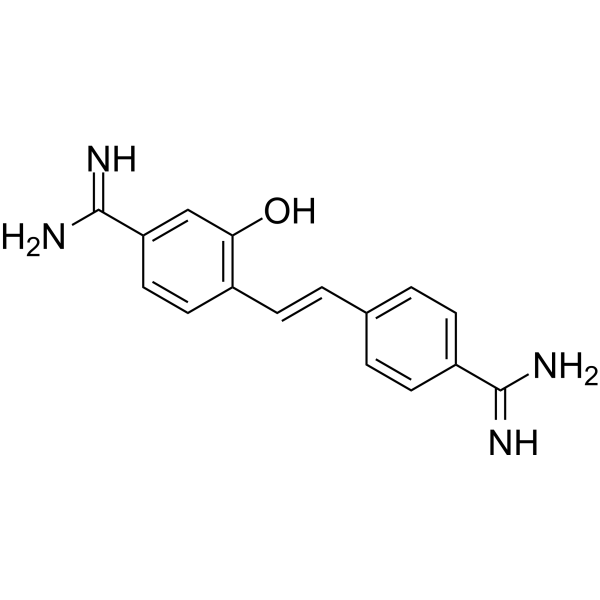
Physicochemical Properties
| Molecular Formula | C16H16N4O |
| Molecular Weight | 280.32 |
| Exact Mass | 280.132 |
| CAS # | 495-99-8 |
| Related CAS # | 223769-64-0 |
| PubChem CID | 5284571 |
| Appearance | Typically exists as solid at room temperature |
| Density | 1.288g/cm3 |
| Boiling Point | 509.678ºC at 760 mmHg |
| Melting Point | 235° |
| Flash Point | 262.044ºC |
| Vapour Pressure | 0mmHg at 25°C |
| Index of Refraction | 1.654 |
| LogP | 1.578 |
| Hydrogen Bond Donor Count | 5 |
| Hydrogen Bond Acceptor Count | 3 |
| Rotatable Bond Count | 4 |
| Heavy Atom Count | 21 |
| Complexity | 413 |
| Defined Atom Stereocenter Count | 0 |
| SMILES | C1=CC(=CC=C1/C=C/C2=C(C=C(C=C2)C(=N)N)O)C(=N)N |
| InChi Key | TUESWZZJYCLFNL-DAFODLJHSA-N |
| InChi Code | InChI=1S/C16H16N4O/c17-15(18)12-5-2-10(3-6-12)1-4-11-7-8-13(16(19)20)9-14(11)21/h1-9,21H,(H3,17,18)(H3,19,20)/b4-1+ |
| Chemical Name | 4-[(E)-2-(4-carbamimidoylphenyl)ethenyl]-3-hydroxybenzenecarboximidamide |
| Synonyms | HYDROXYSTILBAMIDINE; 495-99-8; 1071752-67-4; 4-[(E)-2-(4-carbamimidoylphenyl)ethenyl]-3-hydroxybenzenecarboximidamide; 4-(4-Carbamimidoylstyryl)-3-hydroxybenzimidamide; (E)-4-(4-carbamimidoylstyryl)-3-hydroxybenzimidamide; OHSA; NCGC00166289-01; |
| HS Tariff Code | 2934.99.9001 |
| Storage |
Powder-20°C 3 years 4°C 2 years In solvent -80°C 6 months -20°C 1 month |
| Shipping Condition | Room temperature (This product is stable at ambient temperature for a few days during ordinary shipping and time spent in Customs) |
Biological Activity
| Targets |
Nucleic acids (specifically binds to guanine-rich regions without intercalation, acting as a conformational probe) [2] Lysosomes (stabilizes lysosomal membranes and exhibits anti-proteolytic activity) [1] |
| ln Vitro |
Hydroxystilbamidine demonstrated significant immunosuppressive effects by inhibiting the release of lysosomal enzymes from macrophages. Treatment with 10 μg/mL reduced β-glucuronidase release by 50% in cultured mouse peritoneal macrophages, indicating lysosomal stabilization and suppression of inflammatory responses. [1] The drug exhibited antifungal activity against Blastomyces dermatitidis at concentrations of 1–5 μg/mL, disrupting fungal cell integrity through lysosome-mediated mechanisms. [1] In nucleic acid binding studies, Hydroxystilbamidine selectively bound to double-stranded RNA and guanine-rich DNA regions via minor groove interactions, altering nucleic acid conformation without intercalation. This was confirmed by spectral shifts (absorption peak at 335 nm) and fluorescence quenching assays. [2] |
| ln Vivo |
Intraperitoneal administration of 10 mg/kg Hydroxystilbamidine in mice suppressed delayed-type hypersensitivity (DTH) responses to sheep red blood cells by 70%, attributed to lysosome stabilization and reduced protease release from immune cells. [1] |
| Enzyme Assay |
Lysosomal enzyme release was quantified by measuring β-glucuronidase activity in supernatants of mouse peritoneal macrophages. Cells were treated with Hydroxystilbamidine (0.1–10 μg/mL) for 1 hour, followed by zymosan challenge. Enzyme activity was assayed using phenolphthalein glucuronic acid as substrate, with absorbance read at 540 nm. [1] Nucleic acid binding affinity was assessed via absorption spectroscopy. Titrations of Hydroxystilbamidine (0–50 μM) into solutions of DNA/RNA (50 μM) monitored hypochromicity at 335 nm. Binding constants were calculated from Scatchard plots. [2] |
| Cell Assay |
Mouse peritoneal macrophages were harvested, cultured in medium, and pre-treated with Hydroxystilbamidine (1–10 μg/mL) for 30 min. Cells were then stimulated with zymosan particles (1 mg/mL) for 60 min. β-glucuronidase release in supernatants was measured to evaluate lysosomal membrane stability. [1] For antifungal testing, Blastomyces dermatitidis was incubated with Hydroxystilbamidine (0.1–10 μg/mL) in broth culture at 37°C for 48 hours. Growth inhibition was determined by turbidity measurements at 600 nm. [1] |
| Animal Protocol |
Mice (CBA strain) received intraperitoneal injections of Hydroxystilbamidine (10 mg/kg dissolved in saline) daily for 4 days prior to immunization with sheep red blood cells. DTH response was evaluated by footpad swelling 24 hours after challenge. [1] |
| References |
[1].Immunosuppression by hydroxystilbamidine isethionate, a lysosome-stabilizing, anti-proteolytic, antifungal drug. Infect Immun. 1975 Mar;11(3):441-4. [2].Hydroxystilbamidine. A nonintercalating drug as a probe of nucleic acid conformation. Biochemistry. 1973 Nov 20;12(24):4827-34. |
| Additional Infomation |
Hydroxystilbamidine is a stilbenoid. Hydroxystilbamidine isethionate is used in the therapy of some patients with nonprogressive blastomycosis of the skin, and pulmonary or systemic blastomycosis in children, with fewer side effects than amphotericin B. Hydroxystilbamidine isethionate is also used in pathology for diagnostic purposes. Hydroxystilbamidine is a cationic dye with antifungal, antitrypanosomal, antimalarial, and carcinostatic activities. Hydroxystilbamidine is able to bind to DNA and RNA in a non-intercalating manner, and is a powerful inhibitor of ribonucleases, thereby impeding cellular processes in protozoa. This agent was also shown to bind to and stablize trypanosomal lysosomes. Hydroxystilbamidine is commonly used as a diagnostic agent in neuroanatomy and as a histochemical stain. See also: Hydroxystilbamidine Isethionate (annotation moved to). Drug Indication Used in the treatment of nonprogressive blastomycosis of the skin and other mycoses. Mechanism of Action Hydroxystilbamidine isethionate (HSB) acts on extracellular DNA and lysosomes. In Trypanosomes there is extensive and selective binding of HSB to the kinetoplastic DNA. This inhibits cell division and reproduction. In yeast there is evidence of binding to extranuclear DNA causing numerous mutations. HSB is also taken up in the lysosomes and leads to a significant increase in the number of lysosome-like bodies and secretion granules in trypanosomal organisms. HSB may also stabilize lysosomal membranes. HSB has also been found to bind RNA and is a powerful inhibitor of cellular ribonucleases. Hydroxystilbamidine acts as a lysosome-stabilizing agent that inhibits proteolytic enzyme release, thereby suppressing immune cell activation and inflammation. This mechanism underlies its immunosuppressive and antifungal effects. [1] The drug serves as a unique nonintercalating nucleic acid probe due to its selective binding to guanine bases via hydrogen bonding and electrostatic interactions, inducing conformational changes in double-stranded RNA and GC-rich DNA regions. [2] |
Solubility Data
| Solubility (In Vitro) | Typically soluble in DMSO (e.g. 10 mM) |
| Solubility (In Vivo) |
Note: Listed below are some common formulations that may be used to formulate products with low water solubility (e.g. < 1 mg/mL), you may test these formulations using a minute amount of products to avoid loss of samples. Injection Formulations (e.g. IP/IV/IM/SC) Injection Formulation 1: DMSO : Tween 80: Saline = 10 : 5 : 85 (i.e. 100 μL DMSO stock solution → 50 μL Tween 80 → 850 μL Saline) *Preparation of saline: Dissolve 0.9 g of sodium chloride in 100 mL ddH ₂ O to obtain a clear solution. Injection Formulation 2: DMSO : PEG300 :Tween 80 : Saline = 10 : 40 : 5 : 45 (i.e. 100 μL DMSO → 400 μLPEG300 → 50 μL Tween 80 → 450 μL Saline) Injection Formulation 3: DMSO : Corn oil = 10 : 90 (i.e. 100 μL DMSO → 900 μL Corn oil) Example: Take the Injection Formulation 3 (DMSO : Corn oil = 10 : 90) as an example, if 1 mL of 2.5 mg/mL working solution is to be prepared, you can take 100 μL 25 mg/mL DMSO stock solution and add to 900 μL corn oil, mix well to obtain a clear or suspension solution (2.5 mg/mL, ready for use in animals). Injection Formulation 4: DMSO : 20% SBE-β-CD in saline = 10 : 90 [i.e. 100 μL DMSO → 900 μL (20% SBE-β-CD in saline)] *Preparation of 20% SBE-β-CD in Saline (4°C,1 week): Dissolve 2 g SBE-β-CD in 10 mL saline to obtain a clear solution. Injection Formulation 5: 2-Hydroxypropyl-β-cyclodextrin : Saline = 50 : 50 (i.e. 500 μL 2-Hydroxypropyl-β-cyclodextrin → 500 μL Saline) Injection Formulation 6: DMSO : PEG300 : castor oil : Saline = 5 : 10 : 20 : 65 (i.e. 50 μL DMSO → 100 μLPEG300 → 200 μL castor oil → 650 μL Saline) Injection Formulation 7: Ethanol : Cremophor : Saline = 10: 10 : 80 (i.e. 100 μL Ethanol → 100 μL Cremophor → 800 μL Saline) Injection Formulation 8: Dissolve in Cremophor/Ethanol (50 : 50), then diluted by Saline Injection Formulation 9: EtOH : Corn oil = 10 : 90 (i.e. 100 μL EtOH → 900 μL Corn oil) Injection Formulation 10: EtOH : PEG300:Tween 80 : Saline = 10 : 40 : 5 : 45 (i.e. 100 μL EtOH → 400 μLPEG300 → 50 μL Tween 80 → 450 μL Saline) Oral Formulations Oral Formulation 1: Suspend in 0.5% CMC Na (carboxymethylcellulose sodium) Oral Formulation 2: Suspend in 0.5% Carboxymethyl cellulose Example: Take the Oral Formulation 1 (Suspend in 0.5% CMC Na) as an example, if 100 mL of 2.5 mg/mL working solution is to be prepared, you can first prepare 0.5% CMC Na solution by measuring 0.5 g CMC Na and dissolve it in 100 mL ddH2O to obtain a clear solution; then add 250 mg of the product to 100 mL 0.5% CMC Na solution, to make the suspension solution (2.5 mg/mL, ready for use in animals). Oral Formulation 3: Dissolved in PEG400 Oral Formulation 4: Suspend in 0.2% Carboxymethyl cellulose Oral Formulation 5: Dissolve in 0.25% Tween 80 and 0.5% Carboxymethyl cellulose Oral Formulation 6: Mixing with food powders Note: Please be aware that the above formulations are for reference only. InvivoChem strongly recommends customers to read literature methods/protocols carefully before determining which formulation you should use for in vivo studies, as different compounds have different solubility properties and have to be formulated differently. (Please use freshly prepared in vivo formulations for optimal results.) |
| Preparing Stock Solutions | 1 mg | 5 mg | 10 mg | |
| 1 mM | 3.5674 mL | 17.8368 mL | 35.6735 mL | |
| 5 mM | 0.7135 mL | 3.5674 mL | 7.1347 mL | |
| 10 mM | 0.3567 mL | 1.7837 mL | 3.5674 mL |