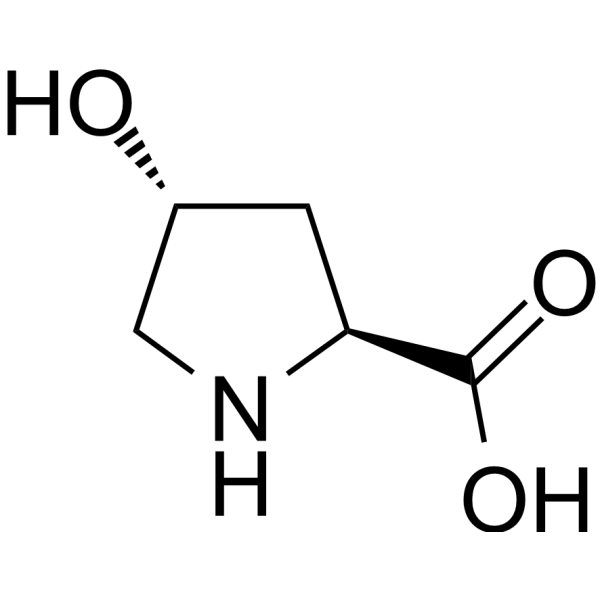
Physicochemical Properties
| Molecular Formula | C5H9NO3 |
| Molecular Weight | 131.13 |
| Exact Mass | 131.058 |
| CAS # | 51-35-4 |
| Related CAS # | 25249-07-4 |
| PubChem CID | 5810 |
| Appearance | White to off-white solid powder |
| Density | 1.4±0.1 g/cm3 |
| Boiling Point | 355.2±42.0 °C at 760 mmHg |
| Melting Point | 273 °C (dec.)(lit.) |
| Flash Point | 168.6±27.9 °C |
| Vapour Pressure | 0.0±1.8 mmHg at 25°C |
| Index of Refraction | 1.540 |
| LogP | -1.84 |
| Hydrogen Bond Donor Count | 3 |
| Hydrogen Bond Acceptor Count | 4 |
| Rotatable Bond Count | 1 |
| Heavy Atom Count | 9 |
| Complexity | 125 |
| Defined Atom Stereocenter Count | 2 |
| SMILES | O([H])C1([H])C([H])([H])N([H])[C@]([H])(C(=O)O[H])C1([H])[H] |
| InChi Key | PMMYEEVYMWASQN-DMTCNVIQSA-N |
| InChi Code | InChI=1S/C5H9NO3/c7-3-1-4(5(8)9)6-2-3/h3-4,6-7H,1-2H2,(H,8,9)/t3-,4+/m1/s1 |
| Chemical Name | (2S,4R)-4-hydroxypyrrolidine-2-carboxylic acid |
| Synonyms | NSC 46704; Oxaceprol; Hydroxyproline |
| HS Tariff Code | 2934.99.9001 |
| Storage |
Powder-20°C 3 years 4°C 2 years In solvent -80°C 6 months -20°C 1 month |
| Shipping Condition | Room temperature (This product is stable at ambient temperature for a few days during ordinary shipping and time spent in Customs) |
Biological Activity
| ln Vitro | L-hydroxyproline, also known as Trans-4-hydroxy-L-proline or Trans-Hyp, is extensively utilized in the food, cosmetic, biochemistry, medical, and other industries. Furthermore, it has been discovered that several secondary metabolites, like actinomycins and echinocandins, include L-hydroxyproline. Because it is abundant in collagen, L-hydroxyproline is mostly produced industrially by acid hydrolyzing mammalian collagen[1]. |
| References |
[1]. Biosynthesis of trans-4-hydroxyproline by recombinant strains of Corynebacterium glutamicum and Escherichia coli. BMC Biotechnol. 2014 May 19;14:44. |
| Additional Infomation |
Trans-4-hydroxy-L-proline is an optically active form of 4-hydroxyproline having L-trans-configuration. It has a role as a human metabolite, a plant metabolite and a mouse metabolite. It is a tautomer of a trans-4-hydroxy-L-proline zwitterion. Hydroxyproline is a neutral heterocyclic protein amino acid. It is found in collagen and as such it is common in many gelatin products. Hydroxyproline is mostly used as a diagnostic marker of bone turnover and liver fibrosis. Therapeutically, hydroxyproline is being studied as an an experimental medicine but is approved in France as a combination topical gel product called Cicactive for small, superficial wounds. Hydroxyproline is a metabolite found in or produced by Escherichia coli (strain K12, MG1655). 4-Hydroxy-L-proline is a metabolite found in or produced by Escherichia coli (strain K12, MG1655). Hydroxyproline has been reported in Daphnia pulex, Glycine max, and other organisms with data available. Hydroxyproline is a nonessential amino acid derivative formed during post-translational protein modification through hydroxylation of the amino acid proline by the enzyme prolyl hydroxylase which requires vitamin C as a co-factor. Hydroxyproline is a major component of the protein collagen and plays a key role in the stability of the collagen triple helix. It can be used as an indicator to determine the amount of collagen. Increased hydroxyproline levels in the urine and/or serum are normally associated with degradation of connective tissue. Vitamin C deficiency decreases the conversion of proline to hydroxyproline, which leads to reduced collagen stability. 4-Hydroxyproline (or hydroxyproline or Hyp) is a major component of the protein collagen. Hydroxyproline is produced by hydroxylation of the amino acid proline and is, therefore, a post-translationally modified amino acid. Hydroxyproline and proline play key roles for collagen stability. In particular, they permit the sharp twisting of the collagen helix. Hydroxyproline is found in few proteins other than collagen. The only other mammalian protein which includes hydroxyproline is elastin. For this reason, hydroxyproline content has been used as an indicator to determine collagen and/or gelatin amount in tissue or biological samples. Increased serum and urine levels of hydroxyproline have been found in Paget's disease Hydroxyproline (Hyp) content in biological fluids is used as a parameter of collagen catabolism, especially bone resorption or tissue degradation. Bedridden and elderly individuals show significantly elevated serum levels of hydroxyproline in comparison to normal, active individuals Elevated levels of urinary hydroxyproline are also indicative of muscle damage Increased reactive oxygen species (ROS) are also known to accelerate collagen degradation. Hydroxyproline levels increase in cases of depression and stress (A3486, A3487, A3488, A3489). See also: Hydroxyproline; octinoxate (component of); Hydroxyproline; niacinamide (component of) ... View More ... Drug Indication Used in France as a combination product for the treatment of small, superficial wounds. Pharmacodynamics Hydroxyproline as well as proline and glycine are the major components of collagen. Collagen is on one of the main building blocks of connective tissue such as skin, bone, and cartilage. Thus when these tissues are damaged, hydroxyproline is necessary for repair of the damaged area. |
Solubility Data
| Solubility (In Vitro) | H2O : ~50 mg/mL (~381.30 mM) |
| Solubility (In Vivo) |
Solubility in Formulation 1: 100 mg/mL (762.60 mM) in PBS (add these co-solvents sequentially from left to right, and one by one), clear solution; with sonication. (Please use freshly prepared in vivo formulations for optimal results.) |
| Preparing Stock Solutions | 1 mg | 5 mg | 10 mg | |
| 1 mM | 7.6260 mL | 38.1301 mL | 76.2602 mL | |
| 5 mM | 1.5252 mL | 7.6260 mL | 15.2520 mL | |
| 10 mM | 0.7626 mL | 3.8130 mL | 7.6260 mL |