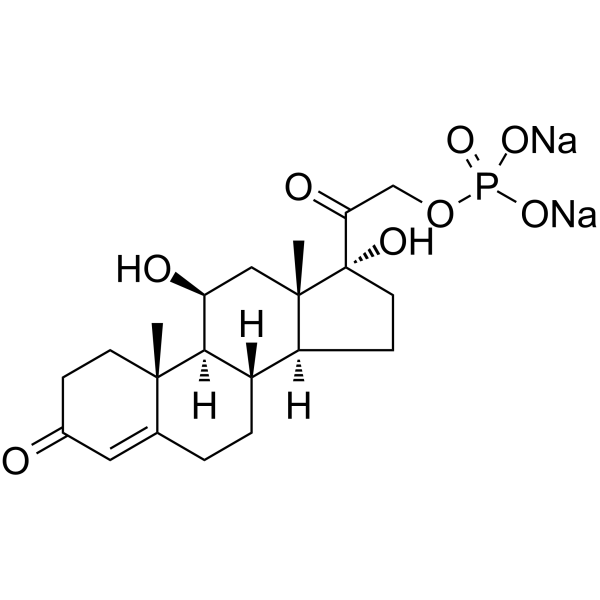
Physicochemical Properties
| Molecular Formula | C21H29O8P-2.2[NA+] |
| Molecular Weight | 486.40356 |
| Exact Mass | 486.139 |
| CAS # | 6000-74-4 |
| Related CAS # | 3863-59-0 |
| PubChem CID | 441406 |
| Appearance | White to off-white solid powder |
| Boiling Point | 669.9ºC at 760 mmHg |
| LogP | 2.775 |
| Hydrogen Bond Donor Count | 2 |
| Hydrogen Bond Acceptor Count | 8 |
| Rotatable Bond Count | 3 |
| Heavy Atom Count | 32 |
| Complexity | 836 |
| Defined Atom Stereocenter Count | 7 |
| SMILES | [Na+].[Na+].O=P(OCC([C@]1(CC[C@H]2[C@@H]3CCC4=CC(CC[C@]4(C)C3[C@H](C[C@]12C)O)=O)O)=O)([O-])[O-] |
| InChi Key | RYJIRNNXCHOUTQ-OJJGEMKLSA-L |
| InChi Code | InChI=1S/C21H31O8P.2Na/c1-19-7-5-13(22)9-12(19)3-4-14-15-6-8-21(25,17(24)11-29-30(26,27)28)20(15,2)10-16(23)18(14)19;;/h9,14-16,18,23,25H,3-8,10-11H2,1-2H3,(H2,26,27,28);;/q;2*+1/p-2/t14-,15-,16-,18+,19-,20-,21-;;/m0../s1 |
| Chemical Name | disodium;[2-[(8S,9S,10R,11S,13S,14S,17R)-11,17-dihydroxy-10,13-dimethyl-3-oxo-2,6,7,8,9,11,12,14,15,16-decahydro-1H-cyclopenta[a]phenanthren-17-yl]-2-oxoethyl] phosphate |
| Synonyms | hydrocortisone sodium phosphate; 6000-74-4; Efcortesol; Cortisol 21-(disodium phosphate); CHEBI:5781; DTXSID5046647; 0388G963HY; DTXCID3026647; |
| HS Tariff Code | 2934.99.9001 |
| Storage |
Powder-20°C 3 years 4°C 2 years In solvent -80°C 6 months -20°C 1 month |
| Shipping Condition | Room temperature (This product is stable at ambient temperature for a few days during ordinary shipping and time spent in Customs) |
Biological Activity
| ln Vivo |
Ocular PK: After topical instillation of 1% hydrocortisone sodium phosphate eye drops (50 μL) in cataract patients, aqueous humor concentrations peaked at 30 min (Tₘₐₓ) with Cₘₐₓ = 23.8 ng/mL. AUC₀₋₁₂₀ was 1342 ng·min/mL. Elimination half-life = 46 min. Systemic absorption was negligible (plasma concentrations below detection limit).[1] In rats with acetic acid-induced stomach ulcers, hydrocortisone sodium phosphate (2.5 mg/kg, intraperitoneal injection, daily) can postpone the healing process [2]. |
| Animal Protocol |
Animal/Disease Models: Wistar rat [2] Doses: 2.5 mg/kg Route of Administration: 2.5 mg/kg, intraperitoneal (ip) injection, daily Experimental Results: Caused significant delay in healing of acetic acid-induced ulcers. |
| ADME/Pharmacokinetics |
Ocular PK: After topical instillation of 1% hydrocortisone sodium phosphate eye drops (50 μL) in cataract patients, aqueous humor concentrations peaked at 30 min (Tₘₐₓ) with Cₘₐₓ = 23.8 ng/mL. AUC₀₋₁₂₀ was 1342 ng·min/mL. Elimination half-life = 46 min. Systemic absorption was negligible (plasma concentrations below detection limit).[1] |
| Toxicity/Toxicokinetics |
Subcutaneous injection of hydrocortisone sodium phosphate (50 mg/kg/day) in rats with acetic acid-induced gastric ulcers significantly delayed ulcer healing: Ulcer index increased to 129 ± 11 vs. 59 ± 7 in control (p<0.01). Caused severe mucosal damage with neutrophil infiltration and edema. Reduced body weight gain by 12% vs. control.[2] 441406 rat LD50 oral 6100 mg/kg Gekkan Yakuji. Pharmaceuticals Monthly., 21(2117), 1979 441406 rat LD50 intraperitoneal 603 mg/kg BEHAVIORAL: SOMNOLENCE (GENERAL DEPRESSED ACTIVITY); BEHAVIORAL: CONVULSIONS OR EFFECT ON SEIZURE THRESHOLD; BEHAVIORAL: ATAXIA Yakkyoku. Pharmacy., 26(379), 1975 441406 rat LD50 subcutaneous 680 mg/kg Gekkan Yakuji. Pharmaceuticals Monthly., 21(2117), 1979 441406 rat LD50 intravenous 632 mg/kg BEHAVIORAL: SOMNOLENCE (GENERAL DEPRESSED ACTIVITY); BEHAVIORAL: CONVULSIONS OR EFFECT ON SEIZURE THRESHOLD; BEHAVIORAL: ATAXIA Yakkyoku. Pharmacy., 26(379), 1975 441406 rat LD50 intramuscular 1500 mg/kg Gekkan Yakuji. Pharmaceuticals Monthly., 21(2117), 1979 |
| References |
[1]. Kinetics of hydrocortisone sodium phosphate penetration into the human aqueous humor after topical application. Int J Clin Pract. 2021 Dec;75(12):e14987. [2]. Effects of sucralfate, lansoprazole, and cimetidine on the delayed healing by hydrocortisone sodium phosphate of chronic gastric ulcers in the rat. Am J Med. 1991 Aug 8;91(2A):15S-19S. |
| Additional Infomation |
Hydrocortisone sodium phosphate eye drops rapidly penetrate human cornea, achieving therapeutic concentrations in aqueous humor within 15 min post-instillation.[1] Concomitant administration of sucralfate/lansoprazole reversed the ulcer-healing impairment caused by hydrocortisone sodium phosphate in rats.[2] Cortisol sodium phosphate is an organic sodium salt that is the disodium salt of cortisol phosphate. It contains a cortisol phosphate(2-). |
Solubility Data
| Solubility (In Vitro) | May dissolve in DMSO (in most cases), if not, try other solvents such as H2O, Ethanol, or DMF with a minute amount of products to avoid loss of samples |
| Solubility (In Vivo) |
Note: Listed below are some common formulations that may be used to formulate products with low water solubility (e.g. < 1 mg/mL), you may test these formulations using a minute amount of products to avoid loss of samples. Injection Formulations (e.g. IP/IV/IM/SC) Injection Formulation 1: DMSO : Tween 80: Saline = 10 : 5 : 85 (i.e. 100 μL DMSO stock solution → 50 μL Tween 80 → 850 μL Saline) *Preparation of saline: Dissolve 0.9 g of sodium chloride in 100 mL ddH ₂ O to obtain a clear solution. Injection Formulation 2: DMSO : PEG300 :Tween 80 : Saline = 10 : 40 : 5 : 45 (i.e. 100 μL DMSO → 400 μLPEG300 → 50 μL Tween 80 → 450 μL Saline) Injection Formulation 3: DMSO : Corn oil = 10 : 90 (i.e. 100 μL DMSO → 900 μL Corn oil) Example: Take the Injection Formulation 3 (DMSO : Corn oil = 10 : 90) as an example, if 1 mL of 2.5 mg/mL working solution is to be prepared, you can take 100 μL 25 mg/mL DMSO stock solution and add to 900 μL corn oil, mix well to obtain a clear or suspension solution (2.5 mg/mL, ready for use in animals). Injection Formulation 4: DMSO : 20% SBE-β-CD in saline = 10 : 90 [i.e. 100 μL DMSO → 900 μL (20% SBE-β-CD in saline)] *Preparation of 20% SBE-β-CD in Saline (4°C,1 week): Dissolve 2 g SBE-β-CD in 10 mL saline to obtain a clear solution. Injection Formulation 5: 2-Hydroxypropyl-β-cyclodextrin : Saline = 50 : 50 (i.e. 500 μL 2-Hydroxypropyl-β-cyclodextrin → 500 μL Saline) Injection Formulation 6: DMSO : PEG300 : castor oil : Saline = 5 : 10 : 20 : 65 (i.e. 50 μL DMSO → 100 μLPEG300 → 200 μL castor oil → 650 μL Saline) Injection Formulation 7: Ethanol : Cremophor : Saline = 10: 10 : 80 (i.e. 100 μL Ethanol → 100 μL Cremophor → 800 μL Saline) Injection Formulation 8: Dissolve in Cremophor/Ethanol (50 : 50), then diluted by Saline Injection Formulation 9: EtOH : Corn oil = 10 : 90 (i.e. 100 μL EtOH → 900 μL Corn oil) Injection Formulation 10: EtOH : PEG300:Tween 80 : Saline = 10 : 40 : 5 : 45 (i.e. 100 μL EtOH → 400 μLPEG300 → 50 μL Tween 80 → 450 μL Saline) Oral Formulations Oral Formulation 1: Suspend in 0.5% CMC Na (carboxymethylcellulose sodium) Oral Formulation 2: Suspend in 0.5% Carboxymethyl cellulose Example: Take the Oral Formulation 1 (Suspend in 0.5% CMC Na) as an example, if 100 mL of 2.5 mg/mL working solution is to be prepared, you can first prepare 0.5% CMC Na solution by measuring 0.5 g CMC Na and dissolve it in 100 mL ddH2O to obtain a clear solution; then add 250 mg of the product to 100 mL 0.5% CMC Na solution, to make the suspension solution (2.5 mg/mL, ready for use in animals). Oral Formulation 3: Dissolved in PEG400 Oral Formulation 4: Suspend in 0.2% Carboxymethyl cellulose Oral Formulation 5: Dissolve in 0.25% Tween 80 and 0.5% Carboxymethyl cellulose Oral Formulation 6: Mixing with food powders Note: Please be aware that the above formulations are for reference only. InvivoChem strongly recommends customers to read literature methods/protocols carefully before determining which formulation you should use for in vivo studies, as different compounds have different solubility properties and have to be formulated differently. (Please use freshly prepared in vivo formulations for optimal results.) |
| Preparing Stock Solutions | 1 mg | 5 mg | 10 mg | |
| 1 mM | 2.0559 mL | 10.2796 mL | 20.5592 mL | |
| 5 mM | 0.4112 mL | 2.0559 mL | 4.1118 mL | |
| 10 mM | 0.2056 mL | 1.0280 mL | 2.0559 mL |