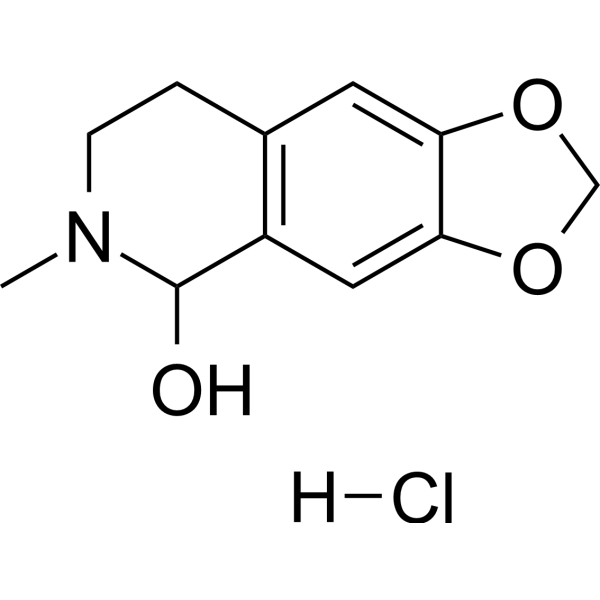
Physicochemical Properties
| Molecular Formula | C11H14CLNO3 |
| Molecular Weight | 243.6868 |
| Exact Mass | 243.066 |
| CAS # | 4884-68-8 |
| Related CAS # | Hydrastinine;6592-85-4 |
| PubChem CID | 71833 |
| Appearance | White to off-white solid powder |
| Boiling Point | 342.5ºC at760mmHg |
| Flash Point | 161ºC |
| LogP | 1.634 |
| Hydrogen Bond Donor Count | 2 |
| Hydrogen Bond Acceptor Count | 4 |
| Rotatable Bond Count | 0 |
| Heavy Atom Count | 16 |
| Complexity | 248 |
| Defined Atom Stereocenter Count | 0 |
| InChi Key | DLNQCQJCIITVHC-UHFFFAOYSA-N |
| InChi Code | InChI=1S/C11H13NO3.ClH/c1-12-3-2-7-4-9-10(15-6-14-9)5-8(7)11(12)13;/h4-5,11,13H,2-3,6H2,1H3;1H |
| Chemical Name | 6-methyl-7,8-dihydro-5H-[1,3]dioxolo[4,5-g]isoquinolin-5-ol;hydrochloride |
| HS Tariff Code | 2934.99.9001 |
| Storage |
Powder-20°C 3 years 4°C 2 years In solvent -80°C 6 months -20°C 1 month Note: Please store this product in a sealed and protected environment, avoid exposure to moisture. |
| Shipping Condition | Room temperature (This product is stable at ambient temperature for a few days during ordinary shipping and time spent in Customs) |
Biological Activity
| ln Vitro | Numerous ailments, including as inflammation, gastrointestinal issues, and urinary tract issues, have been treated using goldenseal. Berberine, palmatine, hydrastine, canadine, and hydrastine are the five primary alkaloid components found in goldenseal[1]. |
| References |
[1]. Mechanism study of goldenseal-associated DNA damage. Toxicol Lett. 2013 Jul 31;221(1):64-72. [2]. The origin of MDMA (ecstasy) revisited: the true story reconstructed from the original documents. Addiction. 2006 Sep;101(9):1241-5. |
Solubility Data
| Solubility (In Vitro) |
DMSO : ~83.33 mg/mL (~341.95 mM) H2O : ~50 mg/mL (~205.18 mM) |
| Solubility (In Vivo) |
Solubility in Formulation 1: ≥ 2.08 mg/mL (8.54 mM) (saturation unknown) in 10% DMSO + 40% PEG300 + 5% Tween80 + 45% Saline (add these co-solvents sequentially from left to right, and one by one), clear solution. For example, if 1 mL of working solution is to be prepared, you can add 100 μL of 20.8 mg/mL clear DMSO stock solution to 400 μL PEG300 and mix evenly; then add 50 μL Tween-80 to the above solution and mix evenly; then add 450 μL normal saline to adjust the volume to 1 mL. Preparation of saline: Dissolve 0.9 g of sodium chloride in 100 mL ddH₂ O to obtain a clear solution. Solubility in Formulation 2: ≥ 2.08 mg/mL (8.54 mM) (saturation unknown) in 10% DMSO + 90% (20% SBE-β-CD in Saline) (add these co-solvents sequentially from left to right, and one by one), clear solution. For example, if 1 mL of working solution is to be prepared, you can add 100 μL of 20.8 mg/mL clear DMSO stock solution to 900 μL of 20% SBE-β-CD physiological saline solution and mix evenly. Preparation of 20% SBE-β-CD in Saline (4°C,1 week): Dissolve 2 g SBE-β-CD in 10 mL saline to obtain a clear solution. Solubility in Formulation 3: ≥ 2.08 mg/mL (8.54 mM) (saturation unknown) in 10% DMSO + 90% Corn Oil (add these co-solvents sequentially from left to right, and one by one), clear solution. For example, if 1 mL of working solution is to be prepared, you can add 100 μL of 20.8 mg/mL clear DMSO stock solution to 900 μL of corn oil and mix evenly. Solubility in Formulation 4: 10 mg/mL (41.04 mM) in PBS (add these co-solvents sequentially from left to right, and one by one), clear solution; with ultrasonication. (Please use freshly prepared in vivo formulations for optimal results.) |
| Preparing Stock Solutions | 1 mg | 5 mg | 10 mg | |
| 1 mM | 4.1036 mL | 20.5179 mL | 41.0357 mL | |
| 5 mM | 0.8207 mL | 4.1036 mL | 8.2071 mL | |
| 10 mM | 0.4104 mL | 2.0518 mL | 4.1036 mL |