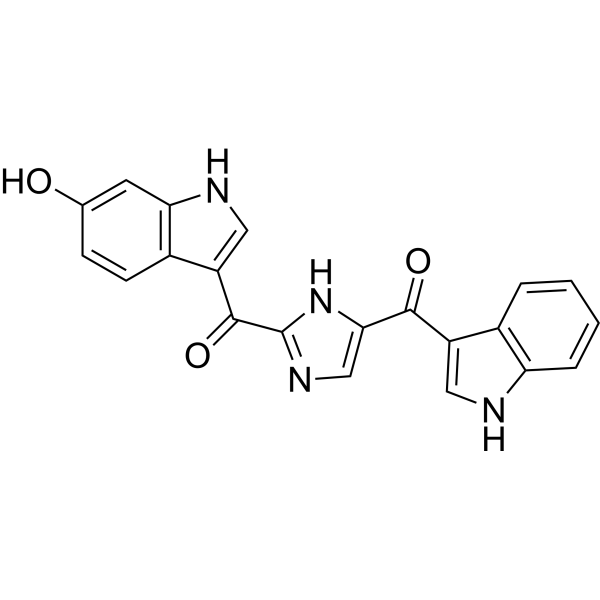
Physicochemical Properties
| Molecular Formula | C21H14N4O3 |
| Molecular Weight | 370.36086 |
| Exact Mass | 370.106 |
| CAS # | 172286-77-0 |
| PubChem CID | 11326167 |
| Appearance | White to yellow solid powder |
| LogP | 3.3 |
| Hydrogen Bond Donor Count | 4 |
| Hydrogen Bond Acceptor Count | 4 |
| Rotatable Bond Count | 4 |
| Heavy Atom Count | 28 |
| Complexity | 629 |
| Defined Atom Stereocenter Count | 0 |
| InChi Key | DRCVQVIMGSWRLN-UHFFFAOYSA-N |
| InChi Code | InChI=1S/C21H14N4O3/c26-11-5-6-13-15(9-23-17(13)7-11)20(28)21-24-10-18(25-21)19(27)14-8-22-16-4-2-1-3-12(14)16/h1-10,22-23,26H,(H,24,25) |
| Chemical Name | [2-(6-hydroxy-1H-indole-3-carbonyl)-1H-imidazol-5-yl]-(1H-indol-3-yl)methanone |
| HS Tariff Code | 2934.99.9001 |
| Storage |
Powder-20°C 3 years 4°C 2 years In solvent -80°C 6 months -20°C 1 month |
| Shipping Condition | Room temperature (This product is stable at ambient temperature for a few days during ordinary shipping and time spent in Customs) |
Biological Activity
| ln Vitro | When homocarbonyltopsentin (PK4C9) (10–40 μM) was applied for 24 hours, GM03813C cells expressed SMN2 isoforms, except for E7, up to 5.2 times less frequently than E7, and up to 3 times more frequently than E7 [1]. Homocarbonyltopsentin (PK4C9) (40 μM; 24 hours) increased SMN protein expression 1.5 times over GM03813C cells treated with DMSO [1]. |
| Cell Assay |
RT-PCR[1] Cell Types: GM03813C (SMA) cells; GM03814B Fibroblast Tested Concentrations: 10-40 μM Incubation Duration: 24 hrs (hours) Experimental Results: E7 inclusion rate reached a maximum of 91% (DMSO-treated cells increased by 25%). Western Blot Analysis[1] Cell Types: GM03813C (SMA) cells; GM03814B fibroblast Tested Concentrations: 40 μM Incubation Duration: 24 hrs (hours) Experimental Results: SMN protein increased in SMA cells. |
| References | [1]. Garcia-Lopez A, et al. Targeting RNA structure in SMN2 reverses spinal muscular atrophy molecular phenotypes. Nat Commun. 2018 May 23;9(1):2032. |
Solubility Data
| Solubility (In Vitro) | DMSO : ~125 mg/mL (~337.51 mM) |
| Solubility (In Vivo) |
Solubility in Formulation 1: ≥ 2.08 mg/mL (5.62 mM) (saturation unknown) in 10% DMSO + 40% PEG300 +5% Tween-80 + 45% Saline (add these co-solvents sequentially from left to right, and one by one), clear solution. For example, if 1 mL of working solution is to be prepared, you can add 100 μL of 20.8 mg/mL clear DMSO stock solution to 400 μL PEG300 and mix evenly; then add 50 μL Tween-80 + to the above solution and mix evenly; then add 450 μL normal saline to adjust the volume to 1 mL. Preparation of saline: Dissolve 0.9 g of sodium chloride in 100 mL ddH₂ O to obtain a clear solution. (Please use freshly prepared in vivo formulations for optimal results.) |
| Preparing Stock Solutions | 1 mg | 5 mg | 10 mg | |
| 1 mM | 2.7001 mL | 13.5004 mL | 27.0008 mL | |
| 5 mM | 0.5400 mL | 2.7001 mL | 5.4002 mL | |
| 10 mM | 0.2700 mL | 1.3500 mL | 2.7001 mL |