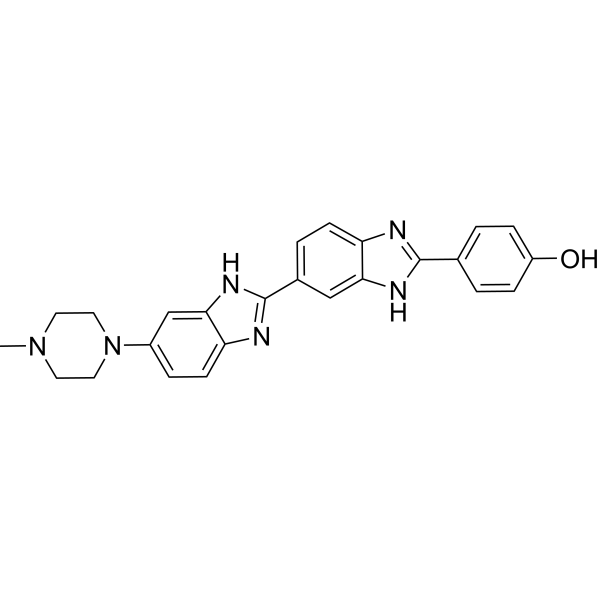
Physicochemical Properties
| Molecular Formula | C25H22N6O |
| Molecular Weight | 422.481784343719 |
| Exact Mass | 424.201 |
| Elemental Analysis | C, 70.73; H, 5.70; N, 19.80; O, 3.77 |
| CAS # | 23491-44-3 |
| Related CAS # | Hoechst 33258 trihydrochloride;23491-45-4;Hoechst 33258 analog;258843-62-8;Hoechst 33258 analog 2;23491-54-5;Hoechst 33258 analog 3;23554-98-5;Hoechst 33258 analog 5;23491-55-6;Hoechst 33258 analog 6;129244-66-2 |
| PubChem CID | 2392 |
| Appearance | Light yellow to yellow solid powder |
| Density | 1.337 g/cm3 |
| Boiling Point | 643.1ºC at 760 mmHg |
| Melting Point | 314ºC |
| Flash Point | 342.7ºC |
| Vapour Pressure | 0mmHg at 25°C |
| Index of Refraction | 1.742 |
| LogP | 4.233 |
| Hydrogen Bond Donor Count | 3 |
| Hydrogen Bond Acceptor Count | 5 |
| Rotatable Bond Count | 3 |
| Heavy Atom Count | 32 |
| Complexity | 634 |
| Defined Atom Stereocenter Count | 0 |
| InChi Key | INAAIJLSXJJHOZ-UHFFFAOYSA-N |
| InChi Code | InChI=1S/C25H24N6O/c1-30-10-12-31(13-11-30)18-5-9-21-23(15-18)29-25(27-21)17-4-8-20-22(14-17)28-24(26-20)16-2-6-19(32)7-3-16/h2-9,14-15,32H,10-13H2,1H3,(H,26,28)(H,27,29) |
| Chemical Name | 4-[6-[6-(4-methylpiperazin-1-yl)-1H-benzimidazol-2-yl]-1H-benzimidazol-2-yl]phenol |
| Synonyms | Pibenzimol; HOECHST 33258; Bisbenzimidazole; 23491-44-3; Hoe-33258; CHEBI:52082; LHQ7J5KV9B; 4-(5-(4-Methyl-1-piperazinyl)(2,5'-bi-1H-benzimidazol)-2'-yl)phenol; |
| HS Tariff Code | 2934.99.9001 |
| Storage |
Powder-20°C 3 years 4°C 2 years In solvent -80°C 6 months -20°C 1 month Note: This product requires protection from light (avoid light exposure) during transportation and storage. |
| Shipping Condition | Room temperature (This product is stable at ambient temperature for a few days during ordinary shipping and time spent in Customs) |
Biological Activity
| Targets | IC50 = 51 μM (HeLa cells), 32 μM (HL60 cells), and 15 μM (U937 cells) |
| ln Vitro |
Preparation of Hoechst working slution: 1.1 Preparation of stock solution Prepare 1 mg/mL Hoechst stock solution with DMSO. Note: Hoechst stock solution is recommended to be aliquoted and stored in the dark at -4 ℃ or -20 ℃. 1.2 Preparation of working slution Dilute the stock solution with preheated serum-free cell culture medium or PBS to a final concentration of 10 μ g/mL Hoechst working solution. Note: Please adjust the concentration of Hoechst working solution according to your specific needs, and use freshly prepared solutions. 2. Cell staining (suspended cells) 2.1 Centrifuge and collect cells, wash twice with PBS for 5 minutes each time. Cell density is 1 × 10~6/mL 2.2 Add 1 mL of Hoechst working solution and incubate at room temperature for 3-10 minutes. 2.3 400 g, centrifuge for 3-4 minutes, discard the supernatant. 2.4 Wash the cells twice with PBS, each time for 5 minutes. After resuspending cells in 1 mL serum-free medium or PBS, observe them using a fluorescence microscope or flow cytometer. 3. Cell staining (adherent cells) 3.1 Cultivate adherent cells on sterile coverslips. 3.2 Remove the cover glass from the culture medium and aspirate excess culture medium. 3.3 Add 100 μ L of dye working solution, gently shake to completely cover the cells, and incubate for 3-10 minutes. 3.4 Remove the dye working solution, wash 2-3 times with culture medium for 5 minutes each time, and observe using a fluorescence microscope or flow cytometer. |
| Enzyme Assay |
Pibenzimol/Hoechst 33258 is a fluorescent dye of benzimidazole derivative. Pibenzimol binds to AT-specific sites in the minor groove of duplex DNA and inhibits topoisomerase I, and DNA polymerase, thereby preventing DNA replication. This agent prolongs the G2 phase of the cell cycle and initiates apoptosis in tumor cells. A benzimidazole antifilarial agent; it is fluorescent when it binds to certain nucleotides in DNA, thus providing a tool for the study of DNA replication; it also interferes with mitosis. |
| Cell Assay |
Staining examples: Example 1: Hoechst 33258 may be utilized for the detection of nuclei. Method: For cell staining. 1. Fix, penetrate and seal cells first. 2. Incubate cells with Hoechst 33258 (1:1000; 30 min; dark). 3. Wash cells with PBS for five times and use a fluorescence microscope for image. Example 2: Hoechst 33258 may be utilized for the detection of nuclei and staining nuclei of live and dead cells (apoptotic/necrotic). Method: For cell staining. 1. Incubate cultured cells with 1 mL of the solution prepared with Hoechst 33258 (7.5 μg/mL; 37℃; 5% CO2; 30 min; 1×PBS). 2. Use a Evos FLc Fluorescent Inverted Microscope for image. Example 3: Hoechst 33258 may be utilized for the detection of nuclei, as well as in apoptosis detection assays. Method: For cell staining. 1. Fix cells in paraformaldehyde after transfection and wash cells with PBS. 2. Stain cells with Hoechst 33258 (30 min; 20℃; dark). 3. Use a fluorescence microscope for image. |
| ADME/Pharmacokinetics |
Rat(iv): LD50: 32200 µg/kg
Mouse(iv): LD50: 36900 µg/kg |
| Toxicity/Toxicokinetics |
Toxicity Data Rat(iv): LD50: 32200 µg/kg Mouse(iv): LD50: 36900 µg/kg |
| References |
[1]. Newly synthesized bis-benzimidazole derivatives exerting anti-tumor activity through inductionof apoptosis and autophagy. Bioorg Med Chem Lett. 2012 Oct 1;22(19):6297-300. [2]. Synthesis, DNA/RNA affinity and antitumour activity of new aromatic diamidines linked by 3,4-ethylenedioxythiophene. Eur J Med Chem. 2011 Feb;46(2):743-55. |
| Additional Infomation |
Pibenzimol is a bibenzimidazole and a N-methylpiperazine. It has a role as a fluorochrome and an anthelminthic drug. Pibenzimol is a fluorescent dye of benzimidazole derivative. Pibenzimol binds to AT-specific sites in the minor groove of duplex DNA and inhibits topoisomerase I, and DNA polymerase, thereby preventing DNA replication. This agent prolongs the G2 phase of the cell cycle and initiates apoptosis in tumor cells. (NCI04) A benzimidazole antifilarial agent; it is fluorescent when it binds to certain nucleotides in DNA, thus providing a tool for the study of DNA replication; it also interferes with mitosis. |
Solubility Data
| Solubility (In Vitro) | DMSO : ~41.67 mg/mL (~98.16 mM) |
| Solubility (In Vivo) |
Solubility in Formulation 1: ≥ 2.08 mg/mL (4.90 mM) (saturation unknown) in 10% DMSO + 40% PEG300 + 5% Tween80 + 45% Saline (add these co-solvents sequentially from left to right, and one by one), clear solution. For example, if 1 mL of working solution is to be prepared, you can add 100 μL of 20.8 mg/mL clear DMSO stock solution to 400 μL PEG300 and mix evenly; then add 50 μL Tween-80 to the above solution and mix evenly; then add 450 μL normal saline to adjust the volume to 1 mL. Preparation of saline: Dissolve 0.9 g of sodium chloride in 100 mL ddH₂ O to obtain a clear solution. Solubility in Formulation 2: ≥ 2.08 mg/mL (4.90 mM) (saturation unknown) in 10% DMSO + 90% (20% SBE-β-CD in Saline) (add these co-solvents sequentially from left to right, and one by one), clear solution. For example, if 1 mL of working solution is to be prepared, you can add 100 μL of 20.8 mg/mL clear DMSO stock solution to 900 μL of 20% SBE-β-CD physiological saline solution and mix evenly. Preparation of 20% SBE-β-CD in Saline (4°C,1 week): Dissolve 2 g SBE-β-CD in 10 mL saline to obtain a clear solution. (Please use freshly prepared in vivo formulations for optimal results.) |
| Preparing Stock Solutions | 1 mg | 5 mg | 10 mg | |
| 1 mM | 2.3670 mL | 11.8349 mL | 23.6698 mL | |
| 5 mM | 0.4734 mL | 2.3670 mL | 4.7340 mL | |
| 10 mM | 0.2367 mL | 1.1835 mL | 2.3670 mL |