Physicochemical Properties
| Molecular Formula | C170H239N47O54S6 |
| Molecular Weight | 3997.39 |
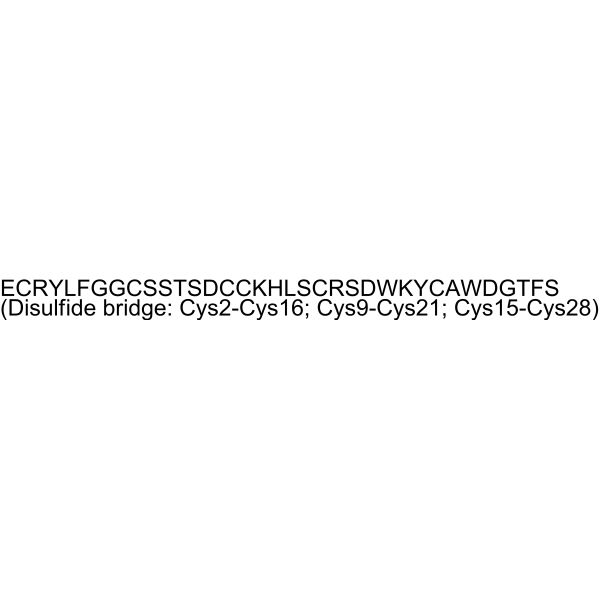
| Sequence | Glu-Cys-Arg-Tyr-Leu-Phe-Gly-Gly-Cys-Ser-Ser-Thr-Ser-Asp-Cys-Cys-Lys-His-Leu-Ser-Cys-Arg-Ser-Asp-Trp-Lys-Tyr-Cys-Ala-Trp-Asp-Gly-Thr-Phe-Ser (Disulfide bridge: Cys2-Cys16; Cys9-Cys21; Cys15-Cys28) |
| SequenceShortening | ECRYLFGGCSSTSDCCKHLSCRSDWKYCAWDGTFS (Disulfide bridge: Cys2-Cys16; Cys9-Cys21; Cys15-Cys28) |
| Appearance | Typically exists as solid at room temperature |
| HS Tariff Code | 2934.99.9001 |
| Storage |
Powder-20°C 3 years 4°C 2 years In solvent -80°C 6 months -20°C 1 month |
| Shipping Condition | Room temperature (This product is stable at ambient temperature for a few days during ordinary shipping and time spent in Customs) |
Biological Activity
| References |
[1]. A selective NaV1.1 activator with potential for treatment of Dravet syndrome epilepsy. Biochem Pharmacol. 2020 Nov;181:113991. |
| Additional Infomation | Dravet syndrome (DS) is a catastrophic epileptic encephalopathy characterised by childhood-onset polymorphic seizures, multiple neuropsychiatric comorbidities, and increased risk of sudden death. Heterozygous loss-of-function mutations in one allele of SCN1A, the gene encoding the voltage-gated sodium channel 1.1 (NaV1.1), lead to DS. NaV1.1 is primarily found in the axon initial segment of fast-spiking GABAergic inhibitory interneurons in the brain, and the principle mechanism proposed to underlie seizure genesis in DS is loss of inhibitory input due to dysfunctional firing of GABAergic interneurons. We hypothesised that DS symptoms could be ameliorated by a drug that activates the reduced population of functional NaV1.1 channels in DS interneurons. We recently identified two homologous disulfide-rich spider-venom peptides (Hm1a and Hm1b) that selectively potentiate NaV1.1, and showed that selective activation of NaV1.1 by Hm1a restores the function of inhibitory interneurons in a mouse model of DS. Here we produced recombinant Hm1b (rHm1b) using an E. coli periplasmic expression system, and examined its selectivity against a panel of human NaV subtypes using whole-cell patch-clamp recordings. rHm1b is a potent and highly selective agonist of NaV1.1 and NaV1.3 (EC50 ~12 nM for both). rHm1b is a gating modifier that shifts the voltage dependence of channel activation and inactivation to hyperpolarised and depolarised potentials respectively, presumably by interacting with the channel's voltage-sensor domains. Like Hm1a, the structure of rHm1b determined by using NMR revealed a classical inhibitor cystine knot (ICK) motif. However, we show that rHm1b is an order of magnitude more stable than Hm1a in human cerebrospinal fluid. Overall, our data suggest that rHm1b is an exciting lead for a precision therapeutic targeted against DS. [1] |
Solubility Data
| Solubility (In Vitro) | May dissolve in DMSO (in most cases), if not, try other solvents such as H2O, Ethanol, or DMF with a minute amount of products to avoid loss of samples |
| Solubility (In Vivo) |
Note: Listed below are some common formulations that may be used to formulate products with low water solubility (e.g. < 1 mg/mL), you may test these formulations using a minute amount of products to avoid loss of samples. Injection Formulations (e.g. IP/IV/IM/SC) Injection Formulation 1: DMSO : Tween 80: Saline = 10 : 5 : 85 (i.e. 100 μL DMSO stock solution → 50 μL Tween 80 → 850 μL Saline) *Preparation of saline: Dissolve 0.9 g of sodium chloride in 100 mL ddH ₂ O to obtain a clear solution. Injection Formulation 2: DMSO : PEG300 :Tween 80 : Saline = 10 : 40 : 5 : 45 (i.e. 100 μL DMSO → 400 μLPEG300 → 50 μL Tween 80 → 450 μL Saline) Injection Formulation 3: DMSO : Corn oil = 10 : 90 (i.e. 100 μL DMSO → 900 μL Corn oil) Example: Take the Injection Formulation 3 (DMSO : Corn oil = 10 : 90) as an example, if 1 mL of 2.5 mg/mL working solution is to be prepared, you can take 100 μL 25 mg/mL DMSO stock solution and add to 900 μL corn oil, mix well to obtain a clear or suspension solution (2.5 mg/mL, ready for use in animals). Injection Formulation 4: DMSO : 20% SBE-β-CD in saline = 10 : 90 [i.e. 100 μL DMSO → 900 μL (20% SBE-β-CD in saline)] *Preparation of 20% SBE-β-CD in Saline (4°C,1 week): Dissolve 2 g SBE-β-CD in 10 mL saline to obtain a clear solution. Injection Formulation 5: 2-Hydroxypropyl-β-cyclodextrin : Saline = 50 : 50 (i.e. 500 μL 2-Hydroxypropyl-β-cyclodextrin → 500 μL Saline) Injection Formulation 6: DMSO : PEG300 : castor oil : Saline = 5 : 10 : 20 : 65 (i.e. 50 μL DMSO → 100 μLPEG300 → 200 μL castor oil → 650 μL Saline) Injection Formulation 7: Ethanol : Cremophor : Saline = 10: 10 : 80 (i.e. 100 μL Ethanol → 100 μL Cremophor → 800 μL Saline) Injection Formulation 8: Dissolve in Cremophor/Ethanol (50 : 50), then diluted by Saline Injection Formulation 9: EtOH : Corn oil = 10 : 90 (i.e. 100 μL EtOH → 900 μL Corn oil) Injection Formulation 10: EtOH : PEG300:Tween 80 : Saline = 10 : 40 : 5 : 45 (i.e. 100 μL EtOH → 400 μLPEG300 → 50 μL Tween 80 → 450 μL Saline) Oral Formulations Oral Formulation 1: Suspend in 0.5% CMC Na (carboxymethylcellulose sodium) Oral Formulation 2: Suspend in 0.5% Carboxymethyl cellulose Example: Take the Oral Formulation 1 (Suspend in 0.5% CMC Na) as an example, if 100 mL of 2.5 mg/mL working solution is to be prepared, you can first prepare 0.5% CMC Na solution by measuring 0.5 g CMC Na and dissolve it in 100 mL ddH2O to obtain a clear solution; then add 250 mg of the product to 100 mL 0.5% CMC Na solution, to make the suspension solution (2.5 mg/mL, ready for use in animals). Oral Formulation 3: Dissolved in PEG400 Oral Formulation 4: Suspend in 0.2% Carboxymethyl cellulose Oral Formulation 5: Dissolve in 0.25% Tween 80 and 0.5% Carboxymethyl cellulose Oral Formulation 6: Mixing with food powders Note: Please be aware that the above formulations are for reference only. InvivoChem strongly recommends customers to read literature methods/protocols carefully before determining which formulation you should use for in vivo studies, as different compounds have different solubility properties and have to be formulated differently. (Please use freshly prepared in vivo formulations for optimal results.) |
| Preparing Stock Solutions | 1 mg | 5 mg | 10 mg | |
| 1 mM | 0.2502 mL | 1.2508 mL | 2.5016 mL | |
| 5 mM | 0.0500 mL | 0.2502 mL | 0.5003 mL | |
| 10 mM | 0.0250 mL | 0.1251 mL | 0.2502 mL |