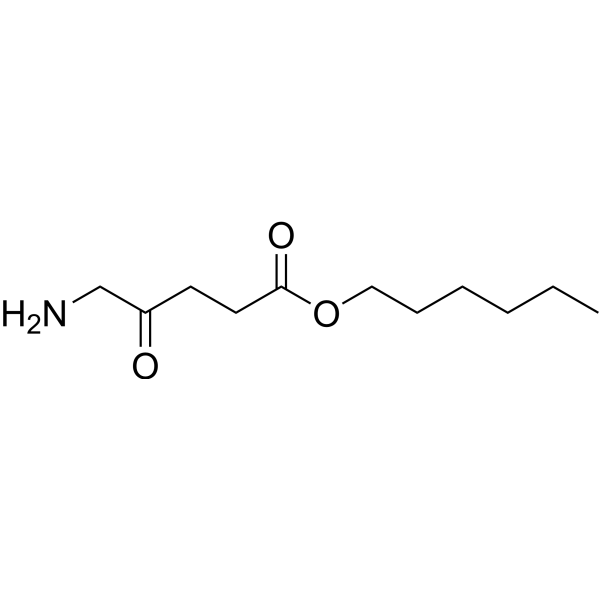
Physicochemical Properties
| Molecular Formula | C11H21NO3 |
| Molecular Weight | 215.29 |
| Exact Mass | 215.152 |
| CAS # | 140898-97-1 |
| PubChem CID | 6433083 |
| Appearance | Typically exists as solid at room temperature |
| Density | 1.004 g/cm3 |
| Boiling Point | 313.2ºC at 760 mmHg |
| Flash Point | 112.6ºC |
| LogP | 2.118 |
| Hydrogen Bond Donor Count | 1 |
| Hydrogen Bond Acceptor Count | 4 |
| Rotatable Bond Count | 10 |
| Heavy Atom Count | 15 |
| Complexity | 192 |
| Defined Atom Stereocenter Count | 0 |
| InChi Key | RYQOILLJDKPETL-UHFFFAOYSA-N |
| InChi Code | InChI=1S/C11H21NO3/c1-2-3-4-5-8-15-11(14)7-6-10(13)9-12/h2-9,12H2,1H3 |
| Chemical Name | hexyl 5-amino-4-oxopentanoate |
| Synonyms | HAL |
| HS Tariff Code | 2934.99.9001 |
| Storage |
Powder-20°C 3 years 4°C 2 years In solvent -80°C 6 months -20°C 1 month |
| Shipping Condition | Room temperature (This product is stable at ambient temperature for a few days during ordinary shipping and time spent in Customs) |
Biological Activity
| ln Vivo | Hexyl 5-aminolevulinate (8 mM, 1 hour intravesical infusion; 20 J/cm2, 635 nm, 2 hours duration) reduces tumor size in a rat bladder cancer model [1]. |
| ADME/Pharmacokinetics |
Absorption, Distribution and Excretion Absolute bioavailability 7% (90% confidence interval [CI]: 5%-10%) Metabolism / Metabolites Rapid metabolism in human blood. Biological Half-Life Biphasic elimination, with an initial elimination half-life of 39 minutes, followed by a terminal half-life of approximately 76 hours. |
| Toxicity/Toxicokinetics |
Effects During Pregnancy and Lactation ◉ Summary of Use during Lactation No information is available on the clinical use of hexaminolevulinate during breastfeeding. After instillation into the bladder, only about 7% of a dose is absorbed into the maternal bloodstream, so the amount of drug excreted into milk is expected to be minimal. Until more data become available, hexaminolevulinate should be used with caution during breastfeeding, especially while nursing a newborn or preterm infant. ◉ Effects in Breastfed Infants Relevant published information was not found as of the revision date. ◉ Effects on Lactation and Breastmilk Relevant published information was not found as of the revision date. Protein Binding No evidence of significant binding. |
| References |
[1]. Monitoring of hexyl 5-aminolevulinate-induced photodynamic therapy in rat bladder cancer by optical spectroscopy. J Biomed Opt. 2008 Jul-Aug;13(4):044031. |
| Additional Infomation |
5-aminolevulinic acid hexyl ester is an organonitrogen compound and an organooxygen compound. It is functionally related to a delta-amino acid. Hexaminolevulinate is an optical imaging drug. In solution form it is instilled intravesically for use with photodynamic blue light cystoscopy as an adjunct to white light cystoscopy. On May 28, 2010, the U.S. Food and Drug Administration (FDA) granted approval for hexaminolevulinate hydrochloride (Cysview for Intravesical Solution, Photocure ASA), as an optical imaging agent for use in combination with the Karl Storz Photodynamic Diagnostic D-Light C (PDD) System for cystoscopic detection of non-muscle invasive papillary cancer of the bladder for patients suspected or known to have lesion(s) on the basis of a prior cystoscopy. Hexaminolevulinate is manufactured under the brand Cysview® by Photocure ASA. In Europe, Hexaminolevulinate is marketed under the brand Hexvix®. Hexaminolevulinate is the hexyl ester of 5-aminolevulinic acid (ALA) with photodynamic properties. As a precursor of photoactive porphorins, hexyl 5-aminolevulinate induces the endogenous production of the photosensitizer protoporphyrin IX (PPIX) which accumulates selectively in tumor tissue. When exposed to specific wavelengths of light, PPIX is activated and, depending on the wavelength and/or intensity of light, either fluoresces, thereby allowing tumor imaging, or induces tumor cell apoptosis. See also: Hexaminolevulinate Hydrochloride (has salt form). Drug Indication Hexaminolevulinate is indicated for use in the cystoscopic detection of non-muscle invasive papillary cancer of the bladder among patients suspected or known to have lesion(s) on the basis of a prior cystoscopy. FDA Label Diagnosis of bladder cancer , Treatment of cervical dysplasia Mechanism of Action Hexaminolevulinate is an ester of the heme precursor, aminolevulinic acid. After bladder instillation, hexaminolevulinate enters the bladder mucosa and is proposed to enter the intracellular space of mucosal cells where it is used as a precursor in the formation of the photoactive intermediate protoporphyrin IX (PpIX) and other photoactive porphyrins (PAPs). PpIX and PAPs are reported to accumulate preferentially in neoplastic cells as compared to normal urothelium, partly due to altered enzymatic activity in the neoplastic cells. After excitation with light at wavelengths between 360 and 450 nm, PpIX and other PAPs return to a lower energy level by fluorescing, which can be detected and used for cystoscopic detection of lesions. The fluorescence from tumor tissue appears bright red and demarcated, whereas the background normal tissue appears dark blue. Similar processes may occur in inflamed cells. Pharmacodynamics In vitro studies have shown increased porphyrin fluorescence in normal urothelium after exposure to hexaminolevulinate hydrochloride intravesical solution. In the human bladder, a greater accumulation of porphyrins is proposed in neoplastic or inflamed cells, compared to normal urothelium. After bladder instillation of hexaminolevulinate hydrochloride intravesical solution for approximately 1 hour and subsequent illumination with blue light at wavelengths 360 – 450nm, the porphyrins will fluoresce red. |
Solubility Data
| Solubility (In Vitro) | May dissolve in DMSO (in most cases), if not, try other solvents such as H2O, Ethanol, or DMF with a minute amount of products to avoid loss of samples |
| Solubility (In Vivo) |
Note: Listed below are some common formulations that may be used to formulate products with low water solubility (e.g. < 1 mg/mL), you may test these formulations using a minute amount of products to avoid loss of samples. Injection Formulations (e.g. IP/IV/IM/SC) Injection Formulation 1: DMSO : Tween 80: Saline = 10 : 5 : 85 (i.e. 100 μL DMSO stock solution → 50 μL Tween 80 → 850 μL Saline) *Preparation of saline: Dissolve 0.9 g of sodium chloride in 100 mL ddH ₂ O to obtain a clear solution. Injection Formulation 2: DMSO : PEG300 :Tween 80 : Saline = 10 : 40 : 5 : 45 (i.e. 100 μL DMSO → 400 μLPEG300 → 50 μL Tween 80 → 450 μL Saline) Injection Formulation 3: DMSO : Corn oil = 10 : 90 (i.e. 100 μL DMSO → 900 μL Corn oil) Example: Take the Injection Formulation 3 (DMSO : Corn oil = 10 : 90) as an example, if 1 mL of 2.5 mg/mL working solution is to be prepared, you can take 100 μL 25 mg/mL DMSO stock solution and add to 900 μL corn oil, mix well to obtain a clear or suspension solution (2.5 mg/mL, ready for use in animals). Injection Formulation 4: DMSO : 20% SBE-β-CD in saline = 10 : 90 [i.e. 100 μL DMSO → 900 μL (20% SBE-β-CD in saline)] *Preparation of 20% SBE-β-CD in Saline (4°C,1 week): Dissolve 2 g SBE-β-CD in 10 mL saline to obtain a clear solution. Injection Formulation 5: 2-Hydroxypropyl-β-cyclodextrin : Saline = 50 : 50 (i.e. 500 μL 2-Hydroxypropyl-β-cyclodextrin → 500 μL Saline) Injection Formulation 6: DMSO : PEG300 : castor oil : Saline = 5 : 10 : 20 : 65 (i.e. 50 μL DMSO → 100 μLPEG300 → 200 μL castor oil → 650 μL Saline) Injection Formulation 7: Ethanol : Cremophor : Saline = 10: 10 : 80 (i.e. 100 μL Ethanol → 100 μL Cremophor → 800 μL Saline) Injection Formulation 8: Dissolve in Cremophor/Ethanol (50 : 50), then diluted by Saline Injection Formulation 9: EtOH : Corn oil = 10 : 90 (i.e. 100 μL EtOH → 900 μL Corn oil) Injection Formulation 10: EtOH : PEG300:Tween 80 : Saline = 10 : 40 : 5 : 45 (i.e. 100 μL EtOH → 400 μLPEG300 → 50 μL Tween 80 → 450 μL Saline) Oral Formulations Oral Formulation 1: Suspend in 0.5% CMC Na (carboxymethylcellulose sodium) Oral Formulation 2: Suspend in 0.5% Carboxymethyl cellulose Example: Take the Oral Formulation 1 (Suspend in 0.5% CMC Na) as an example, if 100 mL of 2.5 mg/mL working solution is to be prepared, you can first prepare 0.5% CMC Na solution by measuring 0.5 g CMC Na and dissolve it in 100 mL ddH2O to obtain a clear solution; then add 250 mg of the product to 100 mL 0.5% CMC Na solution, to make the suspension solution (2.5 mg/mL, ready for use in animals). Oral Formulation 3: Dissolved in PEG400 Oral Formulation 4: Suspend in 0.2% Carboxymethyl cellulose Oral Formulation 5: Dissolve in 0.25% Tween 80 and 0.5% Carboxymethyl cellulose Oral Formulation 6: Mixing with food powders Note: Please be aware that the above formulations are for reference only. InvivoChem strongly recommends customers to read literature methods/protocols carefully before determining which formulation you should use for in vivo studies, as different compounds have different solubility properties and have to be formulated differently. (Please use freshly prepared in vivo formulations for optimal results.) |
| Preparing Stock Solutions | 1 mg | 5 mg | 10 mg | |
| 1 mM | 4.6449 mL | 23.2245 mL | 46.4490 mL | |
| 5 mM | 0.9290 mL | 4.6449 mL | 9.2898 mL | |
| 10 mM | 0.4645 mL | 2.3224 mL | 4.6449 mL |