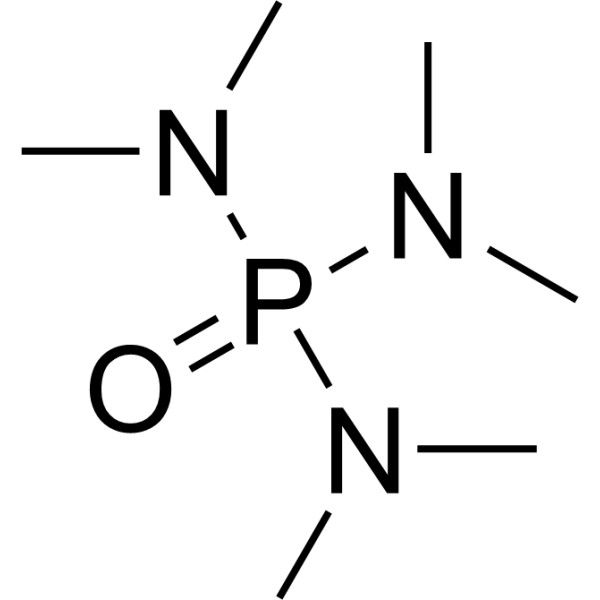
Physicochemical Properties
| Molecular Formula | C6H18N3OP |
| Molecular Weight | 179.20 |
| Exact Mass | 179.119 |
| CAS # | 680-31-9 |
| PubChem CID | 12679 |
| Appearance |
COLORLESS, MOBILE LIQUID Clear, colorless liquid [Note: A solid below 43 degrees F]. |
| Density | 1.03 g/mL at 25 °C(lit.) |
| Boiling Point | 230-232 °C740 mm Hg(lit.) |
| Melting Point | 7 °C(lit.) |
| Flash Point | 222 °F |
| Vapour Pressure | 0.07 mm Hg ( 25 °C) |
| Index of Refraction | n20/D 1.459(lit.) |
| LogP | 0.779 |
| Hydrogen Bond Donor Count | 0 |
| Hydrogen Bond Acceptor Count | 4 |
| Rotatable Bond Count | 3 |
| Heavy Atom Count | 11 |
| Complexity | 139 |
| Defined Atom Stereocenter Count | 0 |
| InChi Key | GNOIPBMMFNIUFM-UHFFFAOYSA-N |
| InChi Code | InChI=1S/C6H18N3OP/c1-7(2)11(10,8(3)4)9(5)6/h1-6H3 |
| Chemical Name | N-[bis(dimethylamino)phosphoryl]-N-methylmethanamine |
| Synonyms | HMPA |
| HS Tariff Code | 2934.99.9001 |
| Storage |
Powder-20°C 3 years 4°C 2 years In solvent -80°C 6 months -20°C 1 month |
| Shipping Condition | Room temperature (This product is stable at ambient temperature for a few days during ordinary shipping and time spent in Customs) |
Biological Activity
| ADME/Pharmacokinetics |
Absorption, Distribution and Excretion SEVENTY PERCENT OF (32)P-LABELED HEXAMETHYLPHOSPHORAMIDE GIVEN IP WAS EXCRETED WITHIN 20 HR BY RATS & MICE AS (32)P. HEXAMETHYLPHOSPHORAMIDE IS EXCRETED IN MILK OF COWS FOLLOWING ITS ORAL ADMIN. Metabolism / Metabolites IN RATS & MICE, HEXAMETHYLPHOSPHORAMIDE UNDERGOES A SEQUENCE OF N-DEMETHYLATION REACTIONS TO YIELD PENTAMETHYLPHOSPHORAMIDE, N',N',N'',N'''-TETRAMETHYLPHOSPHORAMIDE & N', N'',N''-TRIMETHYLPHOSPHORAMIDE. IN VITRO STUDIES WITH RAT LIVER SLICES INDICATED OXIDATIVE DEMETHYLATION, WITH SIMULTANEOUS FORMATION OF FORMALDEHYDE. The metabolism of hexamethylphosphoramide (HMPA), aminopyrine, ethoxycoumarin, ethoxyrsorufin, and pentoxyresorufin, by the monooxygenase cytochrome p450 dependent system, was studied in microsomes from nasal epithelial membranes and liver tissue of Sprague-Dawley rats. Nasal metabolism rates for the different substrates ranged from 9% of liver values for aminopyrine to 83% for ethoxycoumarin. HMPA-demethylase activity followed Michaelis-Menten kinetics in nasal mucosa microsomes but was biphasic in those from liver. SKF 525A, metyrapone, dioxolane and alpha-naphthoflavone (ANF), inhibitors of various p450 monoxygenase, were examined with regard to inhibition of nasal and liver ethoxycoumarin deethylase. In addition, activity of epoxide hydrolase, glutathione S-transferase, DT-diaphorase and UDP-glucuronyltransferase (UDP-GT) in nasal tissue homogenates were investigated. These activities were lower than those present in the liver. Various attempts to increase the activity of oxidative enzymes in nasal tissue by PB, 3-MC and ethanol failed, 3-MC and PB doubled the microsomal UDP-GT and the epoxide hydrolase activities. The results together with data from the literature sugggest that the balance between p450 isozymes and detoxifying enzymes differs in the nose compared with the liver. The activities of these enzymes in nasal tissue of different strains of rats also varies substantially with implications regarding the metabolic fate and activation of inhaled xenobiotics. Two unique forms of cytochrome p450 (p450), designated NMa and NMb, were recently isolated in this laboratory from nasal microsomes of rabbits. In the present study, polyclonal antibodies to the pruified nasal cytochrome were prepared. Immunochemical analysis with specific rabbit anti-NMa and sheep anti-NMb antibodies indicated that p450 isozymes identical to or having a high structural homology with NMa are present in both olfactory and respiratory mucosa, as well as in liver, but NMb was detected only in the olfactory mucosa. Neither form was detected in other tissues examined, including brain, esophageal mucosa, heart, intestinal mucosa, kidney, and lung. The specific occurrence of NMb in the olfactory mucosa was further substantiated by the detection and specific inhibition by anti-NMb of the formation of unique NMb-dependent metabolites of testosterone in olfactory microsomes but not in microsomes from liver or respiratory mucosa. Similar experiments with antibody to previously purified rabbit hepatic p450 isozymes indicated that not all of the hepatic cytochromes are expressed in the nasal tissues. Thus, p450 isozymes structurally homologous to hepatic forms 2, 3a, and 4, but not 3b and 6, were found in the olfactory mucosa. On the other hand, only form 2 was detected in the respiratory mucosa. Immunoquantitation experiments revealed that NMa nd NMb are the major p450 forms in olfactory microsomes, whereas NMa and P450 form 2 (or its homolog) constitute the major portion of the respiratory nasal microsomal p450. The level of NMa in the liver is relatively low, accounting for less than 3% of total microsomal p450 in this tissue. In addition, evidence is provided that NMa is the major catalyst in the dealkylation of two nasal carcinogens, hexamethylphosphoramide and phenacetin, in both olfactory and respiratory nasal microsomes. Possible roles of chtochrome p450 monooxygenases in nasal tissues are discussed. Nasal cytochrome p450 is known to occur in dogs, rats, monkeys mice, guinea pigs, and Syrian hamsters, and possible other species. The concentrations of cytochrome p450 in the olfactory mucosa of monkeys, dogs, and rats is much higher than in the nasal rspiratory mucosa. The substrate specificity of nasal cytochrome p450 is different from that of the liver. For example, whereas liver cytochrome p450 oxidizes benoz(a)pyrene faster than nasal cytochrome, the reverse is true for hexamethylphosphoramide (HMPA). Nasal cytochrome p450 may be involved in producing toxic or carcinogenic metabolites from inhaled compounds. For exampe, HMPA may be demethylated to formaldehyde by nasal cytochrome p450. Nasal cytochrome p450 may have a role in protecting lungs, since nasal metabolism of inhaled organic vapors can reduce the concentration of the vapors reaching the lungs. Nasal cytochrome p450 may help maintain acuity of the sense of smell through removal of odorants by metabolizing them. Without this function, odorants remaining in the mucus covering of the sensory organs might produce an unacceptably high background odor, thereby decreasing acuity. In species that are highly dependent on the sense of smell, the lack of olfactory acuity could have serious debilitating effects. Hexamethylphosphoramide has known human metabolites that include Pentamethylphosphoramide. |
| Toxicity/Toxicokinetics |
Toxicity Data LCLo (rat) = 2,920 mg/m3/4h Interactions A series of six alkyl-substituted dioxolanes were studied for their inhibitory effects on mono-oxygenase activities in vitro with nasal and hepatic microsomes from rats and rabbits. Carbon monoxide binding and hexamethylphosphoramide (HMPA) N-demethyase activity were most susceptible to inhibition by the test compounds. Inhibition of HMPA N-demethylase activity in both nasal and liver microsomes increased with lipophilicity of the inhibiting compound. In olfactory mucosa, the bulk of the substiturent at the 4-position also seemed to have an effect on inhibition. Mono-oxygenase activity in the nasal mucosa was inhibited more readily than that in the liver. Eighteen methylenedioxyphenyl compounds, including some commonly inhaled by people, were tested for the ability to inhibit rabbit nasal microsomal cytochrome p450 dependent hexamethylphosphoramide (HMPA) N-demethylase. For comparison, liver microsomes were also used. Nasal cytochrome p450 from rabbits metabolized methylenedioxyphenyl compounds to form cytochrome p450 metabolite (P-450-MI) complexes as indicated by differences spectra in the Soret region. Several of the methylenedioxyphenyl compounds were potent inhibitors of nasal p450 dependent -N-demethylase. If inhibition of nasal p450 also occurs in vivo after inhibiting MDP compounds are inhaled, the metabolism of concurrently or subsequently inhaled comppounds may be altered. |
| References |
[1]. Biochemical reagents[M]//Methods of Enzymatic Analysis. Academic Press, 1965: 967-1037. |
| Additional Infomation |
Hexamethylphosphoramide can cause cancer according to an independent committee of scientific and health experts. It can cause male reproductive toxicity according to The Environmental Protection Agency (EPA). Hexamethylphosphoramide is a clear colorless to light amber liquid with a spicy odor. (NTP, 1992) Hexamethylphosphoric triamide is a phosphoramide. It has a role as a mutagen and an insect sterilant. Hexamethylphosphoramide is no longer used in large quantities in the United States. No information is available on the acute (short-term), chronic (long-term), reproductive, developmental, or carcinogenic effects of hexamethylphosphoramide in humans. Acute animal studies have reported effects on the kidneys and lungs from oral exposure to hexamethylphosphoramide, while chronic oral studies in animals have reported an increased incidence of lung disease. An increased incidence of nasal tumors from inhalation exposure to hexamethylphosphoramide was reported in rats. EPA has not classified hexamethylphosphoramide for carcinogenicity; however, the International Agency for Research on Cancer (IARC) has classified it as a Group 2B, possible human carcinogen. Hexamethylphosphoramide is a clear, colorless liquid with an aromatic odor that emits toxic fumes of phosphorous oxides and nitrogen oxides when heated to decomposition. Hexamethylphosphoramide is used as a stabilizer against thermal degradation in polystyrene and is used as a solvent in research laboratories. Exposure to this substance irritates the eyes, skin and respiratory-tract. Hexamethylphosphoramide is reasonably anticipated to be a human carcinogen based on evidence of carcinogenicity in experimental animals. (NCI05) A chemosterilant agent that is anticipated to be a carcinogen. |
Solubility Data
| Solubility (In Vitro) | May dissolve in DMSO (in most cases), if not, try other solvents such as H2O, Ethanol, or DMF with a minute amount of products to avoid loss of samples |
| Solubility (In Vivo) |
Note: Listed below are some common formulations that may be used to formulate products with low water solubility (e.g. < 1 mg/mL), you may test these formulations using a minute amount of products to avoid loss of samples. Injection Formulations (e.g. IP/IV/IM/SC) Injection Formulation 1: DMSO : Tween 80: Saline = 10 : 5 : 85 (i.e. 100 μL DMSO stock solution → 50 μL Tween 80 → 850 μL Saline) *Preparation of saline: Dissolve 0.9 g of sodium chloride in 100 mL ddH ₂ O to obtain a clear solution. Injection Formulation 2: DMSO : PEG300 :Tween 80 : Saline = 10 : 40 : 5 : 45 (i.e. 100 μL DMSO → 400 μLPEG300 → 50 μL Tween 80 → 450 μL Saline) Injection Formulation 3: DMSO : Corn oil = 10 : 90 (i.e. 100 μL DMSO → 900 μL Corn oil) Example: Take the Injection Formulation 3 (DMSO : Corn oil = 10 : 90) as an example, if 1 mL of 2.5 mg/mL working solution is to be prepared, you can take 100 μL 25 mg/mL DMSO stock solution and add to 900 μL corn oil, mix well to obtain a clear or suspension solution (2.5 mg/mL, ready for use in animals). Injection Formulation 4: DMSO : 20% SBE-β-CD in saline = 10 : 90 [i.e. 100 μL DMSO → 900 μL (20% SBE-β-CD in saline)] *Preparation of 20% SBE-β-CD in Saline (4°C,1 week): Dissolve 2 g SBE-β-CD in 10 mL saline to obtain a clear solution. Injection Formulation 5: 2-Hydroxypropyl-β-cyclodextrin : Saline = 50 : 50 (i.e. 500 μL 2-Hydroxypropyl-β-cyclodextrin → 500 μL Saline) Injection Formulation 6: DMSO : PEG300 : castor oil : Saline = 5 : 10 : 20 : 65 (i.e. 50 μL DMSO → 100 μLPEG300 → 200 μL castor oil → 650 μL Saline) Injection Formulation 7: Ethanol : Cremophor : Saline = 10: 10 : 80 (i.e. 100 μL Ethanol → 100 μL Cremophor → 800 μL Saline) Injection Formulation 8: Dissolve in Cremophor/Ethanol (50 : 50), then diluted by Saline Injection Formulation 9: EtOH : Corn oil = 10 : 90 (i.e. 100 μL EtOH → 900 μL Corn oil) Injection Formulation 10: EtOH : PEG300:Tween 80 : Saline = 10 : 40 : 5 : 45 (i.e. 100 μL EtOH → 400 μLPEG300 → 50 μL Tween 80 → 450 μL Saline) Oral Formulations Oral Formulation 1: Suspend in 0.5% CMC Na (carboxymethylcellulose sodium) Oral Formulation 2: Suspend in 0.5% Carboxymethyl cellulose Example: Take the Oral Formulation 1 (Suspend in 0.5% CMC Na) as an example, if 100 mL of 2.5 mg/mL working solution is to be prepared, you can first prepare 0.5% CMC Na solution by measuring 0.5 g CMC Na and dissolve it in 100 mL ddH2O to obtain a clear solution; then add 250 mg of the product to 100 mL 0.5% CMC Na solution, to make the suspension solution (2.5 mg/mL, ready for use in animals). Oral Formulation 3: Dissolved in PEG400 Oral Formulation 4: Suspend in 0.2% Carboxymethyl cellulose Oral Formulation 5: Dissolve in 0.25% Tween 80 and 0.5% Carboxymethyl cellulose Oral Formulation 6: Mixing with food powders Note: Please be aware that the above formulations are for reference only. InvivoChem strongly recommends customers to read literature methods/protocols carefully before determining which formulation you should use for in vivo studies, as different compounds have different solubility properties and have to be formulated differently. (Please use freshly prepared in vivo formulations for optimal results.) |
| Preparing Stock Solutions | 1 mg | 5 mg | 10 mg | |
| 1 mM | 5.5804 mL | 27.9018 mL | 55.8036 mL | |
| 5 mM | 1.1161 mL | 5.5804 mL | 11.1607 mL | |
| 10 mM | 0.5580 mL | 2.7902 mL | 5.5804 mL |