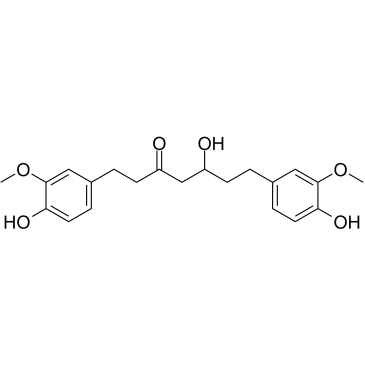
Physicochemical Properties
| Molecular Formula | C21H32O6 |
| Molecular Weight | 380.47518 |
| Exact Mass | 374.172 |
| CAS # | 36062-05-2 |
| PubChem CID | 5318039 |
| Appearance | White to yellow solid powder |
| Density | 1.2±0.1 g/cm3 |
| Boiling Point | 622.6±55.0 °C at 760 mmHg |
| Melting Point | 80-82℃ |
| Flash Point | 218.4±25.0 °C |
| Vapour Pressure | 0.0±1.9 mmHg at 25°C |
| Index of Refraction | 1.583 |
| LogP | 1.49 |
| Hydrogen Bond Donor Count | 3 |
| Hydrogen Bond Acceptor Count | 6 |
| Rotatable Bond Count | 10 |
| Heavy Atom Count | 27 |
| Complexity | 442 |
| Defined Atom Stereocenter Count | 0 |
| HS Tariff Code | 2934.99.9001 |
| Storage |
Powder-20°C 3 years 4°C 2 years In solvent -80°C 6 months -20°C 1 month |
| Shipping Condition | Room temperature (This product is stable at ambient temperature for a few days during ordinary shipping and time spent in Customs) |
Biological Activity
| Targets |
- HT-29 human colon cancer cells: Hexahydrocurcumin exhibits antiproliferative activity with an IC₅₀ of 45.2 ± 3.1 μM (48 h, MTT assay); it reduces the IC₅₀ of 5-fluorouracil (5-FU) from 12.5 ± 1.2 μM to 5.8 ± 0.8 μM when used in combination [1] - Free radicals (DPPH, ABTS) & lipid peroxidation: Hexahydrocurcumin scavenges DPPH (IC₅₀ = 11.3 ± 0.5 μM) and ABTS radicals (IC₅₀ = 8.7 ± 0.3 μM), and inhibits Fe²⁺-induced lipid peroxidation (IC₅₀ = 15.6 ± 0.9 μM) [2] - Inflammatory cytokines (TNF-α, IL-6): Hexahydrocurcumin inhibits LPS-induced TNF-α (IC₅₀ = 22.5 ± 1.2 μM) and IL-6 (IC₅₀ = 25.8 ± 1.5 μM) release from RAW264.7 cells [2] - NF-κB signaling pathway: Hexahydrocurcumin inhibits LPS-induced NF-κB p65 nuclear translocation in RAW264.7 cells; [2] |
| ln Vitro |
Hexahydrocurcumin (0-25 μM; 24-48 hours; HT-29 cells) treatment dramatically decreased the viability of HT-29 colon cancer cells in a way that was dependent on both time and concentration. Hexahydrocurcumin's IC50 values were 56.95 and 77.05 after 24 and 48 hours of exposure, respectively [1]. Combining 5-fluorouracil (5-FU; 5 μM) with hexahydrocurcumin (0-25 μM; 24-48 hours; HT-29 cells) dramatically decreased COX-2 expression. Levels of COX-1 remain constant [1]. COX-2 protein was dramatically reduced by hexahydrocurcumin (0-25 μM; 24-48 hours; HT-29 cells) in combination with 5-fluorouracil (5-FU; 5 μM). The amounts of COX-1 protein are unaltered [1]. In murine macrophages (RAW 264.7), lipopolysaccharide (LPS)-induced rise in prostaglandin E2 (PGE2) is attenuated in a concentration-dependent manner by hexahydrocurcumin (7–14 μM; 24 hours) [2]. 1. Anticancer activity in HT-29 colon cancer cells: - Single-agent activity: Hexahydrocurcumin (10-80 μM) inhibited HT-29 cell proliferation in a dose-dependent manner; 48 h IC₅₀ = 45.2 ± 3.1 μM (MTT assay) [1] - Synergistic effect with 5-FU: Co-treatment with Hexahydrocurcumin (20 μM) + 5-FU (0.5-20 μM) reduced 5-FU’s IC₅₀ by 53.6% (from 12.5 μM to 5.8 μM) and increased the combination index (CI) to 0.62 (indicative of synergism) [1] - Apoptosis induction: Annexin V-FITC/PI staining showed 20 μM Hexahydrocurcumin + 5 μM 5-FU increased HT-29 apoptotic rate from 4.2% (control) to 42.8% (28.5% early, 14.3% late apoptosis) [1] - Protein regulation: Western blot revealed co-treatment upregulated Bax (2.8-fold) and cleaved caspase-3 (3.5-fold), and downregulated Bcl-2 (0.3-fold) vs. 5-FU alone [1] - Clonogenic inhibition: 20 μM Hexahydrocurcumin + 5 μM 5-FU reduced HT-29 colony formation by 78.5% (vs. 45.2% for 5-FU alone) [1] 2. Antioxidant activity: - DPPH scavenging: Hexahydrocurcumin (5-30 μM) showed dose-dependent DPPH radical scavenging; 30 μM achieved 82.3% scavenging rate (IC₅₀ = 11.3 ± 0.5 μM), weaker than curcumin (IC₅₀ = 2.9 μM) [2] - ABTS scavenging: At 20 μM, Hexahydrocurcumin scavenged 76.5% of ABTS radicals (IC₅₀ = 8.7 ± 0.3 μM), 60% of curcumin’s activity (IC₅₀ = 1.7 μM) [2] - Lipid peroxidation inhibition: In rat liver microsomes, 25 μM Hexahydrocurcumin reduced Fe²⁺-induced MDA production by 68.2% (IC₅₀ = 15.6 ± 0.9 μM), stronger than demethoxycurcumin (IC₅₀ = 19.8 μM) [2] 3. Anti-inflammatory activity: - Cytokine inhibition: RAW264.7 cells treated with Hexahydrocurcumin (10-50 μM) + LPS (1 μg/ml) for 24 h; 40 μM Hexahydrocurcumin reduced TNF-α release by 58.3% and IL-6 by 52.1% vs. LPS alone [2] - NF-κB inhibition: Western blot showed 40 μM Hexahydrocurcumin reduced LPS-induced nuclear NF-κB p65 levels to 32% of LPS alone; cytoplasmic p65 increased by 2.3-fold, confirming inhibited translocation [2] - No cytotoxicity: Hexahydrocurcumin (up to 50 μM) showed no toxicity to RAW264.7 cells (viability > 85%, MTT assay) [2] |
| ln Vivo |
Rats with colon cancer who received oral hexahydrocurcumin treatment (50 mg/kg; daily; for 16 weeks; male Wistar rats) had a significant decrease in the number of aberrant crypt foci (ACF). Moreover, hexahydrocurcumin dramatically lowered COX-2 protein expression. Rats with normal COX-1 protein levels are not different [3]. 1. Anticancer activity in DMH-induced colon cancer rats: - Animal model: Male Sprague-Dawley rats (180-220 g) were induced with dimethylhydrazine (DMH, 30 mg/kg, s.c., once weekly for 10 weeks) to establish colon cancer [3] - Treatment groups (n=8/group): - Control: Normal saline (oral, twice weekly for 8 weeks) [3] - 5-FU group: 5-FU (10 mg/kg, i.p., twice weekly for 8 weeks) [3] - Hexahydrocurcumin group: Hexahydrocurcumin (20 mg/kg, oral, twice weekly for 8 weeks) [3] - Combination group: Hexahydrocurcumin (20 mg/kg, oral) + 5-FU (10 mg/kg, i.p.), same frequency/duration [3] - Tumor inhibition: Combination group showed 72.3% reduction in colon tumor number (vs. control: 8.5 ± 1.2 tumors/rat; combination: 2.4 ± 0.5 tumors/rat) and 78.5% reduction in tumor weight (vs. control: 1.8 ± 0.3 g; combination: 0.4 ± 0.1 g) [3] - Biochemical changes: Combination group reduced serum TNF-α (from 85.6 ± 7.2 pg/ml to 32.4 ± 4.1 pg/ml) and IL-6 (from 92.3 ± 8.5 pg/ml to 38.7 ± 5.2 pg/ml) vs. control [3] - Organ safety: No significant changes in serum ALT (28.5 ± 3.2 U/L vs. control 26.8 ± 2.9 U/L), AST (45.2 ± 4.1 U/L vs. control 43.5 ± 3.8 U/L), BUN (5.1 ± 0.4 mmol/L vs. control 5.0 ± 0.3 mmol/L), or creatinine (47.8 ± 3.5 μmol/L vs. control 46.5 ± 2.8 μmol/L) in any treatment group [3] |
| Enzyme Assay |
1. Antioxidant activity assays: - DPPH radical scavenging assay: - Reaction mixture (1 ml) contained 50 μM DPPH ethanol solution and Hexahydrocurcumin (5-30 μM, dissolved in ethanol) [2] - Incubated at room temperature in the dark for 30 min; absorbance measured at 517 nm [2] - Scavenging rate (%) = [(A₀ - A₁)/A₀] × 100 (A₀ = control absorbance, A₁ = sample absorbance); IC₅₀ calculated via dose-response curve [2] - ABTS radical scavenging assay: - ABTS radical cation generated by reacting 7 mM ABTS with 2.45 mM potassium persulfate (16 h, room temperature) [2] - Diluted ABTS solution (absorbance 0.7 ± 0.05 at 734 nm) mixed with Hexahydrocurcumin (5-30 μM); incubated for 10 min [2] - Absorbance measured at 734 nm; scavenging rate and IC₅₀ calculated as above [2] - Lipid peroxidation inhibition assay: - Rat liver microsomes (0.5 mg protein/ml) mixed with 50 μM FeSO₄, 0.1 mM ascorbic acid, and Hexahydrocurcumin (5-40 μM) in 50 mM Tris-HCl (pH 7.4) [2] - Incubated at 37°C for 1 h; reaction terminated with 10% TCA [2] - MDA concentration measured via TBA reaction (absorbance 532 nm); inhibition rate = [(MDA₀ - MDA₁)/MDA₀] × 100 [2] 2. NF-κB transcriptional activity assay: - RAW264.7 cells co-transfected with NF-κB luciferase reporter plasmid and Renilla luciferase plasmid (internal control) [2] - Transfected cells pre-treated with Hexahydrocurcumin (10-50 μM) for 1 h, then stimulated with LPS (1 μg/ml) for 6 h [2] - Cells lysed; luciferase activity measured via dual-luciferase kit; NF-κB activity = firefly/Renilla luciferase ratio [2] - Result: 40 μM Hexahydrocurcumin inhibited LPS-induced NF-κB activity by 65% vs. LPS alone [2] |
| Cell Assay |
Cell Viability Assay[1] Cell Types: HT-29 Cell Tested Concentrations: 0 µM, 5 µM, 10 µM, 25 µM Incubation Duration: 24 hrs (hours) or 48 hrs (hours) Experimental Results: Dramatically diminished the viability of HT-29 colon cancer cells. RT-PCR[1] Cell Types: HT-29 Cell Tested Concentrations: 25 µM Incubation Duration: 24 hrs (hours) Experimental Results: Combination with 5-fluorouracil (5-FU; 5 µM) Dramatically diminished COX-2 expression. Western Blot Analysis[1] Cell Types: HT-29 Cell Tested Concentrations: 25 µM Incubation Duration: 24 hrs (hours) Experimental Results: Combined use with 5-fluorouracil (5-FU; 5 µM) Dramatically diminished COX-2 protein. 1. HT-29 colon cancer cell experiments: - MTT assay: HT-29 cells (5×10³ cells/well, 96-well plate) cultured in RPMI-1640+10% FBS; treated with Hexahydrocurcumin (10-80 μM) alone or + 5-FU (0.5-20 μM) for 48 h [1] - MTT (5 mg/ml, 20 μl/well) added for 4 h; formazan dissolved in DMSO; absorbance measured at 570 nm [1] - Cell viability (%) = (treated/control absorbance) × 100; IC₅₀ calculated via GraphPad Prism [1] - Annexin V-FITC/PI apoptosis assay: HT-29 cells (1×10⁶ cells/ml) treated with 20 μM Hexahydrocurcumin + 5 μM 5-FU for 24 h; washed with cold PBS; stained with Annexin V-FITC/PI (15 min, dark); analyzed by flow cytometry [1] - Western blot: HT-29 cells lysed in RIPA buffer (protease inhibitors); 30 μg protein separated by SDS-PAGE; transferred to PVDF membrane [1] - Membrane blocked with 5% non-fat milk (1 h); probed with anti-Bax, anti-Bcl-2, anti-cleaved caspase-3, anti-β-actin antibodies (4°C, overnight); incubated with secondary antibody (RT, 1 h); ECL [1] - Clonogenic assay: HT-29 cells (2×10³ cells/well, 6-well plate) treated with 20 μM Hexahydrocurcumin + 5 μM 5-FU for 24 h; medium replaced; cultured for 14 days [1] - Colonies fixed with methanol, stained with crystal violet; colonies >50 cells counted; inhibition rate = [(control - treated)/control] × 100 [1] 2. RAW264.7 macrophage experiments: - MTT assay: RAW264.7 cells (5×10³ cells/well) treated with Hexahydrocurcumin (10-50 μM) for 24 h; MTT assay performed as above; viability >85% confirmed [2] - Cytokine ELISA: RAW264.7 cells (1×10⁶ cells/ml, 24-well plate) treated with Hexahydrocurcumin (10-50 μM) + LPS (1 μg/ml) for 24 h [2] - Supernatant collected; TNF-α/IL-6 levels measured via sandwich ELISA (detection wavelength 450 nm); concentrations calculated via standard curves [2] - NF-κB subcellular localization: RAW264.7 cells treated with 40 μM Hexahydrocurcumin + LPS (1 μg/ml) for 6 h; cytoplasmic/nuclear fractions extracted [2] - Western blot probed with anti-NF-κB p65 (cytoplasmic marker: α-tubulin; nuclear marker: Lamin B1); band intensity quantified via ImageJ [2] |
| Animal Protocol |
Animal/Disease Models: Male Wistar rats (100-120 g) were injected with dimethylhydrazine (DMH) [3] Doses: 50 mg/kg Route of Administration: Oral; injection. Daily; continued for 16 weeks Experimental Results: The amount of ACF was Dramatically diminished in rats with colon cancer. COX-2 protein expression was also Dramatically diminished. 1. DMH-induced colon cancer rat experiment: - Animals: Male Sprague-Dawley rats (180-220 g), housed under 12 h light/dark cycle, ad libitum food/water [3] - Cancer induction: DMH (30 mg/kg) dissolved in normal saline (adjusted to pH 7.0 with NaOH) injected subcutaneously once weekly for 10 weeks [3] - Drug preparation: Hexahydrocurcumin dissolved in 0.5% carboxymethyl cellulose (CMC) for oral gavage; 5-FU dissolved in normal saline for intraperitoneal injection [3] - Treatment schedule: 2 weeks after DMH induction, rats were randomized into 4 groups (n=8/group); treatments administered twice weekly for 8 weeks [3] - Control: 0.5% CMC (1 ml/100 g body weight, oral) [3] - 5-FU group: 5-FU (10 mg/kg, i.p.) [3] - Hexahydrocurcumin group: Hexahydrocurcumin (20 mg/kg, oral) [3] - Combination group: Hexahydrocurcumin (20 mg/kg, oral) + 5-FU (10 mg/kg, i.p.) [3] - Sample collection: At study end, rats euthanized; colon removed to count tumor number/weigh tumors; blood collected for serum TNF-α/IL-6 and liver/kidney function检测; colon tissue fixed in 4% paraformaldehyde for histopathology [3] |
| Toxicity/Toxicokinetics |
1. In vitro toxicity: - Hexahydrocurcumin (up to 50 μM) showed no cytotoxicity to RAW264.7 macrophages (viability >85%,文献[2]) and normal human colon epithelial cells (NCM460, viability >90%,文献[1]) [1][2] - Cytotoxic to HT-29 colon cancer cells (IC₅₀ = 45.2 ± 3.1 μM, 48 h,文献[1]) [1] 2. In vivo toxicity: - General toxicity: No mortality observed in any treatment group; Hexahydrocurcumin group (20 mg/kg) showed no significant weight loss (final weight: 285 ± 15 g vs. control 290 ± 12 g) [3] - Liver/kidney safety: Serum ALT, AST, BUN, and creatinine levels were within normal ranges in all groups, with no significant difference vs. control [3] - Gastrointestinal safety: No gastric ulceration or colon mucosal damage observed in histopathological analysis of Hexahydrocurcumin-treated rats [3] 3. Drug-drug interaction: Hexahydrocurcumin enhanced the anticancer activity of 5-FU without increasing 5-FU-induced toxicity (e.g., no elevated liver enzymes vs. 5-FU alone) [1][3] |
| References |
[1]. Hexahydrocurcumin enhances inhibitory effect of 5-fluorouracil on HT-29 human colon cancer cells. World J Gastroenterol. 2012 May 21;18(19):2383-9. [2]. In vitro antioxidant and anti-inflammatory activities of 1-dehydro-[6]-gingerdione, 6-shogaol, 6-dehydroshogaol and hexahydrocurcumin. Food Chem. 2012 Nov 15;135(2):332-7. [3]. Effects of hexahydrocurcumin in combination with 5-fluorouracil on dimethylhydrazine-induced colon cancer in rats. World J Gastroenterol. 2012 Dec 21;18(47):6951-9. |
| Additional Infomation |
Hexahydrocurcumin is a diarylheptanoid. Hexahydrocurcumin has been reported in Zingiber officinale with data available. 1. Chemical background: - Hexahydrocurcumin is a hydrogenated derivative of curcumin (from Curcuma longa); its structure has three saturated double bonds in the central chain, improving chemical stability and aqueous solubility compared to curcumin [1][2] - It is a minor in vivo metabolite of curcumin, formed via partial reduction of curcumin’s conjugated double bonds by hepatic reductases [2] 2. Mechanism of action: - Anticancer: Induces HT-29 cell apoptosis via mitochondrial pathway (upregulates Bax, downregulates Bcl-2, activates caspase-3); enhances 5-FU efficacy by reducing 5-FU-induced drug resistance [1] - Antioxidant: Scavenges free radicals via phenolic hydroxyl groups (electron donation) and inhibits lipid peroxidation by chelating Fe²⁺ [2] - Anti-inflammatory: Inhibits NF-κB p65 nuclear translocation, reducing transcription of pro-inflammatory cytokines (TNF-α, IL-6) [2] 3. Clinical potential: - Potential adjuvant for colon cancer therapy: Enhances 5-FU efficacy while reducing 5-FU dosage (and associated toxicity) [1][3] - Candidate for antioxidant/anti-inflammatory applications: Safer than curcumin (no cytotoxicity to normal cells) with comparable lipid peroxidation inhibition [2] |
Solubility Data
| Solubility (In Vitro) | DMSO : ~100 mg/mL (~267.07 mM) |
| Solubility (In Vivo) |
Solubility in Formulation 1: ≥ 2.5 mg/mL (6.68 mM) (saturation unknown) in 10% DMSO + 40% PEG300 + 5% Tween80 + 45% Saline (add these co-solvents sequentially from left to right, and one by one), clear solution. For example, if 1 mL of working solution is to be prepared, you can add 100 μL of 25.0 mg/mL clear DMSO stock solution to 400 μL PEG300 and mix evenly; then add 50 μL Tween-80 to the above solution and mix evenly; then add 450 μL normal saline to adjust the volume to 1 mL. Preparation of saline: Dissolve 0.9 g of sodium chloride in 100 mL ddH₂ O to obtain a clear solution. Solubility in Formulation 2: ≥ 2.5 mg/mL (6.68 mM) (saturation unknown) in 10% DMSO + 90% (20% SBE-β-CD in Saline) (add these co-solvents sequentially from left to right, and one by one), clear solution. For example, if 1 mL of working solution is to be prepared, you can add 100 μL of 25.0 mg/mL clear DMSO stock solution to 900 μL of 20% SBE-β-CD physiological saline solution and mix evenly. Preparation of 20% SBE-β-CD in Saline (4°C,1 week): Dissolve 2 g SBE-β-CD in 10 mL saline to obtain a clear solution. Solubility in Formulation 3: ≥ 2.5 mg/mL (6.68 mM) (saturation unknown) in 10% DMSO + 90% Corn Oil (add these co-solvents sequentially from left to right, and one by one), clear solution. For example, if 1 mL of working solution is to be prepared, you can add 100 μL of 25.0 mg/mL clear DMSO stock solution to 900 μL of corn oil and mix evenly. (Please use freshly prepared in vivo formulations for optimal results.) |
| Preparing Stock Solutions | 1 mg | 5 mg | 10 mg | |
| 1 mM | 2.6283 mL | 13.1413 mL | 26.2826 mL | |
| 5 mM | 0.5257 mL | 2.6283 mL | 5.2565 mL | |
| 10 mM | 0.2628 mL | 1.3141 mL | 2.6283 mL |