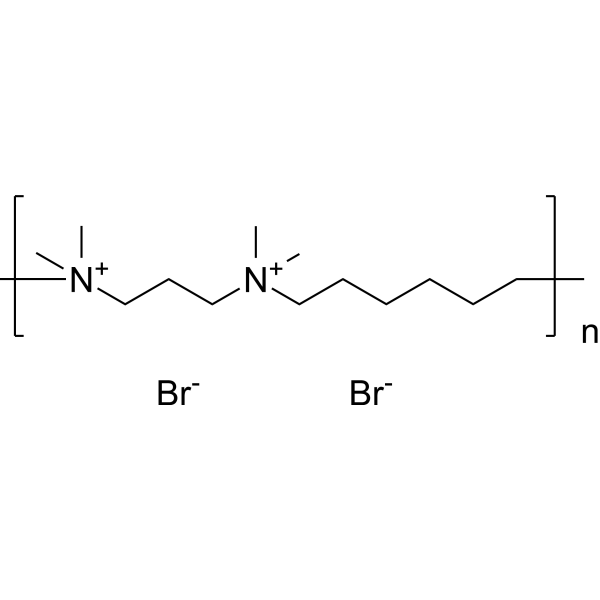
Physicochemical Properties
| Molecular Formula | C39H90BR6N6 |
| Molecular Weight | 1122.60000 |
| Exact Mass | 374.075 |
| CAS # | 28728-55-4 |
| Related CAS # | 9011-04-5 |
| PubChem CID | 24769 |
| Appearance | White to off-white solid powder |
| Boiling Point | 209.5ºC at 760 mmHg |
| Flash Point | 73.9ºC |
| Vapour Pressure | 0.202mmHg at 25°C |
| Hydrogen Bond Donor Count | 0 |
| Hydrogen Bond Acceptor Count | 2 |
| Rotatable Bond Count | 9 |
| Heavy Atom Count | 17 |
| Complexity | 90.2 |
| Defined Atom Stereocenter Count | 0 |
| InChi Key | KZKAYEGOIJEWQB-UHFFFAOYSA-N |
| InChi Code | InChI=1S/C10H24N2.C3H6Br2/c1-11(2)9-7-5-6-8-10-12(3)4;4-2-1-3-5/h5-10H2,1-4H3;1-3H2 |
| Chemical Name | 1,3-dibromopropane;N,N,N',N'-tetramethylhexane-1,6-diamine |
| HS Tariff Code | 2934.99.9001 |
| Storage |
Powder-20°C 3 years 4°C 2 years In solvent -80°C 6 months -20°C 1 month Note: Please store this product in a sealed and protected environment (e.g. under nitrogen), avoid exposure to moisture. |
| Shipping Condition | Room temperature (This product is stable at ambient temperature for a few days during ordinary shipping and time spent in Customs) |
Biological Activity
| ln Vitro |
Hexadimethrine bromide suppresses human mesenchymal stem cell growth during lentiviral transduction. Hexadimethonium bromide is considered harmless at low doses, but has been observed to negatively effect cell proliferation in specific cell types at concentrations greater than 10 µg/mL. When seen under a microscope, trypsin-treated cells exposed to hexamethylene bromide were substantially larger in size [1]. - Hexadimethrine bromide (also known as Polybrene) exhibited dose-dependent inhibitory activity against human mesenchymal stem cell (hMSC) proliferation. At concentrations of 0.5, 1, and 2 μg/mL, the cell proliferation rate was reduced by 15%, 32%, and 58%, respectively, compared to the control group. It did not induce significant apoptosis of hMSCs even at 2 μg/mL [1] - The compound enhanced the efficiency of liposome-mediated gene transfer in multiple cell lines (NIH3T3, HeLa, CHO). At 8 μg/mL, it increased the transfection efficiency by 2–5 folds compared to lipofection alone, without significant cytotoxicity [2] |
| Cell Assay |
- hMSC proliferation inhibition assay: hMSCs were seeded in 96-well plates at 5×10³ cells/well and incubated overnight. Hexadimethrine bromide was added at concentrations of 0.1, 0.5, 1, 2 μg/mL, and cells were cultured for 72 hours. Cell viability was measured by MTT assay, and apoptosis was detected by flow cytometry with Annexin V-FITC/PI staining [1] - Lipofection efficiency assay: Target cells (NIH3T3, HeLa, CHO) were seeded in 24-well plates at 2×10⁴ cells/well. Liposome-DNA complexes were prepared and mixed with Hexadimethrine bromide (2–16 μg/mL). The mixture was added to cells and incubated for 48 hours. Transfection efficiency was evaluated by measuring the activity of the reporter gene (luciferase) [2] |
| Toxicity/Toxicokinetics |
- Hexadimethrine bromide showed low cytotoxicity to hMSCs, with cell viability maintained above 90% at concentrations up to 2 μg/mL [1] - It did not cause significant cell death in NIH3T3, HeLa, or CHO cells at the optimal gene transfer concentration (8 μg/mL) [2] |
| References |
[1]. Polybrene inhibits human mesenchymal stem cell proliferation during lentiviral transduction. PLoS One. 2011;6(8):e23891. [2]. Polybrene increases the efficiency of gene transfer by lipofection. Gene Ther. 1998;5(5):708-711. |
| Additional Infomation |
Hexadimethrine bromide is a polymer. A synthetic polymer which agglutinates red blood cells. It is used as a heparin antagonist. See also: Hexadimethrine Bromide (annotation moved to). - Hexadimethrine bromide is a cationic polymer commonly used as an adjuvant for gene transfer [1][2] - Its mechanism of enhancing gene transfer may involve neutralizing the negative charges on cell membranes and liposomes, promoting their binding and internalization [2] - The inhibitory effect on hMSC proliferation is specific to mesenchymal stem cells, without inducing apoptotic cell death [1] |
Solubility Data
| Solubility (In Vitro) |
H2O : ~100 mg/mL DMSO : ~5 mg/mL |
| Solubility (In Vivo) |
Solubility in Formulation 1: ≥ 0.5 mg/mL (Infinity mM) (saturation unknown) in 10% DMSO + 40% PEG300 + 5% Tween80 + 45% Saline (add these co-solvents sequentially from left to right, and one by one), clear solution. For example, if 1 mL of working solution is to be prepared, you can add 100 μL of 5.0 mg/mL clear DMSO stock solution to 400 μL PEG300 and mix evenly; then add 50 μL Tween-80 to the above solution and mix evenly; then add 450 μL normal saline to adjust the volume to 1 mL. Preparation of saline: Dissolve 0.9 g of sodium chloride in 100 mL ddH₂ O to obtain a clear solution. Solubility in Formulation 2: ≥ 0.5 mg/mL (Infinity mM) (saturation unknown) in 10% DMSO + 90% (20% SBE-β-CD in Saline) (add these co-solvents sequentially from left to right, and one by one), clear solution. For example, if 1 mL of working solution is to be prepared, you can add 100 μL of 5.0 mg/mL clear DMSO stock solution to 900 μL of 20% SBE-β-CD physiological saline solution and mix evenly. Preparation of saline: Dissolve 0.9 g of sodium chloride in 100 mL ddH₂ O to obtain a clear solution. Solubility in Formulation 3: 0.5 mg/mL (Infinity mM) in 10% DMSO + 90% Corn Oil (add these co-solvents sequentially from left to right, and one by one), clear solution. For example, if 1 mL of working solution is to be prepared, you can add 100 μL of 5.0 mg/mL clear DMSO stock solution to 900 μL of corn oil and mix evenly. Solubility in Formulation 4: 100 mg/mL (Infinity mM) in PBS (add these co-solvents sequentially from left to right, and one by one), clear solution; with ultrasonication. (Please use freshly prepared in vivo formulations for optimal results.) |
| Preparing Stock Solutions | 1 mg | 5 mg | 10 mg | |
| 1 mM | 0.8908 mL | 4.4539 mL | 8.9079 mL | |
| 5 mM | 0.1782 mL | 0.8908 mL | 1.7816 mL | |
| 10 mM | 0.0891 mL | 0.4454 mL | 0.8908 mL |