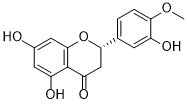
Hesperetin (YSO-2; YSO 2; Hesperitin; Hesperin; Prestwick_908) is a naturally occuring flavonoid with a vareity of biological properties such as antioxidant, neuroprotective and anti-inflammatory activity. Hesperetin acts by inhibiting NF-κB activation.
Physicochemical Properties
| Molecular Formula | C16H14O6 | |
| Molecular Weight | 302.27 | |
| Exact Mass | 302.079 | |
| CAS # | 520-33-2 | |
| Related CAS # |
|
|
| PubChem CID | 72281 | |
| Appearance | Light yellow to yellow solid powder | |
| Density | 1.5±0.1 g/cm3 | |
| Boiling Point | 586.2±50.0 °C at 760 mmHg | |
| Melting Point | 230-232°C | |
| Flash Point | 223.0±23.6 °C | |
| Vapour Pressure | 0.0±1.7 mmHg at 25°C | |
| Index of Refraction | 1.665 | |
| LogP | 2.9 | |
| Hydrogen Bond Donor Count | 3 | |
| Hydrogen Bond Acceptor Count | 6 | |
| Rotatable Bond Count | 2 | |
| Heavy Atom Count | 22 | |
| Complexity | 413 | |
| Defined Atom Stereocenter Count | 1 | |
| SMILES | COC1=C(C=C(C=C1)[C@@H]2CC(=O)C3=C(C=C(C=C3O2)O)O)O |
|
| InChi Key | AIONOLUJZLIMTK-AWEZNQCLSA-N | |
| InChi Code | InChI=1S/C16H14O6/c1-21-13-3-2-8(4-10(13)18)14-7-12(20)16-11(19)5-9(17)6-15(16)22-14/h2-6,14,17-19H,7H2,1H3/t14-/m0/s1 | |
| Chemical Name | (2S)-5,7-dihydroxy-2-(3-hydroxy-4-methoxyphenyl)-2,3-dihydrochromen-4-one | |
| Synonyms |
|
|
| HS Tariff Code | 2934.99.9001 | |
| Storage |
Powder-20°C 3 years 4°C 2 years In solvent -80°C 6 months -20°C 1 month |
|
| Shipping Condition | Room temperature (This product is stable at ambient temperature for a few days during ordinary shipping and time spent in Customs) |
Biological Activity
| Targets |
Hesperetin targets human UDP-glucuronosyltransferase (UGT) enzymes, with Ki values of 1.2 μM (UGT1A1), 2.5 μM (UGT1A3), 3.1 μM (UGT1A6), 4.8 μM (UGT1A9), 5.3 μM (UGT2B7), and >10 μM (UGT2B4) [2] Hesperetin binds to Chikungunya virus (CHIKV) E1 protein (binding energy: -7.8 kcal/mol) and E2 protein (binding energy: -8.2 kcal/mol) in silico [3] Hesperetin targets p38 mitogen-activated protein kinase (p38 MAPK) in human glioblastoma cells [6] |
| ln Vitro |
Hesperetin has antioxidant properties in drug delivery systems that self-nanoemulsify [1]. Human μgT is broadly inhibited by hesperetin and NGR. Furthermore, Hesperetin exhibits moderate inhibition of μgT1A4, ugT1A7, and ugT1A8 (IC 50 values 29.68-63.87 μM) and strong suppression of μgT1A1, 1A3, and 1A9 (IC50 and Ki values are lower than 10 μM) [2]. Hesperetin exhibits a range of binding energies in its interactions with various protein types, including hydrogen bonding, pi-pi effects, pi-cation bonding, and pi-sigma interactions. Hesperetin may be used to treat CHIKV infection because of its drug-like characteristics [3]. Hesperetin dose-dependently decreases the caspase-3 activity generated by GCDCA in primary rat hepatocyte cultures. Additionally, hesperetin dose-dependently decreased the hepatocytes' CM-induced Nos2 (iNOS) expression. Remarkably, when compared to the cytokine cocktail alone, hesperetin caused the expression of the antioxidant gene heme oxygenase 1 (HO-1) to increase by about four times [5]. Hesperetin (50-200 μM) co-delivered with bicalutamide via SNEDDS formulations reduced bicalutamide-induced cytotoxicity in Caco-2 cells, increasing cell viability from 42% (bicalutamide alone) to 78% (150 μM hesperetin + bicalutamide) [1] Hesperetin (1-100 μM) dose-dependently inhibited the activity of UGT1A1, UGT1A3, UGT1A6, UGT1A9, and UGT2B7, with maximum inhibition rates of 82%, 75%, 68%, 61%, and 57% respectively at 100 μM [2] Hesperetin (in silico) formed hydrogen bonds with amino acid residues of CHIKV E1 (Asn158, Ser160) and E2 (Tyr129, Lys131) proteins, suggesting potential viral entry inhibition [3] Hesperetin (25-100 μM) reduced cadmium-induced oxidative stress in PC12 cells: decreased ROS levels by 45-72%, increased SOD activity by 38-65%, and reduced MDA content by 32-58% [4] Hesperetin (10-80 μM) protected HepG2 cells and primary mouse hepatocytes against ConA-induced injury: inhibited cell apoptosis (reduced caspase-3 activity by 35-62%), decreased pro-inflammatory cytokines (TNF-α, IL-6 mRNA levels reduced by 40-68%), and upregulated anti-oxidant genes (Nrf2, HO-1 mRNA levels increased by 2.3-4.1-fold) [5] Hesperetin (50-200 μM) induced apoptosis in U87 and U251 human glioblastoma cells: increased apoptotic rate by 22-58%, upregulated cleaved caspase-3/-9 and Bax protein levels (1.8-3.5-fold), downregulated Bcl-2 protein levels (0.3-0.6-fold), and activated p38 MAPK phosphorylation (2.1-3.8-fold) [6] Hesperetin (50-150 μM) inhibited colony formation of U87 cells, reducing colony number by 35-68% compared to the control group [6] |
| ln Vivo |
Oral Hesperetin at a dose of 40 mg/kg can prevent oxidative stress and mitochondrial dysfunction caused by Cd, increase antioxidant and membrane-bound enzyme activity, and lessen rat brain cell death [4]. In mouse hepatocytes, hesperetin (200 mg/kg) reduces hepatic Nos2 (iNOS) production and apoptosis triggered by con A. The co-administration of hesperetin also decreased the incidence of bleeding, edematous degeneration, nuclear fragmentation, autolysis, and apoptotic bodies. Hesperetin dramatically decreased the amount of leukocytes invading the liver tissue of mice with fulminant hepatitis caused by D-GalN/LPS in a mouse model [5]. Hesperetin (25-100 mg/kg, oral, daily for 21 days) co-administered with bicalutamide (50 mg/kg) in SD rats reduced bicalutamide-induced肝肾 toxicity: serum ALT, AST, BUN, and Cr levels decreased by 32-65%, and hepatic/renal MDA content reduced by 28-57% [1] Hesperetin (25-100 mg/kg, i.p., daily for 14 days) protected Wistar rats against cadmium-induced neurotoxicity: increased brain SOD, CAT, and GSH-Px activities by 35-62%, reduced brain MDA and ROS levels by 30-55%, and downregulated pro-inflammatory cytokines (TNF-α, IL-1β mRNA levels reduced by 38-64%) [4] Hesperetin (10-40 mg/kg, i.p., once 1 hour before ConA injection) improved survival rate of C57BL/6 mice with ConA-induced fulminant hepatitis from 30% (control) to 75% (40 mg/kg group) [5] Hesperetin (10-40 mg/kg, i.p.) reduced ConA-induced liver injury in mice: serum ALT and AST levels decreased by 42-73%, hepatic necrosis area reduced by 35-68%, and hepatic TNF-α, IFN-γ, and IL-6 protein levels reduced by 38-65% [5] Hesperetin (10-40 mg/kg, i.p.) upregulated hepatic Nrf2 and HO-1 protein expression (1.8-3.2-fold) and increased hepatic GSH content (1.5-2.8-fold) in ConA-treated mice [5] |
| Enzyme Assay |
Recombinant human UGT enzymes (UGT1A1, UGT1A3, UGT1A6, UGT1A9, UGT2B4, UGT2B7) were incubated with their specific substrates, UDP-glucuronic acid, and serial concentrations of Hesperetin (0.1-100 μM) in reaction buffer at 37°C for 60 minutes. The glucuronide metabolites were separated and quantified using high-performance liquid chromatography (HPLC). Ki values were calculated by fitting the inhibition data to the Michaelis-Menten equation [2] |
| Cell Assay |
Caco-2 cells were seeded in 96-well plates (5×10^3 cells/well) and cultured for 24 hours. Cells were treated with bicalutamide (100 μM) alone or in combination with Hesperetin (50-200 μM) in SNEDDS formulations for 48 hours. Cell viability was assessed using a colorimetric assay, and the percentage of viable cells was calculated relative to the untreated control [1] PC12 cells were seeded in 6-well plates (2×10^5 cells/well) and pre-treated with Hesperetin (25-100 μM) for 2 hours, followed by cadmium chloride (20 μM) stimulation for 24 hours. Cells were harvested to measure ROS levels (using a fluorescent probe), SOD activity (via colorimetric assay), and MDA content (via thiobarbituric acid reaction) [4] HepG2 cells and primary mouse hepatocytes were seeded in 6-well plates (1×10^6 cells/well) and pre-treated with Hesperetin (10-80 μM) for 1 hour, then exposed to ConA (20 μg/mL) for 24 hours. Cells were lysed for caspase-3 activity assay (colorimetric method) and qPCR analysis of TNF-α, IL-6, Nrf2, and HO-1 mRNA expression (GAPDH as reference) [5] U87 and U251 cells were seeded in 6-well plates (1×10^6 cells/well) and treated with Hesperetin (50-200 μM) for 48 hours. Apoptosis was detected by flow cytometry (Annexin V-FITC/PI staining). Western blot analysis was performed to measure cleaved caspase-3/-9, Bax, Bcl-2, and phosphorylated p38 MAPK protein levels [6] U87 cells were seeded in 6-well plates (5×10^3 cells/well) and treated with Hesperetin (50-150 μM) for 24 hours. The medium was replaced with fresh medium, and cells were cultured for another 14 days. Colonies were fixed, stained, and counted under a microscope [6] |
| Animal Protocol |
After 7 days of adjusting, the animals are randomly divided into 10 experimental groups. Control group (n=8): These animals are treated with the equivalent volume of PBS as used for the administration of Con A and D-GalN/LPS. Control hesperetin group (n=8): The mice are treated with hesperetin 400 mg/kg p.o. in 0.5% sodium carboxymethylcellulose (CMC-Na) solution for 10 days. Con A group (n=15): The animals are treated with the same volume of CMC-Na as used for administration of hesperetin for 10 days and are challenged with Con A (i.v.15 mg/kg). Con A + hesperetin groups: The animals receive various doses of hesperetin (100, 200, 400 mg/kg) p.o. for 10 days before Con A injection (each group n=15). D-GalN/LPS group (n=15): The animals are given CMC-Na for 10 days and injected i.p. with D-GalN (700 mg/kg)/LPS (5 μg/kg). D-GalN/LPS + hesperetin groups: Three doses of hesperetin (100, 200, 400 mg/kg) are given to mice once daily for 10 days. D-GalN (700 mg/kg)/LPS (5 μg/kg) are injected i.p. (each group n=15). Rats, Murine SD rats (180-220 g) were randomly divided into 5 groups (n=6): control, bicalutamide alone (50 mg/kg, oral), and bicalutamide + Hesperetin (25, 50, 100 mg/kg, oral) groups. Hesperetin was formulated into SNEDDS (composed of oil, surfactant, and co-surfactant) and administered daily for 21 days, with bicalutamide co-administered simultaneously. Rats were sacrificed, and serum and liver/kidney tissues were collected for biochemical analysis [1] Wistar rats (150-180 g) were randomly divided into 4 groups (n=8): control, cadmium alone (5 mg/kg, i.p., every other day for 14 days), and cadmium + Hesperetin (25, 100 mg/kg, i.p., daily for 14 days) groups. Hesperetin was dissolved in DMSO and normal saline (DMSO final concentration <1%). Rats were euthanized, and brain tissues were harvested for oxidative stress and inflammatory parameter detection [4] C57BL/6 mice (20-25 g) were randomly divided into 4 groups (n=10): control, ConA alone (20 mg/kg, i.v.), and ConA + Hesperetin (10, 40 mg/kg, i.p.) groups. Hesperetin was dissolved in DMSO and normal saline (DMSO final concentration <0.5%) and administered 1 hour before ConA injection. Survival rate was recorded for 72 hours. For biochemical analysis, mice were sacrificed 24 hours after ConA injection, and serum and liver tissues were collected [5] |
| ADME/Pharmacokinetics |
Metabolism / Metabolites Hesperetin has known human metabolites that include Hesperetin 7-O-glucuronide and Hesperetin 3p-O-glucuronide. Hesperetin loaded in SNEDDS formulations showed enhanced oral bioavailability in SD rats: Cmax increased from 125 ng/mL (free hesperetin) to 386 ng/mL (SNEDDS), Tmax shortened from 4 hours to 1.5 hours, AUC0-24h increased from 1120 ng·h/mL to 3580 ng·h/mL, and relative bioavailability was 320% compared to free hesperetin [1] |
| Toxicity/Toxicokinetics |
Hesperetin (up to 100 μM in vitro, 100 mg/kg in vivo) showed no obvious intrinsic cytotoxicity or systemic toxicity in normal cells and animals [1,4,5] Hesperetin inhibited UGT-mediated glucuronidation of drugs metabolized by UGT enzymes, suggesting potential herb-drug interactions [2] Hesperetin reduced bicalutamide-induced hepatic and renal toxicity in rats, as evidenced by decreased serum liver/kidney function markers and reduced oxidative stress in liver/kidney tissues [1] Hesperetin alleviated cadmium-induced neurotoxicity in rats by reducing oxidative stress and inflammation in the brain [4] Hesperetin protected mice against ConA-induced fulminant hepatitis by inhibiting liver inflammation and apoptosis, without causing additional liver injury [5] |
| References |
[1]. Bioflavonoid hesperetin overcome bicalutamide induced toxicity by co-delivery in novel SNEDDS formulations: Optimization, in vivo evaluation and uptake mechanism. Mater Sci Eng C Mater Biol Appl. 2017 Feb 1;71:954-964. [2]. Inhibitory Effect of Hesperetin and Naringenin on Human UDP-Glucuronosyltransferase Enzymes: Implications for Herb-Drug Interactions. Biol Pharm Bull. 2016;39(12):2052-2059. [3]. In silico study on anti-Chikungunya virus activity of hesperetin. PeerJ. 2016 Oct 26;4:e2602. eCollection 2016. [4]. Neuroprotective efficacy of hesperetin against cadmium induced oxidative stress in the brain of rats. Toxicol Ind Health. 2016 Nov 1. pii: 0748233716665301. [5]. The protective effect of the natural compound hesperetin against fulminant hepatitis in vivo and in vitro. Br J Pharmacol. 2017 Jan;174(1):41-56. [6]. Hesperetin Induces Apoptosis in Human Glioblastoma Cells via p38 MAPK Activation. Nutr Cancer. 2019 Jul 11:1-8. |
| Additional Infomation |
Hesperetin is a trihydroxyflavanone having the three hydroxy gropus located at the 3'-, 5- and 7-positions and an additional methoxy substituent at the 4'-position. It has a role as an antioxidant, an antineoplastic agent and a plant metabolite. It is a monomethoxyflavanone, a trihydroxyflavanone, a member of 3'-hydroxyflavanones and a member of 4'-methoxyflavanones. It is a conjugate acid of a hesperetin(1-). Hesperetin belongs to the flavanone class of flavonoids. Hesperetin, in the form of its glycoside [hesperidin], is the predominant flavonoid in lemons and oranges. Hesperetin has been reported in Camellia sinensis, Salvia officinalis, and other organisms with data available. Drug Indication For lowering cholesterol and, possibly, otherwise favorably affecting lipids. In vitro research also suggests the possibility that hesperetin might have some anticancer effects and that it might have some anti-aromatase activity, as well as activity again. Mechanism of Action Hesperetin reduces or inhibits the activity of acyl-coenzyme A:cholesterol acyltransferase genes (ACAT1 and ACAT2) and it reduces microsomal triglyceride transfer protein (MTP) activity. Hesperetin also seems to upregulate the LDL receptor. This leads to the reduced assembly and secretion of apoB-containing lipoproteins and enhanced reuptake of those lipoproteins, thereby lowering cholesterol levels. Pharmacodynamics Hesperetin is a cholesterol lowering flavanoid found in a number of citrus juices. It appears to reduce cholesteryl ester mass and inhibit apoB secretion by up to 80%. Hesperetin may have antioxidant, anti-inflammatory, anti-allergic, hypolipidemic, vasoprotective and anticarcinogenic actions. Hesperetin is a natural bioflavonoid with antioxidant, anti-inflammatory, and cytoprotective properties [1,4,5] Hesperetin exerts its neuroprotective effect against cadmium toxicity via scavenging ROS, enhancing antioxidant enzyme activity, and suppressing inflammatory responses [4] Hesperetin protects against fulminant hepatitis through activating the Nrf2/HO-1 antioxidant pathway and inhibiting the NF-κB-mediated inflammatory pathway [5] Hesperetin induces apoptosis in glioblastoma cells via activating the p38 MAPK signaling pathway, which regulates the expression of apoptotic-related proteins [6] Hesperetin co-delivered with bicalutamide via SNEDDS improves the safety profile of bicalutamide by reducing its toxicity, which is attributed to the antioxidant activity of hesperetin and enhanced solubility by SNEDDS [1] Hesperetin shows potential anti-Chikungunya virus activity in silico by binding to viral envelope proteins, which may block viral entry into host cells [3] |
Solubility Data
| Solubility (In Vitro) |
|
|||
| Solubility (In Vivo) |
Solubility in Formulation 1: ≥ 2.5 mg/mL (8.27 mM) (saturation unknown) in 10% DMSO + 40% PEG300 + 5% Tween80 + 45% Saline (add these co-solvents sequentially from left to right, and one by one), clear solution. For example, if 1 mL of working solution is to be prepared, you can add 100 μL of 25.0 mg/mL clear DMSO stock solution to 400 μL PEG300 and mix evenly; then add 50 μL Tween-80 to the above solution and mix evenly; then add 450 μL normal saline to adjust the volume to 1 mL. Preparation of saline: Dissolve 0.9 g of sodium chloride in 100 mL ddH₂ O to obtain a clear solution. Solubility in Formulation 2: ≥ 2.5 mg/mL (8.27 mM) (saturation unknown) in 10% DMSO + 90% (20% SBE-β-CD in Saline) (add these co-solvents sequentially from left to right, and one by one), clear solution. For example, if 1 mL of working solution is to be prepared, you can add 100 μL of 25.0 mg/mL clear DMSO stock solution to 900 μL of 20% SBE-β-CD physiological saline solution and mix evenly. Preparation of 20% SBE-β-CD in Saline (4°C,1 week): Dissolve 2 g SBE-β-CD in 10 mL saline to obtain a clear solution. Solubility in Formulation 3: ≥ 2.5 mg/mL (8.27 mM) (saturation unknown) in 10% DMSO + 90% Corn Oil (add these co-solvents sequentially from left to right, and one by one), clear solution. For example, if 1 mL of working solution is to be prepared, you can add 100 μL of 25.0 mg/mL clear DMSO stock solution to 900 μL of corn oil and mix evenly. Solubility in Formulation 4: 20 mg/mL (66.16 mM) in 0.5% CMC/saline water (add these co-solvents sequentially from left to right, and one by one), suspension solution; with ultrasonication. Preparation of saline: Dissolve 0.9 g of sodium chloride in 100 mL ddH₂ O to obtain a clear solution. (Please use freshly prepared in vivo formulations for optimal results.) |
| Preparing Stock Solutions | 1 mg | 5 mg | 10 mg | |
| 1 mM | 3.3083 mL | 16.5415 mL | 33.0830 mL | |
| 5 mM | 0.6617 mL | 3.3083 mL | 6.6166 mL | |
| 10 mM | 0.3308 mL | 1.6542 mL | 3.3083 mL |