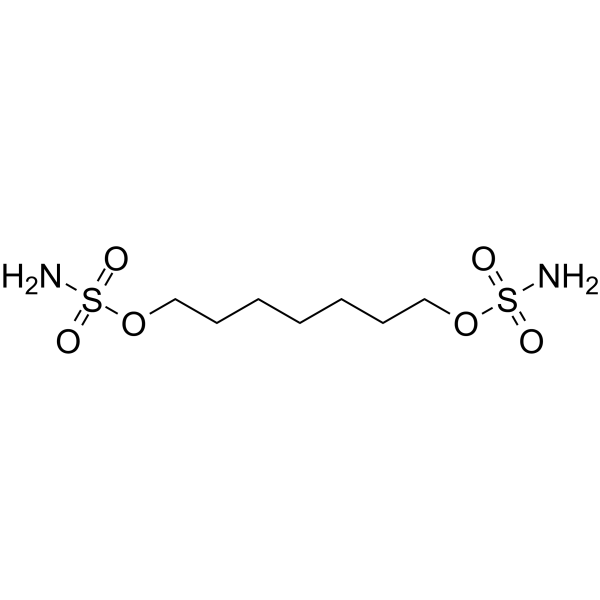
Physicochemical Properties
| Molecular Formula | C7H18N2O6S2 |
| Molecular Weight | 290.35762 |
| Exact Mass | 290.061 |
| CAS # | 96892-57-8 |
| PubChem CID | 100606 |
| Appearance | White to off-white solid powder |
| Density | 1.407g/cm3 |
| Boiling Point | 478.2ºC at 760 mmHg |
| Flash Point | 243ºC |
| Index of Refraction | 1.521 |
| LogP | 2.939 |
| Hydrogen Bond Donor Count | 2 |
| Hydrogen Bond Acceptor Count | 8 |
| Rotatable Bond Count | 10 |
| Heavy Atom Count | 17 |
| Complexity | 342 |
| Defined Atom Stereocenter Count | 0 |
| InChi Key | GOJJWDOZNKBUSR-UHFFFAOYSA-N |
| InChi Code | InChI=1S/C7H18N2O6S2/c8-16(10,11)14-6-4-2-1-3-5-7-15-17(9,12)13/h1-7H2,(H2,8,10,11)(H2,9,12,13) |
| Chemical Name | 7-sulfamoyloxyheptyl sulfamate |
| HS Tariff Code | 2934.99.9001 |
| Storage |
Powder-20°C 3 years 4°C 2 years In solvent -80°C 6 months -20°C 1 month |
| Shipping Condition | Room temperature (This product is stable at ambient temperature for a few days during ordinary shipping and time spent in Customs) |
Biological Activity
| ln Vitro | Hepsulfam was effective against 8 out of 37 tumors (22%), when used at a concentration of 1.0 μg/mL in clonogenic tests. Human bone marrow cells from healthy donors are significantly hazardous to hepsulfam in vitro (CFU-GM). Hepsulfam has been found to be extremely active in vitro isotoxic concentration assessments, particularly in non-small cell lung cancer [1]. Compared to its structural homologue busulfan, hepsulfam is more hazardous to L1210 leukemia cells. Hepsulfam, but not busulfan, caused DNA interstrand cross-links in L1210 murine leukemia cells, which is consistent with variations in toxicity. When it came to two human leukemia cell lines (111-60 and K562) and two human colon cancer cell lines (HT-29 and BE), hepsulfam was more cytotoxic than busulfan. Hepsulfam produced more DNA interstrand cross-links than busulfan, just as in 11210 cells. When the drug exposure duration was extended to 12 hours and the concentration was lowered tenfold, hepsulfam was likewise more cytotoxic against human leukemia cell lines [2]. |
| ln Vivo | In gastric cancer models and large cell lung cancer xenografts, hepsulfam has outstanding in vivo activity. Hepsulfam's preclinical activity raises the possibility that this substance could be used to treat solid cancers in people. For further clinical application, hepsulfam's higher bone marrow toxicity in comparison to busulfan may be crucial [1]. |
| References |
[1]. Preclinical activity of hepsulfam and busulfan in solid human tumor xenografts and human bone marrow. Anticancer Drugs. 1992 Oct;3(5):531-9. [2]. Mechanisms of toxicity of hepsulfam in human tumor cell lines. Cancer Res. 1990 Dec 1;50(23):7555-8. |
| Additional Infomation | Hepsulfam is a bisulfamic ester which is similar in structure to busulfan and belongs to the family of drugs known as alkylsulfonate alkylating agents. Hepsulfam forms covalent linkages with nucleophilic centers in DNA, resulting in depurination, base miscoding, strand scission, DNA-DNA and DNA-protein cross-linking, and cytotoxicity. (NCI04) |
Solubility Data
| Solubility (In Vitro) | DMSO : ~100 mg/mL (~344.40 mM) |
| Solubility (In Vivo) |
Note: Listed below are some common formulations that may be used to formulate products with low water solubility (e.g. < 1 mg/mL), you may test these formulations using a minute amount of products to avoid loss of samples. Injection Formulations (e.g. IP/IV/IM/SC) Injection Formulation 1: DMSO : Tween 80: Saline = 10 : 5 : 85 (i.e. 100 μL DMSO stock solution → 50 μL Tween 80 → 850 μL Saline) *Preparation of saline: Dissolve 0.9 g of sodium chloride in 100 mL ddH ₂ O to obtain a clear solution. Injection Formulation 2: DMSO : PEG300 :Tween 80 : Saline = 10 : 40 : 5 : 45 (i.e. 100 μL DMSO → 400 μLPEG300 → 50 μL Tween 80 → 450 μL Saline) Injection Formulation 3: DMSO : Corn oil = 10 : 90 (i.e. 100 μL DMSO → 900 μL Corn oil) Example: Take the Injection Formulation 3 (DMSO : Corn oil = 10 : 90) as an example, if 1 mL of 2.5 mg/mL working solution is to be prepared, you can take 100 μL 25 mg/mL DMSO stock solution and add to 900 μL corn oil, mix well to obtain a clear or suspension solution (2.5 mg/mL, ready for use in animals). Injection Formulation 4: DMSO : 20% SBE-β-CD in saline = 10 : 90 [i.e. 100 μL DMSO → 900 μL (20% SBE-β-CD in saline)] *Preparation of 20% SBE-β-CD in Saline (4°C,1 week): Dissolve 2 g SBE-β-CD in 10 mL saline to obtain a clear solution. Injection Formulation 5: 2-Hydroxypropyl-β-cyclodextrin : Saline = 50 : 50 (i.e. 500 μL 2-Hydroxypropyl-β-cyclodextrin → 500 μL Saline) Injection Formulation 6: DMSO : PEG300 : castor oil : Saline = 5 : 10 : 20 : 65 (i.e. 50 μL DMSO → 100 μLPEG300 → 200 μL castor oil → 650 μL Saline) Injection Formulation 7: Ethanol : Cremophor : Saline = 10: 10 : 80 (i.e. 100 μL Ethanol → 100 μL Cremophor → 800 μL Saline) Injection Formulation 8: Dissolve in Cremophor/Ethanol (50 : 50), then diluted by Saline Injection Formulation 9: EtOH : Corn oil = 10 : 90 (i.e. 100 μL EtOH → 900 μL Corn oil) Injection Formulation 10: EtOH : PEG300:Tween 80 : Saline = 10 : 40 : 5 : 45 (i.e. 100 μL EtOH → 400 μLPEG300 → 50 μL Tween 80 → 450 μL Saline) Oral Formulations Oral Formulation 1: Suspend in 0.5% CMC Na (carboxymethylcellulose sodium) Oral Formulation 2: Suspend in 0.5% Carboxymethyl cellulose Example: Take the Oral Formulation 1 (Suspend in 0.5% CMC Na) as an example, if 100 mL of 2.5 mg/mL working solution is to be prepared, you can first prepare 0.5% CMC Na solution by measuring 0.5 g CMC Na and dissolve it in 100 mL ddH2O to obtain a clear solution; then add 250 mg of the product to 100 mL 0.5% CMC Na solution, to make the suspension solution (2.5 mg/mL, ready for use in animals). Oral Formulation 3: Dissolved in PEG400 Oral Formulation 4: Suspend in 0.2% Carboxymethyl cellulose Oral Formulation 5: Dissolve in 0.25% Tween 80 and 0.5% Carboxymethyl cellulose Oral Formulation 6: Mixing with food powders Note: Please be aware that the above formulations are for reference only. InvivoChem strongly recommends customers to read literature methods/protocols carefully before determining which formulation you should use for in vivo studies, as different compounds have different solubility properties and have to be formulated differently. (Please use freshly prepared in vivo formulations for optimal results.) |
| Preparing Stock Solutions | 1 mg | 5 mg | 10 mg | |
| 1 mM | 3.4440 mL | 17.2200 mL | 34.4400 mL | |
| 5 mM | 0.6888 mL | 3.4440 mL | 6.8880 mL | |
| 10 mM | 0.3444 mL | 1.7220 mL | 3.4440 mL |