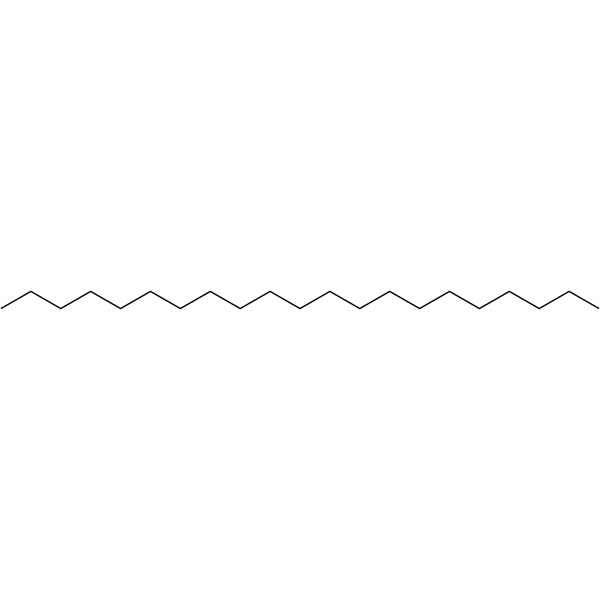
Physicochemical Properties
| Molecular Formula | C21H44 |
| Molecular Weight | 296.57 |
| Exact Mass | 296.344 |
| CAS # | 629-94-7 |
| Related CAS # | Heneicosane-d44;39756-37-1 |
| PubChem CID | 12403 |
| Appearance | White to off-white solid powder |
| Density | 0,792 g/cm3 |
| Boiling Point | 100 °C2 mm Hg(lit.) |
| Melting Point | 39-41 °C(lit.) |
| Flash Point | >230 °F |
| Vapour Pressure | <1 mm Hg ( 20 °C) |
| Index of Refraction | 1.442 |
| LogP | 8.438 |
| Hydrogen Bond Donor Count | 0 |
| Hydrogen Bond Acceptor Count | 0 |
| Rotatable Bond Count | 18 |
| Heavy Atom Count | 21 |
| Complexity | 143 |
| Defined Atom Stereocenter Count | 0 |
| InChi Key | FNAZRRHPUDJQCJ-UHFFFAOYSA-N |
| InChi Code | InChI=1S/C21H44/c1-3-5-7-9-11-13-15-17-19-21-20-18-16-14-12-10-8-6-4-2/h3-21H2,1-2H3 |
| Chemical Name | henicosane |
| HS Tariff Code | 2934.99.9001 |
| Storage |
Powder-20°C 3 years 4°C 2 years In solvent -80°C 6 months -20°C 1 month |
| Shipping Condition | Room temperature (This product is stable at ambient temperature for a few days during ordinary shipping and time spent in Customs) |
Biological Activity
| ADME/Pharmacokinetics |
Absorption, Distribution and Excretion Arthrobacter nicotianae KCC B35 isolated from blue-green mats densely covering oil sediments along the Arabian Gulf coast grew well on C10 to C40 n-alkanes as sole sources of carbon and energy. Growth on C20 to C40 alkanes was even better than on C10 to C18 alkanes. Biomass samples incubated for 6 hr with n-octacosane (C28) or n-nonacosane (C29) accumulated these compounds as the predominant constituent alkanes of the cell hydrocarbon fractions. The even chain hexadecane C16 and the odd chain pentadecane C15 were the second dominant constituent alkanes in C28 and C29 incubated cells, respectively. n-Hexadecane-incubated cells accumulated in their lipids higher proportions of C16-fatty acids than control cells not incubated with hydrocarbons. On the other hand, C28 and C29-incubated cells did not contain any fatty acids with the equivalent chain lengths, but the fatty acid patterns of the cell lipids suggest that there should have been mid-chain oxidation of these very long chain alkanes. This activity qualifies A. nicotianae KCC B35 to be used in cocktails for bioremediating environments polluted with heavy oil sediments. Liver, heart, kidneys, muscle and adipose (perirenal and s.c.) /bovine/ tissues were collected from 6 animals for analysis of their hydrocarbon composition. Qualitative and quantitative determinations were carried out by gas chromatography and combined gas chromatography-mass spectrometry. Although differing in the proportions, a homologous series of n-alkanes ranging from n-C12-n-C31 was found in all samples. The isoprenoid hydrocarbons phytane and phytene (phyt-1-ene and phyt-2-ene) were also identified. (These findings have relevance to the health of humans consuming hydrocarbon-contaminated meats.) /n-Alkanes/ |
| References |
[1]. Identification of a queen and king recognition pheromone in the subterranean termite Reticulitermes flavipes. Proc Natl Acad Sci U S A. 2018 Apr 10;115(15):3888-3893. [2]. Efficacy of volatile compounds from Streptomyces philanthi RL-1-178 as a biofumigant for controlling growth and aflatoxin production of the two aflatoxin-producing fungi on stored soybean seeds. J Appl Microbiol. 2020 Sep;129(3):652-664. [3]. The composition of the aroma of Serapias orchids in Basilicata (Southern Italy). Nat Prod Res. 2020 Jan 20;1-5. |
| Additional Infomation |
Crystals. (NTP, 1992) Henicosane is an alkane that has 21 carbons and a straight-chain structure. It has been isolated from plants like Periploca laevigata and Carthamus tinctorius. It has a role as a pheromone, a plant metabolite and a volatile oil component. Heneicosane has been reported in Vanilla madagascariensis, Magnolia officinalis, and other organisms with data available. See also: Moringa oleifera leaf oil (part of). |
Solubility Data
| Solubility (In Vitro) | DMSO : 2.5 mg/mL (8.43 mM) |
| Solubility (In Vivo) |
Note: Listed below are some common formulations that may be used to formulate products with low water solubility (e.g. < 1 mg/mL), you may test these formulations using a minute amount of products to avoid loss of samples. Injection Formulations (e.g. IP/IV/IM/SC) Injection Formulation 1: DMSO : Tween 80: Saline = 10 : 5 : 85 (i.e. 100 μL DMSO stock solution → 50 μL Tween 80 → 850 μL Saline) *Preparation of saline: Dissolve 0.9 g of sodium chloride in 100 mL ddH ₂ O to obtain a clear solution. Injection Formulation 2: DMSO : PEG300 :Tween 80 : Saline = 10 : 40 : 5 : 45 (i.e. 100 μL DMSO → 400 μLPEG300 → 50 μL Tween 80 → 450 μL Saline) Injection Formulation 3: DMSO : Corn oil = 10 : 90 (i.e. 100 μL DMSO → 900 μL Corn oil) Example: Take the Injection Formulation 3 (DMSO : Corn oil = 10 : 90) as an example, if 1 mL of 2.5 mg/mL working solution is to be prepared, you can take 100 μL 25 mg/mL DMSO stock solution and add to 900 μL corn oil, mix well to obtain a clear or suspension solution (2.5 mg/mL, ready for use in animals). Injection Formulation 4: DMSO : 20% SBE-β-CD in saline = 10 : 90 [i.e. 100 μL DMSO → 900 μL (20% SBE-β-CD in saline)] *Preparation of 20% SBE-β-CD in Saline (4°C,1 week): Dissolve 2 g SBE-β-CD in 10 mL saline to obtain a clear solution. Injection Formulation 5: 2-Hydroxypropyl-β-cyclodextrin : Saline = 50 : 50 (i.e. 500 μL 2-Hydroxypropyl-β-cyclodextrin → 500 μL Saline) Injection Formulation 6: DMSO : PEG300 : castor oil : Saline = 5 : 10 : 20 : 65 (i.e. 50 μL DMSO → 100 μLPEG300 → 200 μL castor oil → 650 μL Saline) Injection Formulation 7: Ethanol : Cremophor : Saline = 10: 10 : 80 (i.e. 100 μL Ethanol → 100 μL Cremophor → 800 μL Saline) Injection Formulation 8: Dissolve in Cremophor/Ethanol (50 : 50), then diluted by Saline Injection Formulation 9: EtOH : Corn oil = 10 : 90 (i.e. 100 μL EtOH → 900 μL Corn oil) Injection Formulation 10: EtOH : PEG300:Tween 80 : Saline = 10 : 40 : 5 : 45 (i.e. 100 μL EtOH → 400 μLPEG300 → 50 μL Tween 80 → 450 μL Saline) Oral Formulations Oral Formulation 1: Suspend in 0.5% CMC Na (carboxymethylcellulose sodium) Oral Formulation 2: Suspend in 0.5% Carboxymethyl cellulose Example: Take the Oral Formulation 1 (Suspend in 0.5% CMC Na) as an example, if 100 mL of 2.5 mg/mL working solution is to be prepared, you can first prepare 0.5% CMC Na solution by measuring 0.5 g CMC Na and dissolve it in 100 mL ddH2O to obtain a clear solution; then add 250 mg of the product to 100 mL 0.5% CMC Na solution, to make the suspension solution (2.5 mg/mL, ready for use in animals). Oral Formulation 3: Dissolved in PEG400 Oral Formulation 4: Suspend in 0.2% Carboxymethyl cellulose Oral Formulation 5: Dissolve in 0.25% Tween 80 and 0.5% Carboxymethyl cellulose Oral Formulation 6: Mixing with food powders Note: Please be aware that the above formulations are for reference only. InvivoChem strongly recommends customers to read literature methods/protocols carefully before determining which formulation you should use for in vivo studies, as different compounds have different solubility properties and have to be formulated differently. (Please use freshly prepared in vivo formulations for optimal results.) |
| Preparing Stock Solutions | 1 mg | 5 mg | 10 mg | |
| 1 mM | 3.3719 mL | 16.8594 mL | 33.7189 mL | |
| 5 mM | 0.6744 mL | 3.3719 mL | 6.7438 mL | |
| 10 mM | 0.3372 mL | 1.6859 mL | 3.3719 mL |