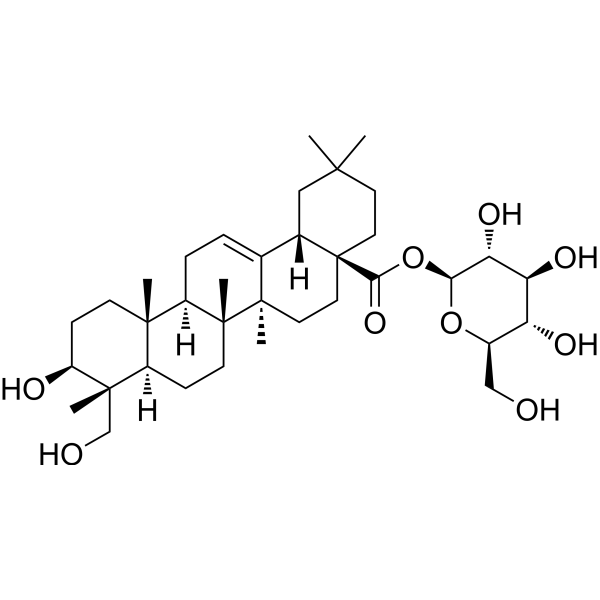
Physicochemical Properties
| Molecular Formula | C36H58O9 |
| Molecular Weight | 634.8403 |
| Exact Mass | 634.408 |
| CAS # | 53931-25-2 |
| PubChem CID | 21120798 |
| Appearance | White to off-white solid powder |
| Density | 1.27±0.1 g/cm3 |
| Boiling Point | 729.7±60.0 °C at 760 mmHg |
| Melting Point | 197-202 ºC (methanol ) |
| Flash Point | 220.2±26.4 °C |
| Vapour Pressure | 0.0±5.4 mmHg at 25°C |
| Index of Refraction | 1.596 |
| LogP | 6.68 |
| Hydrogen Bond Donor Count | 6 |
| Hydrogen Bond Acceptor Count | 9 |
| Rotatable Bond Count | 5 |
| Heavy Atom Count | 45 |
| Complexity | 1200 |
| Defined Atom Stereocenter Count | 14 |
| SMILES | O([H])C1([H])C([H])([H])C([H])([H])[C@@]2(C([H])([H])[H])[C@]([H])([C@]1(C([H])([H])[H])C([H])([H])O[H])C([H])([H])C([H])([H])[C@@]1(C([H])([H])[H])[C@]3(C([H])([H])[H])C([H])([H])C([H])([H])[C@@]4(C(=O)OC5([H])C([H])(C([H])(C([H])(C([H])(C([H])([H])O[H])O5)O[H])O[H])O[H])C([H])([H])C([H])([H])C(C([H])([H])[H])(C([H])([H])[H])C([H])([H])[C@]4([H])C3=C([H])C([H])([H])[C@@]12[H] |
| InChi Key | WJMMBVSOQPALFO-DLQTVUGOSA-N |
| InChi Code | InChI=1S/C36H58O9/c1-31(2)13-15-36(30(43)45-29-28(42)27(41)26(40)22(18-37)44-29)16-14-34(5)20(21(36)17-31)7-8-24-32(3)11-10-25(39)33(4,19-38)23(32)9-12-35(24,34)6/h7,21-29,37-42H,8-19H2,1-6H3/t21-,22+,23+,24+,25-,26+,27-,28+,29-,32-,33-,34+,35+,36-/m0/s1 |
| Chemical Name | [(2S,3R,4S,5S,6R)-3,4,5-trihydroxy-6-(hydroxymethyl)oxan-2-yl] (4aS,6aR,6aS,6bR,8aR,9R,10S,12aR,14bS)-10-hydroxy-9-(hydroxymethyl)-2,2,6a,6b,9,12a-hexamethyl-1,3,4,5,6,6a,7,8,8a,10,11,12,13,14b-tetradecahydropicene-4a-carboxylate |
| HS Tariff Code | 2934.99.9001 |
| Storage |
Powder-20°C 3 years 4°C 2 years In solvent -80°C 6 months -20°C 1 month Note: Please store this product in a sealed and protected environment (e.g. under nitrogen), avoid exposure to moisture and light. |
| Shipping Condition | Room temperature (This product is stable at ambient temperature for a few days during ordinary shipping and time spent in Customs) |
Biological Activity
| Targets |
In H9c2 rat cardiomyocytes injured by H₂O₂ (0.5 mM), Hederagenin 28-O-beta-D-glucopyranosyl ester (10 μM, 20 μM, 40 μM) exerted dose-dependent protective effects. 1. Cell viability: MTT assay showed that H₂O₂ alone reduced cell viability to 45.2% of the control group; pretreatment with 10 μM, 20 μM, and 40 μM Hederagenin 28-O-beta-D-glucopyranosyl ester increased viability to 58.7%, 71.3%, and 82.3% respectively [1] 2. Oxidative stress markers: DCFH-DA staining revealed that 40 μM Hederagenin 28-O-beta-D-glucopyranosyl ester reduced intracellular reactive oxygen species (ROS) levels by 58.6% compared to the H₂O₂ group. It also decreased malondialdehyde (MDA, a lipid peroxidation product) content by 42.1% (40 μM dose) and increased the activities of superoxide dismutase (SOD) and glutathione peroxidase (GSH-Px) by 35.8% and 41.5% respectively (40 μM dose) [1] |
| Cell Assay |
1. Cell culture and grouping: H9c2 rat cardiomyocytes were cultured in DMEM medium containing 10% fetal bovine serum at 37°C with 5% CO₂. Cells were divided into 4 groups: control group (no treatment), H₂O₂ group (0.5 mM H₂O₂ for 4 hours), and two Hederagenin 28-O-beta-D-glucopyranosyl ester pretreatment groups (10 μM, 20 μM, 40 μM drug for 2 hours before H₂O₂ exposure) [1] 2. Cell viability detection: After treatment, cells were incubated with MTT reagent (5 mg/mL) for 4 hours at 37°C. The supernatant was removed, and DMSO was added to dissolve formazan crystals. Absorbance was measured at 570 nm to calculate cell viability [1] 3. Oxidative stress detection: For ROS measurement, cells were loaded with DCFH-DA probe (10 μM) for 30 minutes, then washed and observed under a fluorescence microscope to quantify fluorescence intensity. For MDA, SOD, and GSH-Px detection: cell homogenates were prepared, and commercial assay kits were used to measure their levels/activities according to the kit instructions [1] |
| Toxicity/Toxicokinetics |
In normal H9c2 cardiomyocytes (without H₂O₂ treatment), Hederagenin 28-O-beta-D-glucopyranosyl ester at concentrations up to 40 μM had no significant cytotoxicity. MTT assay showed that cell viability remained >95% compared to the control group after 24 hours of drug treatment, indicating no obvious damage to normal myocardial cells [1] |
| References |
[1]. New triterpenoid saponins from Ilex cornuta and their protective effects against H2O2-induced myocardial cell injury. J Agric Food Chem. 2014 Jan 15;62(2):488-96. |
| Additional Infomation |
Hederagenin 28-O-beta-D-glucopyranoside is a triterpenoid saponin that is the carboxylic ester obtained by the formal condensation of the carboxy group of hederagenin with beta-D-glucopyranose. It has been isolated from Juglans sinensis. It has a role as a plant metabolite and an anti-inflammatory agent. It is a triterpenoid saponin, a pentacyclic triterpenoid, a monosaccharide derivative, a beta-D-glucoside and a carboxylic ester. It is functionally related to a hederagenin. It derives from a hydride of an oleanane. hederagenin 28-O-beta-D-glucopyranosyl ester has been reported in Achyranthes bidentata, Acer pictum, and other organisms with data available. Hederagenin 28-O-beta-D-glucopyranosyl ester is a new triterpenoid saponin isolated from the leaves of Ilex cornuta , a traditional Chinese medicinal plant [1] The protective effect of Hederagenin 28-O-beta-D-glucopyranosyl ester against H₂O₂-induced myocardial cell injury is mainly mediated by inhibiting oxidative stress: it reduces ROS generation and lipid peroxidation (lower MDA), while enhancing the activity of endogenous antioxidant enzymes (SOD, GSH-Px) to restore the cellular redox balance [1] |
Solubility Data
| Solubility (In Vitro) | May dissolve in DMSO (in most cases), if not, try other solvents such as H2O, Ethanol, or DMF with a minute amount of products to avoid loss of samples |
| Solubility (In Vivo) |
Note: Listed below are some common formulations that may be used to formulate products with low water solubility (e.g. < 1 mg/mL), you may test these formulations using a minute amount of products to avoid loss of samples. Injection Formulations (e.g. IP/IV/IM/SC) Injection Formulation 1: DMSO : Tween 80: Saline = 10 : 5 : 85 (i.e. 100 μL DMSO stock solution → 50 μL Tween 80 → 850 μL Saline) *Preparation of saline: Dissolve 0.9 g of sodium chloride in 100 mL ddH ₂ O to obtain a clear solution. Injection Formulation 2: DMSO : PEG300 :Tween 80 : Saline = 10 : 40 : 5 : 45 (i.e. 100 μL DMSO → 400 μLPEG300 → 50 μL Tween 80 → 450 μL Saline) Injection Formulation 3: DMSO : Corn oil = 10 : 90 (i.e. 100 μL DMSO → 900 μL Corn oil) Example: Take the Injection Formulation 3 (DMSO : Corn oil = 10 : 90) as an example, if 1 mL of 2.5 mg/mL working solution is to be prepared, you can take 100 μL 25 mg/mL DMSO stock solution and add to 900 μL corn oil, mix well to obtain a clear or suspension solution (2.5 mg/mL, ready for use in animals). Injection Formulation 4: DMSO : 20% SBE-β-CD in saline = 10 : 90 [i.e. 100 μL DMSO → 900 μL (20% SBE-β-CD in saline)] *Preparation of 20% SBE-β-CD in Saline (4°C,1 week): Dissolve 2 g SBE-β-CD in 10 mL saline to obtain a clear solution. Injection Formulation 5: 2-Hydroxypropyl-β-cyclodextrin : Saline = 50 : 50 (i.e. 500 μL 2-Hydroxypropyl-β-cyclodextrin → 500 μL Saline) Injection Formulation 6: DMSO : PEG300 : castor oil : Saline = 5 : 10 : 20 : 65 (i.e. 50 μL DMSO → 100 μLPEG300 → 200 μL castor oil → 650 μL Saline) Injection Formulation 7: Ethanol : Cremophor : Saline = 10: 10 : 80 (i.e. 100 μL Ethanol → 100 μL Cremophor → 800 μL Saline) Injection Formulation 8: Dissolve in Cremophor/Ethanol (50 : 50), then diluted by Saline Injection Formulation 9: EtOH : Corn oil = 10 : 90 (i.e. 100 μL EtOH → 900 μL Corn oil) Injection Formulation 10: EtOH : PEG300:Tween 80 : Saline = 10 : 40 : 5 : 45 (i.e. 100 μL EtOH → 400 μLPEG300 → 50 μL Tween 80 → 450 μL Saline) Oral Formulations Oral Formulation 1: Suspend in 0.5% CMC Na (carboxymethylcellulose sodium) Oral Formulation 2: Suspend in 0.5% Carboxymethyl cellulose Example: Take the Oral Formulation 1 (Suspend in 0.5% CMC Na) as an example, if 100 mL of 2.5 mg/mL working solution is to be prepared, you can first prepare 0.5% CMC Na solution by measuring 0.5 g CMC Na and dissolve it in 100 mL ddH2O to obtain a clear solution; then add 250 mg of the product to 100 mL 0.5% CMC Na solution, to make the suspension solution (2.5 mg/mL, ready for use in animals). Oral Formulation 3: Dissolved in PEG400 Oral Formulation 4: Suspend in 0.2% Carboxymethyl cellulose Oral Formulation 5: Dissolve in 0.25% Tween 80 and 0.5% Carboxymethyl cellulose Oral Formulation 6: Mixing with food powders Note: Please be aware that the above formulations are for reference only. InvivoChem strongly recommends customers to read literature methods/protocols carefully before determining which formulation you should use for in vivo studies, as different compounds have different solubility properties and have to be formulated differently. (Please use freshly prepared in vivo formulations for optimal results.) |
| Preparing Stock Solutions | 1 mg | 5 mg | 10 mg | |
| 1 mM | 1.5752 mL | 7.8760 mL | 15.7520 mL | |
| 5 mM | 0.3150 mL | 1.5752 mL | 3.1504 mL | |
| 10 mM | 0.1575 mL | 0.7876 mL | 1.5752 mL |