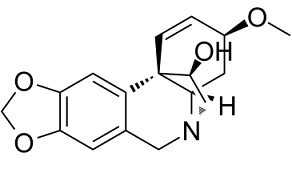
Haemanthamine is a naturally occuring crinine-type alkaloid extracted from the Amaryllidaceae plants with highly potent anticancer activity. Haemanthamine HCl targets ribosomal that inhibits protein biosynthesis during the elongation stage of translation. Haemanthamine HCl has pro-apoptotic, antioxidant, antiviral, antimalarial and anticonvulsant activities.
Physicochemical Properties
| Molecular Formula | C17H19NO4 |
| Molecular Weight | 301.33700 |
| Exact Mass | 301.131 |
| CAS # | 466-75-1 |
| Related CAS # | Haemanthamine hydrochloride |
| PubChem CID | 441593 |
| Appearance | White to off-white solid powder |
| Density | 1.42g/cm3 |
| Boiling Point | 467.5ºC at 760 mmHg |
| Flash Point | 236.5ºC |
| Vapour Pressure | 1.53E-09mmHg at 25°C |
| Index of Refraction | 1.679 |
| LogP | 1.124 |
| Hydrogen Bond Donor Count | 1 |
| Hydrogen Bond Acceptor Count | 5 |
| Rotatable Bond Count | 1 |
| Heavy Atom Count | 22 |
| Complexity | 497 |
| Defined Atom Stereocenter Count | 4 |
| SMILES | CO[C@H]1C[C@H]2[C@@]3(C=C1)[C@H](CN2CC4=CC5=C(C=C34)OCO5)O |
| InChi Key | YGPRSGKVLATIHT-HSHDSVGOSA-N |
| InChi Code | InChI=1S/C17H19NO4/c1-20-11-2-3-17-12-6-14-13(21-9-22-14)4-10(12)7-18(8-16(17)19)15(17)5-11/h2-4,6,11,15-16,19H,5,7-9H2,1H3/t11-,15+,16+,17+/m1/s1 |
| Chemical Name | (1S,13S,15S,18R)-15-methoxy-5,7-dioxa-12-azapentacyclo[10.5.2.01,13.02,10.04,8]nonadeca-2,4(8),9,16-tetraen-18-ol |
| HS Tariff Code | 2934.99.9001 |
| Storage |
Powder-20°C 3 years 4°C 2 years In solvent -80°C 6 months -20°C 1 month |
| Shipping Condition | Room temperature (This product is stable at ambient temperature for a few days during ordinary shipping and time spent in Customs) |
Biological Activity
| ln Vitro | The treatment of A2780 cells with hememanthamine (1-100 µM) for 24 to 48 hours results in a time- and dose-dependent reduction in cell viability [2]. Treatment of A2780 cells with hememanthamine (10 µM) for 24–72 hours can greatly reduce their ability to proliferate [2]. Haemanthamine forms a special molecular interaction with 25S rRNA by binding to the A-site cleft in the middle of the peptidyl transferase on the big ribosomal subunit. Haemanthamine activates the p53-dependent nucleolar stress anti-tumor surveillance mechanism by selectively inhibiting the processing of rRNA precursors [1]. |
| ln Vivo | Haemanthamine's half-life is 70.4 minutes, its rapid distribution period is 30 minutes, and the kidneys are primarily responsible for its elimination, according to pharmacokinetic studies conducted on rats. After a single dose of 10 mg/kg, its plasma concentration stays above 1 μM for at least an hour, indicating high intracellular permeability as indicated by the high distribution volume of 13.7 L/kg [1]. |
| Cell Assay |
Cell Viability Assay[2] Cell Types: A2780 Ovarian Cancer Cell Tested Concentrations: 1 µM, 10 µM, 50 µM, 100 µM Incubation Duration: 24 hrs (hours), 48 hrs (hours) Experimental Results: demonstrated a time- and dose-dependent decrease in cell viability. Cell proliferation assay [2] Cell Types: A2780 ovarian cancer cells Tested Concentrations: 10 µM Incubation Duration: 24 hrs (hours), 48 hrs (hours), 72 hrs (hours) Experimental Results: Significant inhibitory effect on A2780 cell proliferation. |
| References |
[1]. The Amaryllidaceae Alkaloid Haemanthamine Binds the Eukaryotic Ribosome to Repress Cancer Cell Growth. Structure. 2018 Mar 6;26(3):416-425.e4. [2]. Haemanthamine alters sodium butyrate-induced histone acetylation, p21WAF1/Cip1 expression, Chk1 and Chk2 activation and leads to increased growth inhibition and death in A2780 ovarian cancer cells. Phytomedicine. 2017 Nov 15;35:1-10. |
| Additional Infomation |
Haemanthamine is an alkaloid. Hemanthamine has been reported in Hippeastrum puniceum, Hymenocallis littoralis, and other organisms with data available. |
Solubility Data
| Solubility (In Vitro) | DMSO : ~100 mg/mL (~331.85 mM) |
| Solubility (In Vivo) |
Note: Listed below are some common formulations that may be used to formulate products with low water solubility (e.g. < 1 mg/mL), you may test these formulations using a minute amount of products to avoid loss of samples. Injection Formulations (e.g. IP/IV/IM/SC) Injection Formulation 1: DMSO : Tween 80: Saline = 10 : 5 : 85 (i.e. 100 μL DMSO stock solution → 50 μL Tween 80 → 850 μL Saline) *Preparation of saline: Dissolve 0.9 g of sodium chloride in 100 mL ddH ₂ O to obtain a clear solution. Injection Formulation 2: DMSO : PEG300 :Tween 80 : Saline = 10 : 40 : 5 : 45 (i.e. 100 μL DMSO → 400 μLPEG300 → 50 μL Tween 80 → 450 μL Saline) Injection Formulation 3: DMSO : Corn oil = 10 : 90 (i.e. 100 μL DMSO → 900 μL Corn oil) Example: Take the Injection Formulation 3 (DMSO : Corn oil = 10 : 90) as an example, if 1 mL of 2.5 mg/mL working solution is to be prepared, you can take 100 μL 25 mg/mL DMSO stock solution and add to 900 μL corn oil, mix well to obtain a clear or suspension solution (2.5 mg/mL, ready for use in animals). Injection Formulation 4: DMSO : 20% SBE-β-CD in saline = 10 : 90 [i.e. 100 μL DMSO → 900 μL (20% SBE-β-CD in saline)] *Preparation of 20% SBE-β-CD in Saline (4°C,1 week): Dissolve 2 g SBE-β-CD in 10 mL saline to obtain a clear solution. Injection Formulation 5: 2-Hydroxypropyl-β-cyclodextrin : Saline = 50 : 50 (i.e. 500 μL 2-Hydroxypropyl-β-cyclodextrin → 500 μL Saline) Injection Formulation 6: DMSO : PEG300 : castor oil : Saline = 5 : 10 : 20 : 65 (i.e. 50 μL DMSO → 100 μLPEG300 → 200 μL castor oil → 650 μL Saline) Injection Formulation 7: Ethanol : Cremophor : Saline = 10: 10 : 80 (i.e. 100 μL Ethanol → 100 μL Cremophor → 800 μL Saline) Injection Formulation 8: Dissolve in Cremophor/Ethanol (50 : 50), then diluted by Saline Injection Formulation 9: EtOH : Corn oil = 10 : 90 (i.e. 100 μL EtOH → 900 μL Corn oil) Injection Formulation 10: EtOH : PEG300:Tween 80 : Saline = 10 : 40 : 5 : 45 (i.e. 100 μL EtOH → 400 μLPEG300 → 50 μL Tween 80 → 450 μL Saline) Oral Formulations Oral Formulation 1: Suspend in 0.5% CMC Na (carboxymethylcellulose sodium) Oral Formulation 2: Suspend in 0.5% Carboxymethyl cellulose Example: Take the Oral Formulation 1 (Suspend in 0.5% CMC Na) as an example, if 100 mL of 2.5 mg/mL working solution is to be prepared, you can first prepare 0.5% CMC Na solution by measuring 0.5 g CMC Na and dissolve it in 100 mL ddH2O to obtain a clear solution; then add 250 mg of the product to 100 mL 0.5% CMC Na solution, to make the suspension solution (2.5 mg/mL, ready for use in animals). Oral Formulation 3: Dissolved in PEG400 Oral Formulation 4: Suspend in 0.2% Carboxymethyl cellulose Oral Formulation 5: Dissolve in 0.25% Tween 80 and 0.5% Carboxymethyl cellulose Oral Formulation 6: Mixing with food powders Note: Please be aware that the above formulations are for reference only. InvivoChem strongly recommends customers to read literature methods/protocols carefully before determining which formulation you should use for in vivo studies, as different compounds have different solubility properties and have to be formulated differently. (Please use freshly prepared in vivo formulations for optimal results.) |
| Preparing Stock Solutions | 1 mg | 5 mg | 10 mg | |
| 1 mM | 3.3185 mL | 16.5926 mL | 33.1851 mL | |
| 5 mM | 0.6637 mL | 3.3185 mL | 6.6370 mL | |
| 10 mM | 0.3319 mL | 1.6593 mL | 3.3185 mL |