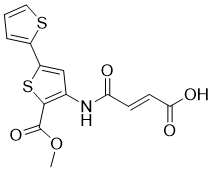
HTS01037 (HTS-01037) is a novel and potent inhibitor of fatty acid binding proteins (FABPs), acting as an antagonist of protein-protein interactions mediated by FABPs, in particular adipocyte FABP.
Physicochemical Properties
| Molecular Formula | C14H11NO5S2 |
| Molecular Weight | 337.36 |
| Exact Mass | 337.007 |
| CAS # | 682741-29-3 |
| PubChem CID | 5714537 |
| Appearance | Light yellow to yellow solid powder |
| Density | 1.5±0.1 g/cm3 |
| Boiling Point | 621.2±55.0 °C at 760 mmHg |
| Flash Point | 329.5±31.5 °C |
| Vapour Pressure | 0.0±1.9 mmHg at 25°C |
| Index of Refraction | 1.672 |
| LogP | 3.7 |
| Hydrogen Bond Donor Count | 2 |
| Hydrogen Bond Acceptor Count | 7 |
| Rotatable Bond Count | 6 |
| Heavy Atom Count | 22 |
| Complexity | 482 |
| Defined Atom Stereocenter Count | 0 |
| SMILES | COC(=O)C1=C(C=C(S1)C2=CC=CS2)NC(=O)/C=C/C(=O)O |
| InChi Key | GJODSFZNKNHKML-SNAWJCMRSA-N |
| InChi Code | InChI=1S/C14H11NO5S2/c1-20-14(19)13-8(15-11(16)4-5-12(17)18)7-10(22-13)9-3-2-6-21-9/h2-7H,1H3,(H,15,16)(H,17,18)/b5-4+ |
| Chemical Name | (E)-4-[(2-methoxycarbonyl-5-thiophen-2-ylthiophen-3-yl)amino]-4-oxobut-2-enoic acid |
| Synonyms | HTS-01037 HTS 01037 HTS01037 |
| HS Tariff Code | 2934.99.9001 |
| Storage |
Powder-20°C 3 years 4°C 2 years In solvent -80°C 6 months -20°C 1 month |
| Shipping Condition | Room temperature (This product is stable at ambient temperature for a few days during ordinary shipping and time spent in Customs) |
Biological Activity
| Targets |
|
|
| ln Vitro | HTS01037 has an apparent Ki of 0.67 μM and binds to AFABP/aP2 with high affinity. HTS01037 is a pan-specific FABP inhibitor at higher concentrations, yet it is relatively selective for AFABP/aP2. HTS01037 decreases LPS-stimulated inflammation in cultured macrophages and inhibits lipolysis in 3T3-L1 adipocytes. HTS01037 does not activate PPARγ in macrophage or CV-1 cells, but it functions as an antagonist of the protein-protein interaction between AFABP/aP2 and hormone sensitive lipase[1]. Whether palmitic acid is present or not, HTS01037 treatment of microglial cells results in an increase in Ucp2 and arginase expression. Furthermore, compared to palmitic acid alone, cells treated to HTS01037 show reduced production of inducible nitric oxide synthase (iNOS), indicating decreased NFκB signaling[2]. When HTS01037 is administered to macrophages, there is a significant reduction in basal and fatty acid-stimulated LTC4 secretion, but neither 5-HETE synthesis nor 5-lipoxygenase expression are affected[3]. | |
| Cell Assay |
|
|
| References |
[1]. Identification and characterization of a small molecule inhibitor of Fatty Acid binding proteins. J Med Chem. 2009 Oct 8;52(19):6024-31. [2]. Identification of a fatty acid binding protein4-UCP2 axis regulating microglial mediated neuroinflammation. Mol Cell Neurosci. 2017 Apr;80:52-57. [3]. Fatty acids induce leukotriene C4 synthesis in macrophages in a fatty acid binding protein-dependent manner. Biochim Biophys Acta. 2013 Jul;1831(7):1199-207. |
|
| Additional Infomation | HTS 01037 is a ring assembly and a member of thiophenes. |
Solubility Data
| Solubility (In Vitro) | DMSO : ~100 mg/mL (~296.41 mM) |
| Solubility (In Vivo) |
Solubility in Formulation 1: 2.5 mg/mL (7.41 mM) in 10% DMSO + 40% PEG300 + 5% Tween80 + 45% Saline (add these co-solvents sequentially from left to right, and one by one), suspension solution; with sonication. For example, if 1 mL of working solution is to be prepared, you can add 100 μL of 25.0 mg/mL clear DMSO stock solution to 400 μL PEG300 and mix evenly; then add 50 μL Tween-80 to the above solution and mix evenly; then add 450 μL normal saline to adjust the volume to 1 mL. Preparation of saline: Dissolve 0.9 g of sodium chloride in 100 mL ddH₂ O to obtain a clear solution. Solubility in Formulation 2: 2.5 mg/mL (7.41 mM) in 10% DMSO + 90% (20% SBE-β-CD in Saline) (add these co-solvents sequentially from left to right, and one by one), suspension solution; with ultrasonication. For example, if 1 mL of working solution is to be prepared, you can add 100 μL of 25.0 mg/mL clear DMSO stock solution to 900 μL of 20% SBE-β-CD physiological saline solution and mix evenly. Preparation of 20% SBE-β-CD in Saline (4°C,1 week): Dissolve 2 g SBE-β-CD in 10 mL saline to obtain a clear solution. Solubility in Formulation 3: ≥ 2.5 mg/mL (7.41 mM) (saturation unknown) in 10% DMSO + 90% Corn Oil (add these co-solvents sequentially from left to right, and one by one), clear solution. For example, if 1 mL of working solution is to be prepared, you can add 100 μL of 25.0 mg/mL clear DMSO stock solution to 900 μL of corn oil and mix evenly. (Please use freshly prepared in vivo formulations for optimal results.) |
| Preparing Stock Solutions | 1 mg | 5 mg | 10 mg | |
| 1 mM | 2.9642 mL | 14.8210 mL | 29.6419 mL | |
| 5 mM | 0.5928 mL | 2.9642 mL | 5.9284 mL | |
| 10 mM | 0.2964 mL | 1.4821 mL | 2.9642 mL |