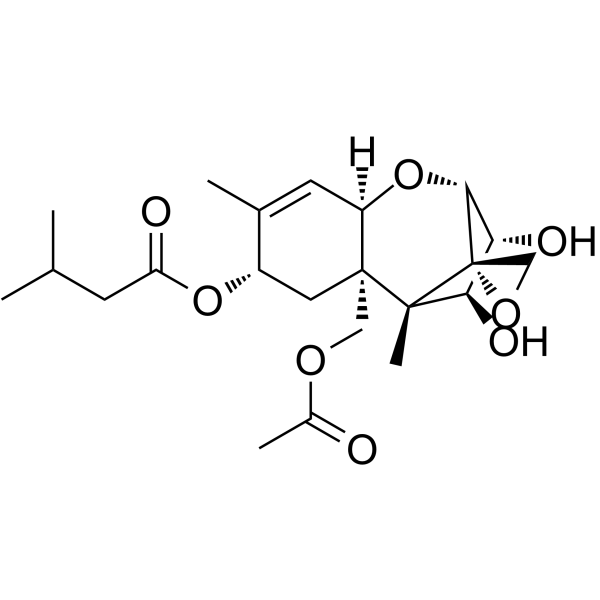
Physicochemical Properties
| Molecular Formula | C22H32O8 |
| Molecular Weight | 424.48468 |
| Exact Mass | 424.209 |
| CAS # | 26934-87-2 |
| Related CAS # | HT-2 Toxin-13C22;1486469-92-4 |
| PubChem CID | 10093830 |
| Appearance | White to off-white solid powder |
| Density | 1.3±0.1 g/cm3 |
| Boiling Point | 537.1±50.0 °C at 760 mmHg |
| Flash Point | 179.8±23.6 °C |
| Vapour Pressure | 0.0±3.2 mmHg at 25°C |
| Index of Refraction | 1.562 |
| LogP | 2.27 |
| Hydrogen Bond Donor Count | 2 |
| Hydrogen Bond Acceptor Count | 8 |
| Rotatable Bond Count | 7 |
| Heavy Atom Count | 30 |
| Complexity | 777 |
| Defined Atom Stereocenter Count | 8 |
| SMILES | CC1=C[C@@H]2[C@](C[C@@H]1OC(=O)CC(C)C)([C@]3([C@@H]([C@H]([C@H]([C@@]34CO4)O2)O)O)C)COC(=O)C |
| InChi Key | PNKLMTPXERFKEN-MLXHEQMXSA-N |
| InChi Code | InChI=1S/C22H32O8/c1-11(2)6-16(24)29-14-8-21(9-27-13(4)23)15(7-12(14)3)30-19-17(25)18(26)20(21,5)22(19)10-28-22/h7,11,14-15,17-19,25-26H,6,8-10H2,1-5H3/t14-,15+,17+,18+,19+,20+,21+,22-/m0/s1 |
| Chemical Name | [(1S,2R,4S,7R,9R,10R,11S,12S)-2-(acetyloxymethyl)-10,11-dihydroxy-1,5-dimethylspiro[8-oxatricyclo[7.2.1.02,7]dodec-5-ene-12,2'-oxirane]-4-yl] 3-methylbutanoate |
| Synonyms | HT-2 Toxin; Mycotoxin HT 2; 26934-87-2; Toxin HT 2; HT 2 Toxin; NC6C26RM46; UNII-NC6C26RM46; [(1S,2R,4S,7R,9R,10R,11S,12S)-2-(acetyloxymethyl)-10,11-dihydroxy-1,5-dimethylspiro[8-oxatricyclo[7.2.1.02,7]dodec-5-ene-12,2'-oxirane]-4-yl] 3-methylbutanoate; |
| HS Tariff Code | 2934.99.9001 |
| Storage |
Powder-20°C 3 years 4°C 2 years In solvent -80°C 6 months -20°C 1 month |
| Shipping Condition | Room temperature (This product is stable at ambient temperature for a few days during ordinary shipping and time spent in Customs) |
Biological Activity
| Targets | Deacetylated metabolite of T-2 toxin |
| ln Vivo | To investigate the metabolic fate of HT-2 toxin (HT2) and T-2 toxin (T2) in wheat (Triticum aestivum L.), an untargeted metabolomics study utilizing stable isotopic labeling and liquid chromatography-high resolution mass spectrometry was performed. In total, 11 HT2 and 12 T2 derived in planta biotransformation products were annotated putatively. In addition to previously reported mono- and diglucosylated forms of HT2, evidence for the formation of HT2-malonyl-glucoside and feruloyl-T2, as well as acetylation and deacetylation products in wheat was obtained for the first time. To monitor the kinetics of metabolite formation, a time course experiment was conducted involving the Fusarium head blight susceptible variety Remus and the resistant cultivar CM-82036. Biotransformation reactions were observed already at the earliest tested time point (6 h after treatment), and formed metabolites showed different kinetic profiles. After ripening, less than 15% of the toxins added to the plants were determined to be unmetabolized [1]. |
| Animal Protocol |
In the metabolic profiling experiment a 50:50 (v/v) mixture of 13C-labeled and nonlabeled solutions of HT-2 toxin (HT2) or T2 (in acetonitrile:water (50:50, v/v) and 1% TWEEN) was used. As controls, ears were treated with a mock solution containing only acetonitrile:water (50:50, v/v) and 1% TWEEN. At time point zero, two neighboring spikelets were treated, and 48 h later the second treatment on the same ears was performed using the next pair of adjacent spikelets located above those treated previously. At 96, 120, and 144 h after the first application, treatments on the same ear continued as described, always selecting the next pair of spikelets in acropetal direction. In total, 200 μg of the 12C/13C toxin mixture was applied per ear. Sampling was performed 24 h after the last round of toxin application by removing the ear with a surgical scissor and dividing the wheat ear into three parts, but only the middle part was later used for LC-MS analysis: lower part (upper part of the stem and nontreated spikelets in basipetal direction of the treated ones), middle part (spikelets treated with toxins), and upper part (spikelets above the treated spikelets). All samples were weighed, shock-frozen in liquid nitrogen, and stored at −80 °C until further processing. [1] For the time course study, wheat ears were treated with nonlabeled T2 or HT-2 toxin (HT2) or with the mock solution (methanol:water (50:50, v/v) and 1% TWEEN) similar to the process described above. The only difference was that 10 pairs of neighboring spikelets were treated with 10 μL each in one treatment resulting in a single dose of 200 μg per ear. Samples were collected at eight time points (0 h, 6 h, 12 h, 1 day, 2 days, 3 days, 1 week, and at full ripening) in triplicate. Wheat ears were removed from the plants with a surgical scissor, weighed as a whole, and immediately frozen with liquid nitrogen to prevent any metabolic activity until analysis. All collected samples were stored at −80 °C until further processing. [1] |
| Toxicity/Toxicokinetics |
10093830 rat LD50 subcutaneous 1 mg/kg Toxicon., 26(923), 1988 [PMID:3201481] 10093830 rat LD50 intracrebral 52 ug/kg BEHAVIORAL: CONVULSIONS OR EFFECT ON SEIZURE THRESHOLD; BEHAVIORAL: FLUID INTAKE; BEHAVIORAL: ATAXIA Toxicon., 26(923), 1988 [PMID:3201481] 10093830 mouse LD50 oral 3800 ug/kg CRC Handbook of Antibiotic Compounds, Vols.1- , Berdy, J., Boca Raton, FL, CRC Press, 1980, 6(191), 1981 10093830 mouse LD50 intraperitoneal 6500 ug/kg Agricultural and Biological Chemistry., 46(2613), 1982 10093830 mouse LD50 subcutaneous 6700 ug/kg Toxicon., 24(985), 1986 [PMID:3824405] |
| References |
[1]. Metabolism of the fusarium mycotoxins T-2 toxin and HT-2 toxin in wheat J.Agric.Food Chem 63(35), 7862-7872 (2015). [2]. Masked mycotoxins: A review Mol.Nutr.Food Res. 57, 165-186 (2013). |
| Additional Infomation | The aim of this review is to give a comprehensive overview of the current knowledge on plant metabolites of mycotoxins, also called masked mycotoxins. Mycotoxins are secondary fungal metabolites, toxic to human and animals. Toxigenic fungi often grow on edible plants, thus contaminating food and feed. Plants, as living organisms, can alter the chemical structure of mycotoxins as part of their defence against xenobiotics. The extractable conjugated or non-extractable bound mycotoxins formed remain present in the plant tissue but are currently neither routinely screened for in food nor regulated by legislation, thus they may be considered masked. Fusarium mycotoxins (deoxynivalenol, zearalenone, fumonisins, nivalenol, fusarenon-X, T-2 toxin, HT-2 toxin, fusaric acid) are prone to metabolisation or binding by plants, but transformation of other mycotoxins by plants (ochratoxin A, patulin, destruxins) has also been described. Toxicological data are scarce, but several studies highlight the potential threat to consumer safety from these substances. In particular, the possible hydrolysis of masked mycotoxins back to their toxic parents during mammalian digestion raises concerns. Dedicated chapters of this article address plant metabolism as well as the occurrence of masked mycotoxins in food, analytical aspects for their determination, toxicology and their impact on stakeholders.[2] |
Solubility Data
| Solubility (In Vitro) | May dissolve in DMSO (in most cases), if not, try other solvents such as H2O, Ethanol, or DMF with a minute amount of products to avoid loss of samples |
| Solubility (In Vivo) |
Note: Listed below are some common formulations that may be used to formulate products with low water solubility (e.g. < 1 mg/mL), you may test these formulations using a minute amount of products to avoid loss of samples. Injection Formulations (e.g. IP/IV/IM/SC) Injection Formulation 1: DMSO : Tween 80: Saline = 10 : 5 : 85 (i.e. 100 μL DMSO stock solution → 50 μL Tween 80 → 850 μL Saline) *Preparation of saline: Dissolve 0.9 g of sodium chloride in 100 mL ddH ₂ O to obtain a clear solution. Injection Formulation 2: DMSO : PEG300 :Tween 80 : Saline = 10 : 40 : 5 : 45 (i.e. 100 μL DMSO → 400 μLPEG300 → 50 μL Tween 80 → 450 μL Saline) Injection Formulation 3: DMSO : Corn oil = 10 : 90 (i.e. 100 μL DMSO → 900 μL Corn oil) Example: Take the Injection Formulation 3 (DMSO : Corn oil = 10 : 90) as an example, if 1 mL of 2.5 mg/mL working solution is to be prepared, you can take 100 μL 25 mg/mL DMSO stock solution and add to 900 μL corn oil, mix well to obtain a clear or suspension solution (2.5 mg/mL, ready for use in animals). Injection Formulation 4: DMSO : 20% SBE-β-CD in saline = 10 : 90 [i.e. 100 μL DMSO → 900 μL (20% SBE-β-CD in saline)] *Preparation of 20% SBE-β-CD in Saline (4°C,1 week): Dissolve 2 g SBE-β-CD in 10 mL saline to obtain a clear solution. Injection Formulation 5: 2-Hydroxypropyl-β-cyclodextrin : Saline = 50 : 50 (i.e. 500 μL 2-Hydroxypropyl-β-cyclodextrin → 500 μL Saline) Injection Formulation 6: DMSO : PEG300 : castor oil : Saline = 5 : 10 : 20 : 65 (i.e. 50 μL DMSO → 100 μLPEG300 → 200 μL castor oil → 650 μL Saline) Injection Formulation 7: Ethanol : Cremophor : Saline = 10: 10 : 80 (i.e. 100 μL Ethanol → 100 μL Cremophor → 800 μL Saline) Injection Formulation 8: Dissolve in Cremophor/Ethanol (50 : 50), then diluted by Saline Injection Formulation 9: EtOH : Corn oil = 10 : 90 (i.e. 100 μL EtOH → 900 μL Corn oil) Injection Formulation 10: EtOH : PEG300:Tween 80 : Saline = 10 : 40 : 5 : 45 (i.e. 100 μL EtOH → 400 μLPEG300 → 50 μL Tween 80 → 450 μL Saline) Oral Formulations Oral Formulation 1: Suspend in 0.5% CMC Na (carboxymethylcellulose sodium) Oral Formulation 2: Suspend in 0.5% Carboxymethyl cellulose Example: Take the Oral Formulation 1 (Suspend in 0.5% CMC Na) as an example, if 100 mL of 2.5 mg/mL working solution is to be prepared, you can first prepare 0.5% CMC Na solution by measuring 0.5 g CMC Na and dissolve it in 100 mL ddH2O to obtain a clear solution; then add 250 mg of the product to 100 mL 0.5% CMC Na solution, to make the suspension solution (2.5 mg/mL, ready for use in animals). Oral Formulation 3: Dissolved in PEG400 Oral Formulation 4: Suspend in 0.2% Carboxymethyl cellulose Oral Formulation 5: Dissolve in 0.25% Tween 80 and 0.5% Carboxymethyl cellulose Oral Formulation 6: Mixing with food powders Note: Please be aware that the above formulations are for reference only. InvivoChem strongly recommends customers to read literature methods/protocols carefully before determining which formulation you should use for in vivo studies, as different compounds have different solubility properties and have to be formulated differently. (Please use freshly prepared in vivo formulations for optimal results.) |
| Preparing Stock Solutions | 1 mg | 5 mg | 10 mg | |
| 1 mM | 2.3558 mL | 11.7791 mL | 23.5582 mL | |
| 5 mM | 0.4712 mL | 2.3558 mL | 4.7116 mL | |
| 10 mM | 0.2356 mL | 1.1779 mL | 2.3558 mL |