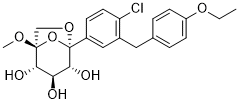
HSK0935 (HSK-0935) is a novel and potent SGLT2 inhibitor (IC50 of 1.3 nM) with potential antihyperglycemic activities. As an inhibitor of Sodium-Dependent Glucose Cotransporter 2 (SGLT2), it has the potential to be used for the Treatment of Type 2 Diabetes.
Physicochemical Properties
| Molecular Formula | C22H25CLO7 |
| Molecular Weight | 436.882706403732 |
| Exact Mass | 436.128 |
| CAS # | 1638851-44-1 |
| PubChem CID | 86282875 |
| Appearance | White to off-white solid powder |
| LogP | 1.8 |
| Hydrogen Bond Donor Count | 3 |
| Hydrogen Bond Acceptor Count | 7 |
| Rotatable Bond Count | 6 |
| Heavy Atom Count | 30 |
| Complexity | 586 |
| Defined Atom Stereocenter Count | 5 |
| SMILES | ClC1C=CC(=CC=1CC1C=CC(=CC=1)OCC)[C@]12[C@@H]([C@H]([C@@H]([C@@](CO1)(OC)O2)O)O)O |
| InChi Key | UFWQAQJFRMQRFR-CUUWFGFTSA-N |
| InChi Code | InChI=1S/C22H25ClO7/c1-3-28-16-7-4-13(5-8-16)10-14-11-15(6-9-17(14)23)22-20(26)18(24)19(25)21(27-2,30-22)12-29-22/h4-9,11,18-20,24-26H,3,10,12H2,1-2H3/t18-,19-,20+,21-,22-/m0/s1 |
| Chemical Name | (1S,2S,3R,4R,5S)-5-[4-chloro-3-[(4-ethoxyphenyl)methyl]phenyl]-1-methoxy-6,8-dioxabicyclo[3.2.1]octane-2,3,4-triol |
| Synonyms | HSK 0935 HSK-0935 HSK0935 |
| HS Tariff Code | 2934.99.9001 |
| Storage |
Powder-20°C 3 years 4°C 2 years In solvent -80°C 6 months -20°C 1 month |
| Shipping Condition | Room temperature (This product is stable at ambient temperature for a few days during ordinary shipping and time spent in Customs) |
Biological Activity
| Targets |
|
|
| ln Vitro | HSK0935 (Compound 31) has a strong hSGLT1/hSGLT2 selectivity of 843-fold and good hSGLT2 inhibition at 1.3 nM[1]. | |
| ln Vivo | In Sprague-Dawley (SD) rats, HSK0935 administration (1, 3, and 10 mg/kg) exhibits strong urine glucose excretion, but in Rhesus monkeys, it has a greater impact[1]. HSK0935 is well tolerated up to 300 mg/kg in beagle dogs, with no fatalities or serious side effects observed in a 28-day repeat-dose toxicology study[1]. | |
| References |
[1]. Discovery of a Potent, Selective Renal Sodium-Dependent Glucose Cotransporter 2 (SGLT2) Inhibitor (HSK0935) for the Treatment of Type 2 Diabetes. J Med Chem. 2017 May 25;60(10):4173-4184. |
Solubility Data
| Solubility (In Vitro) | DMSO : ~100 mg/mL (~228.90 mM) |
| Solubility (In Vivo) |
Solubility in Formulation 1: ≥ 2.5 mg/mL (5.72 mM) (saturation unknown) in 10% DMSO + 40% PEG300 + 5% Tween80 + 45% Saline (add these co-solvents sequentially from left to right, and one by one), clear solution. For example, if 1 mL of working solution is to be prepared, you can add 100 μL of 25.0 mg/mL clear DMSO stock solution to 400 μL PEG300 and mix evenly; then add 50 μL Tween-80 to the above solution and mix evenly; then add 450 μL normal saline to adjust the volume to 1 mL. Preparation of saline: Dissolve 0.9 g of sodium chloride in 100 mL ddH₂ O to obtain a clear solution. Solubility in Formulation 2: ≥ 2.5 mg/mL (5.72 mM) (saturation unknown) in 10% DMSO + 90% Corn Oil (add these co-solvents sequentially from left to right, and one by one), clear solution. For example, if 1 mL of working solution is to be prepared, you can add 100 μL of 25.0 mg/mL clear DMSO stock solution to 900 μL of corn oil and mix evenly. (Please use freshly prepared in vivo formulations for optimal results.) |
| Preparing Stock Solutions | 1 mg | 5 mg | 10 mg | |
| 1 mM | 2.2890 mL | 11.4448 mL | 22.8896 mL | |
| 5 mM | 0.4578 mL | 2.2890 mL | 4.5779 mL | |
| 10 mM | 0.2289 mL | 1.1445 mL | 2.2890 mL |