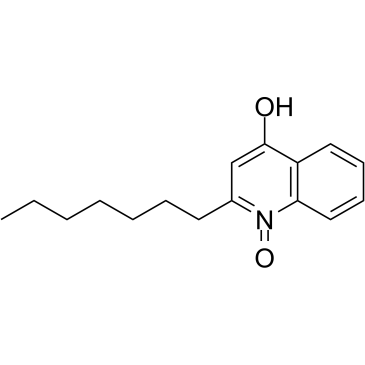
HQNO, secreted by P. aeruginosa, is a novel and potent electron transport chain inhibitor with a Kd of 64 nM for complex III. HQNO is a potent inhibitor of mitochondrial NDH-2 in many species.
Physicochemical Properties
| Molecular Formula | C16H21NO2 |
| Molecular Weight | 259.34344 |
| Exact Mass | 259.157 |
| CAS # | 341-88-8 |
| PubChem CID | 1561 |
| Appearance | Off-white to light yellow solid powder |
| Density | 1.1±0.1 g/cm3 |
| Boiling Point | 445.8±37.0 °C at 760 mmHg |
| Melting Point | 156-157ºC |
| Flash Point | 223.4±26.5 °C |
| Vapour Pressure | 0.0±1.1 mmHg at 25°C |
| Index of Refraction | 1.558 |
| LogP | 3.18 |
| Hydrogen Bond Donor Count | 1 |
| Hydrogen Bond Acceptor Count | 3 |
| Rotatable Bond Count | 6 |
| Heavy Atom Count | 19 |
| Complexity | 338 |
| Defined Atom Stereocenter Count | 0 |
| InChi Key | ICTVCUOZYWNYHM-UHFFFAOYSA-N |
| InChi Code | InChI=1S/C16H21NO2/c1-2-3-4-5-6-9-13-12-16(18)14-10-7-8-11-15(14)17(13)19/h7-8,10-12,19H,2-6,9H2,1H3 |
| Chemical Name | 2-heptyl-1-hydroxyquinolin-4-one |
| HS Tariff Code | 2934.99.9001 |
| Storage |
Powder-20°C 3 years 4°C 2 years In solvent -80°C 6 months -20°C 1 month |
| Shipping Condition | Room temperature (This product is stable at ambient temperature for a few days during ordinary shipping and time spent in Customs) |
Biological Activity
| Targets |
HQNO targets NADH dehydrogenase 2 (NDH-2) (Ki = 0.12 μM) by binding to its quinone-binding site [2] HQNO inhibits the electron transport system in anaerobic microbial heme synthesis, acting on a late step of the pathway [1] |
| ln Vitro |
HQNO is effective in reducing free radicals that are highly reactive for mitochondrial type II NADH:quinone oxidase (NDH-2) in a variety of species, such as Staphylococcus aureus, Saccharomyces cerevisiae, Gluconobacter oxidans, Toxoplasma gondii, Yarrowia lipolytica, and Plasmodium falciparum. For wild-type (WT) and I379E C, the range of HQNO concentrations was 0 to 100 μM and 0 to 300 μM, respectively. thermarum NDH-2 variations, in accordance with IC50 values. WT NDH-2's IC50 value in the presence of 400μM methoquinone (MD) is 10.5±1.3μM HQNO. The IC50 value of HQNO reduced to 7.3±1.2 μM in the presence of 50 μM MD, while >50 μM HQNO resulted in near total suppression (~15% residual activity). HQNO inhibition was measured at 50μM MD, and the IC50 value was 54.3±1.2μM[2]. In Rhodopseudomonas capsulata (anaerobic photosynthetic bacterium), HQNO at 0.5 μM significantly inhibited heme synthesis under anaerobic conditions, blocking the electron transport process required for the final steps of heme biosynthesis [1] - Against Mycobacterium tuberculosis NDH-2 (MtNDH-2), HQNO exhibited potent inhibitory activity with a Ki value of 0.12 μM, disrupting the enzyme’s ability to transfer electrons from NADH to quinone [2] - Structural analysis showed that HQNO binds to the quinone-binding pocket of MtNDH-2, forming hydrophobic interactions and hydrogen bonds with key amino acid residues, which prevents quinone substrate binding and enzyme activation [2] |
| Enzyme Assay |
MtNDH-2 inhibition assay: Recombinant MtNDH-2 was incubated with NADH (substrate), quinone acceptor, and serial dilutions of HQNO in reaction buffer. The assay monitored the oxidation of NADH by measuring absorbance at 340 nm over time. Inhibition rates were calculated by comparing NADH oxidation rates in the presence and absence of HQNO, and Ki values were derived from nonlinear regression analysis [2] - Electron transport system activity assay: Anaerobic bacterial membrane fractions (from Rhodopseudomonas capsulata) were prepared, and the electron transport chain activity was measured by monitoring the reduction of artificial electron acceptors. HQNO was added to the reaction system, and the decrease in electron transport activity was quantified to assess inhibition efficacy [1] |
| Cell Assay |
Anaerobic microbial heme synthesis assay: Rhodopseudomonas capsulata was cultured under anaerobic photosynthetic conditions in medium supplemented with 14C-labeled δ-aminolevulinic acid (precursor of heme). Different concentrations of HQNO were added, and after incubation for 24 hours, heme was extracted and the radioactivity was measured to quantify heme synthesis levels [1] |
| References |
[1]. Evidence for Involvement of the Electron Transport System at a Late Step of Anaerobic Microbial Heme Synthesis. Biochim Biophys Acta. 1977 Jan 6;459(1):141-4. [2]. Structure of the NDH-2 - HQNO Inhibited Complex Provides Molecular Insight Into Quinone-Binding Site Inhibitors. Biochim Biophys Acta Bioenerg. 2018 Jul;1859(7):482-490. |
| Additional Infomation |
2-heptyl-4-hydroxyquinoline N-oxide is an inhibitor of the mitochondrial respiratory chain at cytochrome bc1 and of photosynthetic electron flow immediately before cytochrome b559. It is a monohydroxyquinoline and a quinoline N-oxide. 2-Heptyl-4-hydroxyquinoline n-oxide has been reported in Streptomyces with data available. HQNO (2-heptyl-4-hydroxyquinoline N-oxide) is a natural product-derived inhibitor, widely used as a tool compound to study the function of NDH-2 and electron transport systems in bacteria [2] - Its mechanism of action involves competitive binding to the quinone-binding site of NDH-2, a key enzyme in bacterial respiratory chains, making it a potential lead for antibacterial drug development [2] - In anaerobic microbes, HQNO interferes with heme synthesis by blocking electron flow, which is essential for the reduction steps in heme biosynthetic pathways [1] |
Solubility Data
| Solubility (In Vitro) | DMSO : ~5 mg/mL (~19.28 mM) |
| Solubility (In Vivo) |
Solubility in Formulation 1: 0.5 mg/mL (1.93 mM) in 10% DMSO + 40% PEG300 + 5% Tween80 + 45% Saline (add these co-solvents sequentially from left to right, and one by one), suspension solution; with sonication. For example, if 1 mL of working solution is to be prepared, you can add 100 μL of 5.0 mg/mL clear DMSO stock solution to 400 μL PEG300 and mix evenly; then add 50 μL Tween-80 to the above solution and mix evenly; then add 450 μL normal saline to adjust the volume to 1 mL. Preparation of saline: Dissolve 0.9 g of sodium chloride in 100 mL ddH₂ O to obtain a clear solution. Solubility in Formulation 2: ≥ 0.5 mg/mL (1.93 mM) (saturation unknown) in 10% DMSO + 90% Corn Oil (add these co-solvents sequentially from left to right, and one by one), clear solution. For example, if 1 mL of working solution is to be prepared, you can add 100 μL of 5.0 mg/mL clear DMSO stock solution to 900 μL of corn oil and mix evenly. (Please use freshly prepared in vivo formulations for optimal results.) |
| Preparing Stock Solutions | 1 mg | 5 mg | 10 mg | |
| 1 mM | 3.8559 mL | 19.2797 mL | 38.5594 mL | |
| 5 mM | 0.7712 mL | 3.8559 mL | 7.7119 mL | |
| 10 mM | 0.3856 mL | 1.9280 mL | 3.8559 mL |