Physicochemical Properties
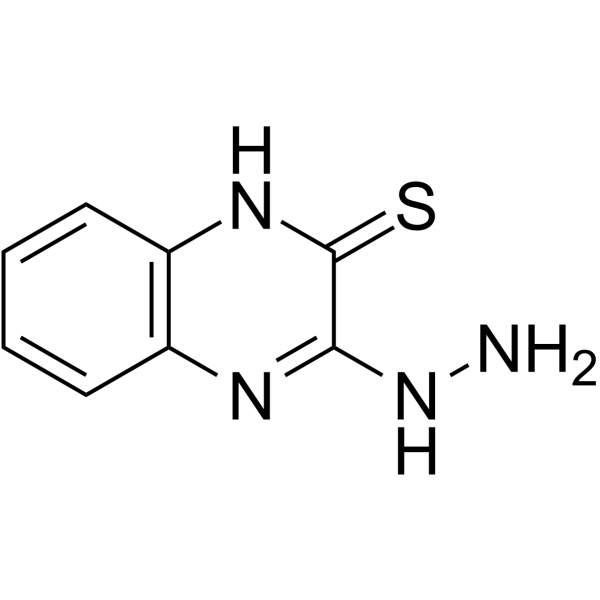
| Molecular Formula | C8H8N4S |
| Molecular Weight | 192.24 |
| Exact Mass | 192.047 |
| CAS # | 13080-21-2 |
| PubChem CID | 781248 |
| Appearance | Light yellow to yellow solid powder |
| Density | 1.55g/cm3 |
| Boiling Point | 376.1ºC at 760 mmHg |
| Flash Point | 181.3ºC |
| Vapour Pressure | 7.41E-06mmHg at 25°C |
| Index of Refraction | 1.794 |
| LogP | 1.977 |
| Hydrogen Bond Donor Count | 3 |
| Hydrogen Bond Acceptor Count | 3 |
| Rotatable Bond Count | 1 |
| Heavy Atom Count | 13 |
| Complexity | 251 |
| Defined Atom Stereocenter Count | 0 |
| InChi Key | TVYAHCDRRICQJM-UHFFFAOYSA-N |
| InChi Code | InChI=1S/C8H8N4S/c9-12-7-8(13)11-6-4-2-1-3-5(6)10-7/h1-4H,9H2,(H,10,12)(H,11,13) |
| Chemical Name | 3-hydrazinyl-1H-quinoxaline-2-thione |
| Synonyms | HPi 1; HPi-1; HPi1 |
| HS Tariff Code | 2934.99.9001 |
| Storage |
Powder-20°C 3 years 4°C 2 years In solvent -80°C 6 months -20°C 1 month |
| Shipping Condition | Room temperature (This product is stable at ambient temperature for a few days during ordinary shipping and time spent in Customs) |
Biological Activity
| ln Vitro | The MIC range of H. pylori isolates in the agar dilution assay ranged from 0.01-0.17 μM, or 0.002-0.032 μg/mL. The strains ARHp172 (MIC 0.004–0.016 μg/mL) and ARHp246 (MIC 0.008–0.032 μg/mL) that are resistant to clarithromycin can be effectively inhibited by HPi1 [1]. Although HPi1 is at least eighteen times more concentrated than the minimum inhibitory concentration of Helicobacter pylori, it exhibits modest effect against Bacteroidetes. A MIC of 0.3 μg/mL was shown to indicate more powerful action for Campylobacter jejuni [1]. It has been observed that HPi1 possesses favorable physicochemical and pharmacological characteristics, such as determined water solubility (19 μg/mL), 93% binding to human plasma protein, human liver microsomal stability (T1/2 of 1.3 hours), and passively permeable membrane Ability[1]. |
| ln Vivo | At doses of 25 or 50 mg/kg/day, treatment with HPi1 (6.25-50 mg/kg; oral gavage; once daily; for 3 days; female C57BL/6 mice) decreased colony counts below the detection limit [ 1]. |
| Animal Protocol |
Animal/Disease Models: Adult specific pathogen-free female C57BL/6 mice (6-8 weeks old), fed Helicobacter pylori SS1 suspension [1] Doses: 6.25 mg/kg, 12.5 mg/kg, 25 mg/kg, 50 mg/kg Doses: po (oral gavage); one time/day; for 3 days. Experimental Results: The colony count diminished below the detection limit. |
| References |
[1]. In vitro and in vivo activities of HPi1, a selective antimicrobial against Helicobacter pylori. Antimicrob Agents Chemother. 2014 Jun;58(6):3255-60. |
Solubility Data
| Solubility (In Vitro) | DMSO : ~62.5 mg/mL (~325.11 mM) |
| Solubility (In Vivo) |
Solubility in Formulation 1: ≥ 2.08 mg/mL (10.82 mM) (saturation unknown) in 10% DMSO + 90% (20% SBE-β-CD in Saline) (add these co-solvents sequentially from left to right, and one by one), clear solution. For example, if 1 mL of working solution is to be prepared, you can add 100 μL of 20.8 mg/mL clear DMSO stock solution to 900 μL of 20% SBE-β-CD physiological saline solution and mix evenly. Preparation of 20% SBE-β-CD in Saline (4°C,1 week): Dissolve 2 g SBE-β-CD in 10 mL saline to obtain a clear solution. (Please use freshly prepared in vivo formulations for optimal results.) |
| Preparing Stock Solutions | 1 mg | 5 mg | 10 mg | |
| 1 mM | 5.2018 mL | 26.0092 mL | 52.0183 mL | |
| 5 mM | 1.0404 mL | 5.2018 mL | 10.4037 mL | |
| 10 mM | 0.5202 mL | 2.6009 mL | 5.2018 mL |