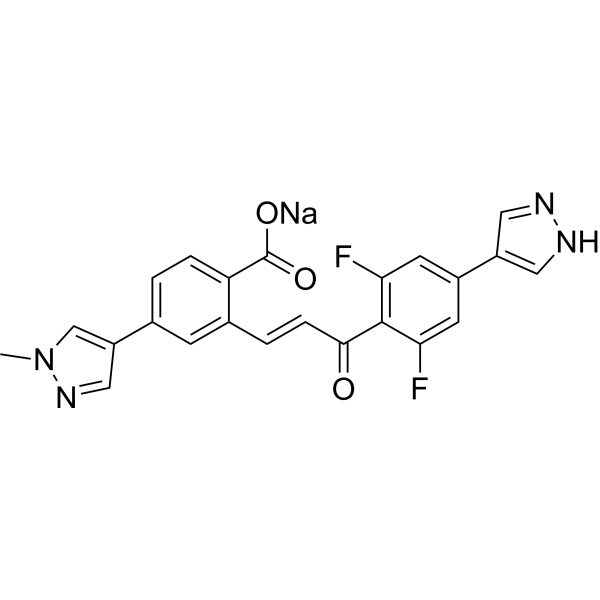
Physicochemical Properties
| Molecular Formula | C23H15F2N4NAO3 |
| Molecular Weight | 456.38 |
| Appearance | Off-white to light yellow solid powder |
| HS Tariff Code | 2934.99.9001 |
| Storage |
Powder-20°C 3 years 4°C 2 years In solvent -80°C 6 months -20°C 1 month Note: Please store this product in a sealed and protected environment (e.g. under nitrogen), avoid exposure to moisture and light. |
| Shipping Condition | Room temperature (This product is stable at ambient temperature for a few days during ordinary shipping and time spent in Customs) |
Biological Activity
| ln Vitro | At an IC50 value of 100 μM, HOIPIN-8 (0-100 μM; 72 hours) exhibits nearly little cytotoxicity against A549 cells[1]. HOIPIN-8 (0–10 μM; 24 hours) inhibits NF-κB activation more than ten times more than HOIPIN-1, which has an IC50 value of 0.42 μM in HEK293T cells [1]. With an IC50 value of 11.9 μM, HOIPIN-8 (0-30 μM) is 4 times more successful than HOIPIN-1, which transfects cells with the NF-κB luciferase reporter gene for 18 hours before transfecting them with 10 ng/mL TNF-α for 6 hours. It is also more effective than HOIPIN-1 at reducing the expression of NF-κB target genes (including ICAM1 and IL-6) that are triggered by IL-1β [1]. |
| Cell Assay |
Cell Viability Assay[1] Cell Types: Human lung carcinoma A549 cells, HEK293T cells Tested Concentrations: 0 μM; 1 μM; 3 μM; 10 μM; 30 μM; 100 μM Incubation Duration: 72 hrs (hours) Experimental Results: Did not effect A549 cell viability. RT-PCR[1] Cell Types: HEK293T cells Tested Concentrations: 0 μM; 0.3 μM; 1 μM; 10 μM; 30 μM Incubation Duration: 24 hrs (hours) Experimental Results: Had an inhibitory effect on the inflammatory cytokine-induced NF-κB activation pathway. |
| References |
[1]. Small-molecule Inhibitors of Linear Ubiquitin Chain Assembly Complex (LUBAC), HOIPINs, Suppress NF-κB Signaling. Biochem Biophys Res Commun. 2019 Feb 12;509(3):700-706. |
Solubility Data
| Solubility (In Vitro) | DMSO :~100 mg/mL (~219.12 mM) |
| Solubility (In Vivo) |
Solubility in Formulation 1: 1.25 mg/mL (2.74 mM) in 10% DMSO + 40% PEG300 + 5% Tween80 + 45% Saline (add these co-solvents sequentially from left to right, and one by one), clear solution; with sonication. For example, if 1 mL of working solution is to be prepared, you can add 100 μL of 12.5 mg/mL clear DMSO stock solution to 400 μL PEG300 and mix evenly; then add 50 μL Tween-80 to the above solution and mix evenly; then add 450 μL normal saline to adjust the volume to 1 mL. Preparation of saline: Dissolve 0.9 g of sodium chloride in 100 mL ddH₂ O to obtain a clear solution. Solubility in Formulation 2: ≥ 1.25 mg/mL (2.74 mM) (saturation unknown) in 10% DMSO + 90% (20% SBE-β-CD in Saline) (add these co-solvents sequentially from left to right, and one by one), clear solution. For example, if 1 mL of working solution is to be prepared, you can add 100 μL of 12.5 mg/mL clear DMSO stock solution to 900 μL of 20% SBE-β-CD physiological saline solution and mix evenly. Preparation of 20% SBE-β-CD in Saline (4°C,1 week): Dissolve 2 g SBE-β-CD in 10 mL saline to obtain a clear solution. Solubility in Formulation 3: 1.25 mg/mL (2.74 mM) in 10% DMSO + 90% Corn Oil (add these co-solvents sequentially from left to right, and one by one), clear solution; with ultrasonication. For example, if 1 mL of working solution is to be prepared, you can add 100 μL of 12.5 mg/mL clear DMSO stock solution to 900 μL of corn oil and mix evenly. (Please use freshly prepared in vivo formulations for optimal results.) |
| Preparing Stock Solutions | 1 mg | 5 mg | 10 mg | |
| 1 mM | 2.1912 mL | 10.9558 mL | 21.9116 mL | |
| 5 mM | 0.4382 mL | 2.1912 mL | 4.3823 mL | |
| 10 mM | 0.2191 mL | 1.0956 mL | 2.1912 mL |