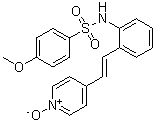
Physicochemical Properties
| Molecular Formula | C20H18N2O4S |
| Molecular Weight | 382.432923793793 |
| Exact Mass | 382.099 |
| Elemental Analysis | C, 62.81; H, 4.74; N, 7.33; O, 16.73; S, 8.38 |
| CAS # | 173529-10-7 |
| Related CAS # | 173529-10-7 |
| PubChem CID | 12134997 |
| Appearance | White to off-white solid powder |
| LogP | 3.758 |
| Hydrogen Bond Donor Count | 1 |
| Hydrogen Bond Acceptor Count | 6 |
| Rotatable Bond Count | 4 |
| Heavy Atom Count | 27 |
| Complexity | 846 |
| Defined Atom Stereocenter Count | 0 |
| SMILES | S(C1C=CC(=CC=1)OC)(N=C1C=CC=CC1=C/C=C1/C=CN(C=C/1)O)(=O)=O |
| InChi Key | MYEJOKLXXLVMPR-STNHEDLKSA-N |
| InChi Code | InChI=1S/C20H18N2O4S/c1-26-18-8-10-19(11-9-18)27(24,25)21-20-5-3-2-4-17(20)7-6-16-12-14-22(23)15-13-16/h2-15,23H,1H3/b17-7+,21-20+ |
| Chemical Name | (NE)-N-[(6E)-6-[2-(1-hydroxypyridin-4-ylidene)ethylidene]cyclohexa-2,4-dien-1-ylidene]-4-methoxybenzenesulfonamide |
| Synonyms | HMN176; HMN-176; HMN 176 |
| HS Tariff Code | 2934.99.9001 |
| Storage |
Powder-20°C 3 years 4°C 2 years In solvent -80°C 6 months -20°C 1 month |
| Shipping Condition | Room temperature (This product is stable at ambient temperature for a few days during ordinary shipping and time spent in Customs) |
Biological Activity
| Targets | PLK1 |
| ln Vitro | HMN-176 (2.5 μM) greatly increases the duration of mitosis in hTERT-RPE1 and CFPAC-1 Cell lines. Microtubule polymerization effects do not seem to be connected to spindle morphology effects of HMN-176. Aster formation is inhibited in a concentration-dependent manner by HMN-176 at 2.5, 0.25, and 0.025 μM[1]. Samples of ovarian, breast, and nonsmall-cell lung cancers show the greatest activity when exposed to HMN-176 (0.1, 1.0, or 10.0 µg/mL), which has inhibitory effects on a variety of tumors. 67% of non-small cell lung (4/6), 57% of breast (5/8), and 4/7 of ovarian tumor specimens treated with 10.0 µg/mL exhibit activity towards HMN-176[2]. The mean IC50 value of HMN-176 is 118 nM, indicating strong cytotoxicity. Regarding tumors with diverse features originating from different organs, HMN-176 exhibits comparable cytotoxicity[3]. Suppression of MDR1 mRNA expression by 56% occurs upon treatment with 3 μM HMN-176. On the residual promoter activity, HMN-176 has no discernible effect[4]. |
| ln Vivo | Plasma levels of HMN-176 peak at 2 hours and then progressively decline after p.o. of HMN-214 to male rats, but no prodrug is found in the plasma[3]. |
| Cell Assay | The test cells are seeded at a density of 3 ×10³–1×10⁴ cells/well into a 96-well microplate. The following day, medications are added, and the plate is kept in a humidified incubator with 5% CO2 and 95% air for 72 hours at 37 °C. The Scansoft 96 software calculates the concentration needed to produce 50% inhibition of growth (IC50), and the MTT assay is used to measure the amount of growth inhibition. The reference agents and HMN-176 IC50 values are shown. In summary, each compound's mean IC50 value across all tested cell lines is determined, and a bar projecting to the right or left of the mean indicates the difference between the IC50 values for each individual cell line and the mean IC50 value (log10). (IC50 value for drug-resistant cell line) / (IC50 for parent cell line) yields the resistance index. |
| Animal Protocol | Male SD rats are given injections of 14C-HMN-214 and 14C-HMN-176 at doses of 33 (or 30 mg/kg of HMN-176) and 30 mg/kg, respectively. At predetermined times, blood samples are collected, and a liquid scintillation counter is used to measure the radioactivity levels in the plasma. Additionally, male rats are given unlabeled HMN-214 (33 mg/kg), and high performance liquid chromatography is used to measure the amounts of HMN-214 and HMN-176 in the plasma. |
| References |
[1]. The small organic compound HMN-176 delays satisfaction of the spindle assembly checkpoint by inhibiting centrosome-dependent microtubule nucleation. Mol Cancer Ther. 2009 Mar;8(3):592-601. [2]. Investigation of HMN-176 anticancer activity in human tumor specimens in vitro and the effects of HMN-176 on differential gene expression. Invest New Drugs. 2005 Jan;23(1):3-9. [3]. In vivo antitumor activity of a novel sulfonamide, HMN-214, against human tumor xenografts in mice and the spectrum of cytotoxicity of its active metabolite, HMN-176. Invest New Drugs. 2003 Nov;21(4):387-99. [4]. HMN-176, an active metabolite of the synthetic antitumor agent HMN-214, restores chemosensitivity to multidrug-resistant cells by targeting the transcription factor NF-Y. Cancer Res. 2003 Oct 15;63(20):6942-7. [5]. A phase I pharmacokinetic study of HMN-214, a novel oral stilbene derivative with polo-like kinase-1-interacting properties, in patients with advanced solid tumors. Clin Cancer Res. 2006 Sep 1;12(17):5182-9. |
Solubility Data
| Solubility (In Vitro) | DMSO: ≥ 30 mg/mL (~78.5 mM) |
| Solubility (In Vivo) |
Note: Listed below are some common formulations that may be used to formulate products with low water solubility (e.g. < 1 mg/mL), you may test these formulations using a minute amount of products to avoid loss of samples. Injection Formulations (e.g. IP/IV/IM/SC) Injection Formulation 1: DMSO : Tween 80: Saline = 10 : 5 : 85 (i.e. 100 μL DMSO stock solution → 50 μL Tween 80 → 850 μL Saline) *Preparation of saline: Dissolve 0.9 g of sodium chloride in 100 mL ddH ₂ O to obtain a clear solution. Injection Formulation 2: DMSO : PEG300 :Tween 80 : Saline = 10 : 40 : 5 : 45 (i.e. 100 μL DMSO → 400 μLPEG300 → 50 μL Tween 80 → 450 μL Saline) Injection Formulation 3: DMSO : Corn oil = 10 : 90 (i.e. 100 μL DMSO → 900 μL Corn oil) Example: Take the Injection Formulation 3 (DMSO : Corn oil = 10 : 90) as an example, if 1 mL of 2.5 mg/mL working solution is to be prepared, you can take 100 μL 25 mg/mL DMSO stock solution and add to 900 μL corn oil, mix well to obtain a clear or suspension solution (2.5 mg/mL, ready for use in animals). Injection Formulation 4: DMSO : 20% SBE-β-CD in saline = 10 : 90 [i.e. 100 μL DMSO → 900 μL (20% SBE-β-CD in saline)] *Preparation of 20% SBE-β-CD in Saline (4°C,1 week): Dissolve 2 g SBE-β-CD in 10 mL saline to obtain a clear solution. Injection Formulation 5: 2-Hydroxypropyl-β-cyclodextrin : Saline = 50 : 50 (i.e. 500 μL 2-Hydroxypropyl-β-cyclodextrin → 500 μL Saline) Injection Formulation 6: DMSO : PEG300 : castor oil : Saline = 5 : 10 : 20 : 65 (i.e. 50 μL DMSO → 100 μLPEG300 → 200 μL castor oil → 650 μL Saline) Injection Formulation 7: Ethanol : Cremophor : Saline = 10: 10 : 80 (i.e. 100 μL Ethanol → 100 μL Cremophor → 800 μL Saline) Injection Formulation 8: Dissolve in Cremophor/Ethanol (50 : 50), then diluted by Saline Injection Formulation 9: EtOH : Corn oil = 10 : 90 (i.e. 100 μL EtOH → 900 μL Corn oil) Injection Formulation 10: EtOH : PEG300:Tween 80 : Saline = 10 : 40 : 5 : 45 (i.e. 100 μL EtOH → 400 μLPEG300 → 50 μL Tween 80 → 450 μL Saline) Oral Formulations Oral Formulation 1: Suspend in 0.5% CMC Na (carboxymethylcellulose sodium) Oral Formulation 2: Suspend in 0.5% Carboxymethyl cellulose Example: Take the Oral Formulation 1 (Suspend in 0.5% CMC Na) as an example, if 100 mL of 2.5 mg/mL working solution is to be prepared, you can first prepare 0.5% CMC Na solution by measuring 0.5 g CMC Na and dissolve it in 100 mL ddH2O to obtain a clear solution; then add 250 mg of the product to 100 mL 0.5% CMC Na solution, to make the suspension solution (2.5 mg/mL, ready for use in animals). Oral Formulation 3: Dissolved in PEG400 Oral Formulation 4: Suspend in 0.2% Carboxymethyl cellulose Oral Formulation 5: Dissolve in 0.25% Tween 80 and 0.5% Carboxymethyl cellulose Oral Formulation 6: Mixing with food powders Note: Please be aware that the above formulations are for reference only. InvivoChem strongly recommends customers to read literature methods/protocols carefully before determining which formulation you should use for in vivo studies, as different compounds have different solubility properties and have to be formulated differently. (Please use freshly prepared in vivo formulations for optimal results.) |
| Preparing Stock Solutions | 1 mg | 5 mg | 10 mg | |
| 1 mM | 2.6149 mL | 13.0743 mL | 26.1486 mL | |
| 5 mM | 0.5230 mL | 2.6149 mL | 5.2297 mL | |
| 10 mM | 0.2615 mL | 1.3074 mL | 2.6149 mL |