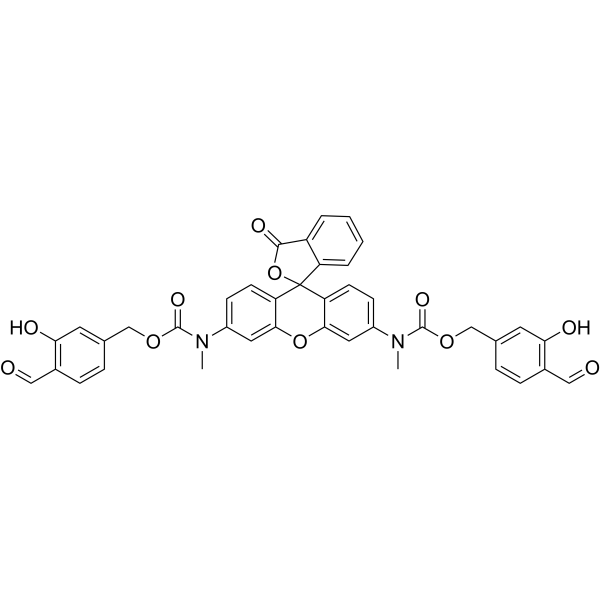
Physicochemical Properties
| Molecular Formula | C40H30N2O11 |
| Molecular Weight | 714.673011302948 |
| Exact Mass | 714.184 |
| CAS # | 2240163-05-5 |
| PubChem CID | 162640794 |
| Appearance | Yellow to orange solid powder |
| LogP | 6 |
| Hydrogen Bond Donor Count | 2 |
| Hydrogen Bond Acceptor Count | 11 |
| Rotatable Bond Count | 10 |
| Heavy Atom Count | 53 |
| Complexity | 1280 |
| Defined Atom Stereocenter Count | 0 |
| SMILES | O=C1C2=CC=CC=C2C2(C3=CC=C(N(C)C(=O)OCC4C=CC(C=O)=C(O)C=4)C=C3OC3=CC(N(C)C(=O)OCC4C=CC(C=O)=C(O)C=4)=CC=C23)O1 |
| InChi Key | WOSPPMBMPHNEFP-UHFFFAOYSA-N |
| InChi Code | InChI=1S/C40H30N2O11/c1-41(38(48)50-21-23-7-9-25(19-43)33(45)15-23)27-11-13-31-35(17-27)52-36-18-28(42(2)39(49)51-22-24-8-10-26(20-44)34(46)16-24)12-14-32(36)40(31)30-6-4-3-5-29(30)37(47)53-40/h3-20,45-46H,21-22H2,1-2H3 |
| Chemical Name | (4-formyl-3-hydroxyphenyl)methyl N-[6'-[(4-formyl-3-hydroxyphenyl)methoxycarbonyl-methylamino]-3-oxospiro[2-benzofuran-1,9'-xanthene]-3'-yl]-N-methylcarbamate |
| HS Tariff Code | 2934.99.9001 |
| Storage |
Powder-20°C 3 years 4°C 2 years In solvent -80°C 6 months -20°C 1 month Note: This product requires protection from light (avoid light exposure) during transportation and storage. |
| Shipping Condition | Room temperature (This product is stable at ambient temperature for a few days during ordinary shipping and time spent in Customs) |
Biological Activity
| ln Vitro | 1. 1.1 Creating the working solution for HKPerox-1 Dilute 1 milligram of HKPerox-1 with 140 μL of anhydrous DMF to create a 10 mM stock solution. It is advised that HKPerox-1 storage solution be aliquoted and kept in the dark at -20°C or -80°C. 1.2 Making the working solution: To make a 1-10 μM HKPerox-1 working solution, use warmed serum-free cell culture medium or PBS dilution stock solution. Note: Please be ready for instant use by adjusting the HKPerox-1 working fluid concentration based on the current circumstances. 2. Staining cells (suspension cells) 2.1 Centrifuge the cells, add PBS, then wash twice for five minutes each. One x 10^6 cells per milliliter. 2.2 After adding 1 mL of HKPerox-1 working solution, let it sit at room temperature for a duration of 5 to 30 minutes. 2.3 Discard the supernatant after centrifuging for 3–4 minutes at 400 g. 2.4 Add PBS and give the cells two 5-minute washing cycles. 2.5 Use a flow cytometer or fluorescence microscope to view the cells after resuspending them in 1 mL of serum-free media or PBS. 3. 3. Culture adherent cells on sterile coverslips for cell labeling (adherent cells). 3.2 Take off the coverslip from the culture media and use an aspirator to remove any extra. 3.3 Add 100 μL of the dye working solution, give the cells a gentle shake to cover them completely, and then let them sit for five to thirty minutes. 3.4 Aspirate the dye working solution, rinse with culture medium two or three times for five minutes each time, and use a flow cytometer or fluorescence microscope to monitor. |
| References |
[1]. Trends Cell Biol. 2007 Sep;17(9):422-7. doi: 10.1016/j.tcb.2007.07.009. Epub 2007 Sep 4. [2]. Tandem Payne/Dakin Reaction: A New Strategy for Hydrogen Peroxide Detection and Molecular Imaging. Angew Chem Int Ed Engl. 2018 Aug 6;57(32):10173-10177. |
Solubility Data
| Solubility (In Vitro) | DMF: 50 mg/mL (69.96 mM) |
| Solubility (In Vivo) |
Solubility in Formulation 1: 2.5 mg/mL (3.50 mM) = in 10% DMSO + 40% PEG300 + 5% Tween80 + 45% Saline (add these co-solvents sequentially from left to right, and one by one), suspension solution; with sonication. For example, if 1 mL of working solution is to be prepared, you can add 100 μL of 25.0 mg/mL clear DMSO stock solution to 400 μL PEG300 and mix evenly; then add 50 μL Tween-80 to the above solution and mix evenly; then add 450 μL normal saline to adjust the volume to 1 mL. Preparation of saline: Dissolve 0.9 g of sodium chloride in 100 mL ddH₂ O to obtain a clear solution. Solubility in Formulation 2: ≥ 2.5 mg/mL (3.50 mM) (saturation unknown) in 10% DMSO + 90% Corn Oil (add these co-solvents sequentially from left to right, and one by one), clear solution. For example, if 1 mL of working solution is to be prepared, you can add 100 μL of 25.0 mg/mL clear DMSO stock solution to 900 μL of corn oil and mix evenly.= Solubility in Formulation 3: 1.25 mg/mL (1.75 mM) in 10% DMF 40% PEG300 + 5% Tween80 + 45% Saline (add these co-solvents sequentially from left to right, and one by one), suspension solution; with ultrasonication. Preparation of saline: Dissolve 0.9 g of sodium chloride in 100 mL ddH₂ O to obtain a clear solution. Solubility in Formulation 4: ≥ 1.25 mg/mL (1.75 mM) (saturation unknown) in 10% DMF 90% Corn Oil (add these co-solvents sequentially from left to right, and one by one), clear solution. (Please use freshly prepared in vivo formulations for optimal results.) |
| Preparing Stock Solutions | 1 mg | 5 mg | 10 mg | |
| 1 mM | 1.3992 mL | 6.9962 mL | 13.9925 mL | |
| 5 mM | 0.2798 mL | 1.3992 mL | 2.7985 mL | |
| 10 mM | 0.1399 mL | 0.6996 mL | 1.3992 mL |