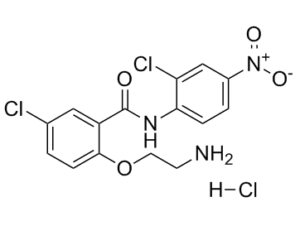
HJC0152 hydrochloride is a novel, orally bioavailable and potent inhibitor of the signal transducers and activators of transcription 3 (STAT3). It has potential application for treating human head and neck squamous cell carcinoma (HNSCC). HJC0152 has been demonstrated to significantly suppress MDA-MB-231 xenograft tumor growth in vivo (i.p. & p.o.), indicating its great potential as efficacious and orally bioavailable therapeutics for human cancers. HJC0152 was designed and developed based on niclosamide which has been identified to potently inhibit the activation, nuclear translocation, and transactivation of STAT3 but with pharmacokinetics such as poor aqueous solubility and bioavailability of niclosamide. HJC0152 has improved pharmacokinetic profiles.
Physicochemical Properties
| Molecular Formula | C15H14CL3N3O4 | |
| Molecular Weight | 406.64 | |
| Exact Mass | 405.004 | |
| CAS # | 1420290-99-8 | |
| Related CAS # | HJC0152 free base;1420290-88-5 | |
| PubChem CID | 71719978 | |
| Appearance | Light yellow to yellow solid powder | |
| Hydrogen Bond Donor Count | 3 | |
| Hydrogen Bond Acceptor Count | 5 | |
| Rotatable Bond Count | 5 | |
| Heavy Atom Count | 25 | |
| Complexity | 449 | |
| Defined Atom Stereocenter Count | 0 | |
| InChi Key | XRZHLOYBZOONSZ-UHFFFAOYSA-N | |
| InChi Code | InChI=1S/C15H13Cl2N3O4.ClH/c16-9-1-4-14(24-6-5-18)11(7-9)15(21)19-13-3-2-10(20(22)23)8-12(13)17;/h1-4,7-8H,5-6,18H2,(H,19,21);1H | |
| Chemical Name |
|
|
| Synonyms |
|
|
| HS Tariff Code | 2934.99.9001 | |
| Storage |
Powder-20°C 3 years 4°C 2 years In solvent -80°C 6 months -20°C 1 month Note: Please store this product in a sealed and protected environment, avoid exposure to moisture. |
|
| Shipping Condition | Room temperature (This product is stable at ambient temperature for a few days during ordinary shipping and time spent in Customs) |
Biological Activity
| ln Vitro |
At concentrations of 1, 5, and 10 μM, HJC0152 (compound 11) dramatically reduced cell proliferation and induced apoptosis along with alterations in cell morphology. The findings demonstrated that treatment with 10 μM HJC0152 decreased STAT3 promoter activity in MDA-MB-231 cells by roughly 32% in comparison to the control, and that STAT3 promoter activity was further reduced by 62% upon increasing the dose of HJC0152 to 20 μM. Following HJC0152 treatment, total STAT3 fell. In MDA-MB-231 cells, HJC0152 downregulates cyclin D1 and induces cleaved caspase-3 [1]. HJC0152 hydrochloride exhibited potent antiproliferative activity against multiple human cancer cell lines: IC50 = 0.3 μM (A549 lung cancer), IC50 = 0.5 μM (HCT116 colorectal cancer), IC50 = 0.7 μM (MCF-7 breast cancer), IC50 = 0.4 μM (HepG2 hepatocellular carcinoma), and IC50 = 0.6 μM (MDA-MB-231 breast cancer) after 72 hours of treatment [1] - HJC0152 hydrochloride (1 μM) induced apoptotic cell death in HCT116 cells, with apoptotic rate of 42% after 48 hours; Western blot showed increased cleaved caspase-3 (3.2-fold) and cleaved PARP (2.8-fold) expression, along with decreased Bcl-2 (55% reduction) and increased Bax (2.1-fold) expression [1] - HJC0152 hydrochloride (0.5 μM) inhibited colony formation of A549 cells by 75% compared to control, suppressing anchorage-dependent growth [1] - HJC0152 hydrochloride (0.1-2 μM) dose-dependently blocked Wnt/β-catenin signaling in HCT116 cells, reducing β-catenin nuclear translocation by 60% at 1 μM and downregulating downstream target genes (c-Myc, Cyclin D1) mRNA levels by 45% and 50% respectively [1] - HJC0152 hydrochloride showed low cytotoxicity to normal human colon fibroblasts (CCD-18Co) with CC50 = 25 μM, resulting in a therapeutic index (CC50/IC50) of >50 for HCT116 cells [1] |
| ln Vivo |
Compound 11 (HJC0152; 7.5, 25 mg/kg, ip) prevents transplanted tumors in mice from growing. Furthermore, HJC0152 did not exhibit any overt toxicity at a 75 mg/kg dose [1]. Nude mice (BALB/c-nu) bearing HCT116 colorectal cancer xenografts were administered HJC0152 hydrochloride (10, 20 mg/kg, oral gavage, once daily for 14 days). The 20 mg/kg group showed 68% tumor growth inhibition and 25% reduction in tumor weight, with no significant weight loss (<5% change) [1] - HJC0152 hydrochloride (20 mg/kg, po) treatment in xenograft mice downregulated β-catenin and c-Myc protein expression in tumor tissues by 62% and 58% respectively, as detected by immunohistochemistry [1] |
| Cell Assay |
Antiproliferation assay: A549, HCT116, MCF-7, HepG2, and MDA-MB-231 cells were cultured in RPMI 1640 or DMEM medium supplemented with fetal bovine serum. Cells were treated with HJC0152 hydrochloride (0.01-10 μM) for 72 hours, and cell viability was assessed by MTT assay; IC50 values were derived from dose-response curves [1] - Apoptosis assay: HCT116 cells were treated with HJC0152 hydrochloride (1 μM) for 48 hours, stained with Annexin V-FITC/PI, and analyzed by flow cytometry to quantify apoptotic cells; total protein was extracted for Western blot detection of apoptosis-related proteins [1] - Colony formation assay: A549 cells were seeded in 6-well plates at low density, treated with HJC0152 hydrochloride (0.1-1 μM) for 14 days, fixed with methanol, stained with crystal violet, and visible colonies were counted [1] - Wnt/β-catenin signaling assay: HCT116 cells were treated with HJC0152 hydrochloride (0.1-2 μM) for 24 hours. Nuclear and cytoplasmic fractions were isolated to detect β-catenin distribution by Western blot; total RNA was extracted for RT-PCR quantification of c-Myc and Cyclin D1 mRNA levels [1] - Normal cell cytotoxicity assay: CCD-18Co cells were seeded in 96-well plates, treated with HJC0152 hydrochloride (0.1-50 μM) for 72 hours, and cell viability was measured by MTT assay to calculate CC50 [1] |
| Animal Protocol |
7.5 mg/kg; i.p. Female nude mice Colorectal cancer xenograft model: 6-8 weeks old BALB/c-nu nude mice were subcutaneously injected with HCT116 cells (5×10⁶ cells/mouse) to establish xenograft tumors. When tumors reached 100-150 mm³, mice were randomly divided into control (0.5% carboxymethylcellulose sodium) and HJC0152 hydrochloride groups (10, 20 mg/kg). The drug was suspended in 0.5% carboxymethylcellulose sodium and administered via oral gavage once daily for 14 days. Tumor volume was measured every 3 days; mice were euthanized on day 15, and tumor tissues were collected for immunohistochemical analysis of β-catenin and c-Myc [1] |
| ADME/Pharmacokinetics |
Oral bioavailability of HJC0152 hydrochloride in rats was 45% after a 30 mg/kg dose [1] - The drug showed a terminal elimination half-life (t1/2) of 5.8 hours in rat plasma and a peak plasma concentration (Cmax) of 180 ng/mL at 1.5 hours post-oral dosing [1] - Plasma protein binding rate of HJC0152 hydrochloride was 92% in human plasma and 90% in rat plasma [1] - HJC0152 hydrochloride was stable in human liver microsomes with a half-life of 4.2 hours, showing low metabolic clearance [1] |
| Toxicity/Toxicokinetics |
HJC0152 hydrochloride (≤10 μM) showed no significant cytotoxicity to normal human fibroblasts (CCD-18Co) and hepatocytes (HL-7702), with cell viability >85% after 72 hours [1] - Acute toxicity in mice: Oral LD50 was >200 mg/kg; no treatment-related death or obvious clinical signs were observed at doses ≤150 mg/kg [1] - Subchronic toxicity study (14 days) in rats administered HJC0152 hydrochloride (20, 40 mg/kg/day, po) showed no significant changes in serum ALT, AST, creatinine, or blood urea nitrogen levels, and no pathological damage in liver, kidney, heart, or lung [1] |
| References |
[1]. Discovery of O-Alkylamino Tethered Niclosamide Derivatives as Potent and Orally Bioavailable Anticancer Agents. ACS Med Chem Lett. 2013 Feb 14;4(2):180-185. |
| Additional Infomation |
HJC0152 hydrochloride is a synthetic O-alkylamino tethered niclosamide derivative, optimized for improved oral bioavailability compared to the parent compound niclosamide [1] - Its anti-tumor mechanism involves inhibition of the Wnt/β-catenin signaling pathway, induction of mitochondrial-mediated apoptosis, and suppression of cancer cell proliferation and colony formation [1] - The drug exhibits potent activity against a broad range of solid tumors (lung, colorectal, breast, liver cancer) with favorable therapeutic index and oral bioavailability, supporting its potential as an oral anticancer agent [1] - HJC0152 hydrochloride maintains the core pharmacophore of niclosamide while improving aqueous solubility and oral absorption, addressing the poor bioavailability limitation of niclosamide [1] |
Solubility Data
| Solubility (In Vitro) |
|
|||
| Solubility (In Vivo) |
Solubility in Formulation 1: 10 mg/mL (24.59 mM) in 50% PEG300 +50% Saline (add these co-solvents sequentially from left to right, and one by one), suspension solution; with sonication. Preparation of saline: Dissolve 0.9 g of sodium chloride in 100 mL ddH₂ O to obtain a clear solution. (Please use freshly prepared in vivo formulations for optimal results.) |
| Preparing Stock Solutions | 1 mg | 5 mg | 10 mg | |
| 1 mM | 2.4592 mL | 12.2959 mL | 24.5918 mL | |
| 5 mM | 0.4918 mL | 2.4592 mL | 4.9184 mL | |
| 10 mM | 0.2459 mL | 1.2296 mL | 2.4592 mL |