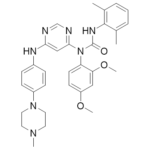
HG-9-91-01 (HG9-91-01) is a novel, potent and highly selective inhibitor of salt-inducible kinase (SIKs) with antidiabetic effects. It inhibits SIK1/2/3 with IC50s of 0.92 nM, 6.6 nM and 9.6 nM, respectively. The selective SIK inhibitor HG-9-91-01 promotes dephosphorylation of transcriptional co-activators CRTC2/3 resulting in enhanced gluconeogenic gene expression and glucose production in hepatocytes, an effect that is abolished when an HG-9-91-01-insensitive mutant SIK is introduced or LKB1 is ablated. Although SIK2 was proposed as a key regulator of insulin-mediated suppression of gluconeogenesis, we provide genetic evidence that liver-specific ablation of SIK2 alone has no effect on gluconeogenesis and insulin does not modulate SIK2 phosphorylation or activity. Collectively, we demonstrate that the LKB1-SIK pathway functions as a key gluconeogenic gatekeeper in the liver.
Physicochemical Properties
| Molecular Formula | C32H37N7O3 |
| Molecular Weight | 567.6813 |
| Exact Mass | 567.295 |
| CAS # | 1456858-58-4 |
| PubChem CID | 78357808 |
| Appearance | White to yellow solid powder |
| Density | 1.2±0.1 g/cm3 |
| Boiling Point | 779.7±70.0 °C at 760 mmHg |
| Flash Point | 425.3±35.7 °C |
| Vapour Pressure | 0.0±2.8 mmHg at 25°C |
| Index of Refraction | 1.630 |
| LogP | 4.57 |
| Hydrogen Bond Donor Count | 2 |
| Hydrogen Bond Acceptor Count | 8 |
| Rotatable Bond Count | 8 |
| Heavy Atom Count | 42 |
| Complexity | 825 |
| Defined Atom Stereocenter Count | 0 |
| InChi Key | UYUHRKLITDJEHB-UHFFFAOYSA-N |
| InChi Code | InChI=1S/C32H37N7O3/c1-22-7-6-8-23(2)31(22)36-32(40)39(27-14-13-26(41-4)19-28(27)42-5)30-20-29(33-21-34-30)35-24-9-11-25(12-10-24)38-17-15-37(3)16-18-38/h6-14,19-21H,15-18H2,1-5H3,(H,36,40)(H,33,34,35) |
| Chemical Name | 1-(2,4-dimethoxyphenyl)-3-(2,6-dimethylphenyl)-1-[6-[4-(4-methylpiperazin-1-yl)anilino]pyrimidin-4-yl]urea |
| HS Tariff Code | 2934.99.9001 |
| Storage |
Powder-20°C 3 years 4°C 2 years In solvent -80°C 6 months -20°C 1 month |
| Shipping Condition | Room temperature (This product is stable at ambient temperature for a few days during ordinary shipping and time spent in Customs) |
Biological Activity
| ln Vitro | Many protein tyrosine kinases containing threonine residues at gatekeeping regions, including BTK, FGF and Ephrin receptors, Yes, Lck, and Src family members, are inhibited by HG-9-91-01 [1]. HG-9-91-01 revealed a robust association between increased IL-10 production and SIK2 inhibitory efficacy. In line with these findings, pretreatment of BMDC with a number of other kinases and the recently reported SIK1-3 inhibitor HG-9-91-01 led to a concentration-dependent increase in zymosan-induced IL-10 production, with an EC50~200 nM maximum effect that is comparable to that seen for PGE2 [2]. HG-9-91-01 exhibited over 100-fold more potency against SIK in cell-free tests compared to AMPK (IC50=4.5 μM). Pck1 and G6pc mRNA expression was dose-dependently raised by HG-9-91-01 treatment, and the result was comparable to that of cells treated with 4 μM HG-9-91-01. Additionally, after receiving HG-9-91-01 therapy, there was a dose-dependent increase in glucose production, which is consistent with this observation [3]. |
| References |
[1]. Phosphorylation of CRTC3 by the salt-inducible kinases controls the interconversion of classically activated andregulatory macrophages. Proc Natl Acad Sci U S A. 2012 Oct 16;109(42):16986-91. [2]. Small-molecule screening identifies inhibition of salt-inducible kinases as a therapeutic strategy to enhance immunoregulatory functions of dendritic cells. Proc Natl Acad Sci U S A. 2014 Aug 26;111(34):12468-73. [3]. The LKB1-salt-inducible kinase pathway functions as a key gluconeogenic suppressor in the liver. Nat Commun. 2014 Aug 4;5:4535. |
| Additional Infomation | HG-9-91-01 is a member of the class of phenylureas that is a potent inhibitor of salt-inducible kinase 2, a potential target protein for therapy in ovarian cancer. It has a role as an antineoplastic agent and a salt-inducible kinase 2 inhibitor. It is a dimethoxybenzene, an aminopyrimidine, a N-arylpiperazine, a N-alkylpiperazine, a secondary amino compound and a member of phenylureas. |
Solubility Data
| Solubility (In Vitro) | DMSO : ≥ 150 mg/mL (~264.23 mM) |
| Solubility (In Vivo) |
Solubility in Formulation 1: ≥ 2.5 mg/mL (4.40 mM) (saturation unknown) in 10% DMSO + 90% (20% SBE-β-CD in Saline) (add these co-solvents sequentially from left to right, and one by one), clear solution. For example, if 1 mL of working solution is to be prepared, you can add 100 μL of 25.0 mg/mL clear DMSO stock solution to 900 μL of 20% SBE-β-CD physiological saline solution and mix evenly. Preparation of 20% SBE-β-CD in Saline (4°C,1 week): Dissolve 2 g SBE-β-CD in 10 mL saline to obtain a clear solution. Solubility in Formulation 2: ≥ 2.08 mg/mL (3.66 mM) (saturation unknown) in 10% DMSO + 40% PEG300 + 5% Tween80 + 45% Saline (add these co-solvents sequentially from left to right, and one by one), clear solution. For example, if 1 mL of working solution is to be prepared, you can add 100 μL of 20.8 mg/mL clear DMSO stock solution to 400 μL PEG300 and mix evenly; then add 50 μL Tween-80 to the above solution and mix evenly; then add 450 μL normal saline to adjust the volume to 1 mL. Preparation of saline: Dissolve 0.9 g of sodium chloride in 100 mL ddH₂ O to obtain a clear solution. Solubility in Formulation 3: ≥ 2.08 mg/mL (3.66 mM) (saturation unknown) in 10% DMSO + 90% Corn Oil (add these co-solvents sequentially from left to right, and one by one), clear solution. For example, if 1 mL of working solution is to be prepared, you can add 100 μL of 20.8 mg/mL clear DMSO stock solution to 900 μL of corn oil and mix evenly. (Please use freshly prepared in vivo formulations for optimal results.) |
| Preparing Stock Solutions | 1 mg | 5 mg | 10 mg | |
| 1 mM | 1.7616 mL | 8.8078 mL | 17.6156 mL | |
| 5 mM | 0.3523 mL | 1.7616 mL | 3.5231 mL | |
| 10 mM | 0.1762 mL | 0.8808 mL | 1.7616 mL |