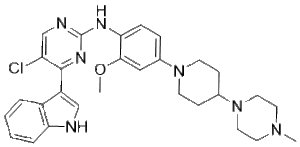
HG-14-10-04 is a novel, potent and specific ALK (Anaplastic lymphoma kinase) inhibitor with IC50 of 20 The anaplastic lymphoma kinase (ALK) gene plays an important physiologic role in the development of the brain and can be oncogenically altered in several malignancies, including non-small-cell lung cancer (NSCLC) and anaplastic large cell lymphomas (ALCL).
Physicochemical Properties
| Molecular Formula | C29H34CLN7O |
| Molecular Weight | 532.0796 |
| Exact Mass | 531.251 |
| Elemental Analysis | C, 65.46; H, 6.44; Cl, 6.66; N, 18.43; O, 3.01 |
| CAS # | 1356962-34-9 |
| Related CAS # | 1356962-34-9 |
| PubChem CID | 56655374 |
| Appearance | Light yellow to yellow solid powder |
| LogP | 5.26 |
| Hydrogen Bond Donor Count | 2 |
| Hydrogen Bond Acceptor Count | 7 |
| Rotatable Bond Count | 6 |
| Heavy Atom Count | 38 |
| Complexity | 746 |
| Defined Atom Stereocenter Count | 0 |
| SMILES | ClC1=C([H])N=C(N=C1C1=C([H])N([H])C2=C([H])C([H])=C([H])C([H])=C12)N([H])C1C([H])=C([H])C(=C([H])C=1OC([H])([H])[H])N1C([H])([H])C([H])([H])C([H])(C([H])([H])C1([H])[H])N1C([H])([H])C([H])([H])N(C([H])([H])[H])C([H])([H])C1([H])[H] |
| InChi Key | HRYNCLKDKCPYBF-UHFFFAOYSA-N |
| InChi Code | InChI=1S/C29H34ClN7O/c1-35-13-15-37(16-14-35)20-9-11-36(12-10-20)21-7-8-26(27(17-21)38-2)33-29-32-19-24(30)28(34-29)23-18-31-25-6-4-3-5-22(23)25/h3-8,17-20,31H,9-16H2,1-2H3,(H,32,33,34) |
| Chemical Name | 5-chloro-4-(1H-indol-3-yl)-N-[2-methoxy-4-[4-(4-methylpiperazin-1-yl)piperidin-1-yl]phenyl]pyrimidin-2-amine |
| Synonyms | HG-141004; HG 141004; HG141004; HG-14-10-04; 1356962-34-9; 5-Chloro-4-(1H-indol-3-yl)-N-(2-methoxy-4-(4-(4-methylpiperazin-1-yl)piperidin-1-yl)phenyl)pyrimidin-2-amine; CHEMBL5172338; 5-chloro-4-(1H-indol-3-yl)-N-[2-methoxy-4-[4-(4-methylpiperazin-1-yl)piperidin-1-yl]phenyl]pyrimidin-2-amine; SCHEMBL517288; orb1303304; SCHEMBL30341887; HG-14-10 04; HG 14 10-04; HG 14-10-04 |
| HS Tariff Code | 2934.99.9001 |
| Storage |
Powder-20°C 3 years 4°C 2 years In solvent -80°C 6 months -20°C 1 month |
| Shipping Condition | Room temperature (This product is stable at ambient temperature for a few days during ordinary shipping and time spent in Customs) |
Biological Activity
| Targets |
EGFRLR/TM (IC50 = 15.6 nM); EGFR19del/TM/CS (IC50 = 22.6 nM); EGFRLR/TM/CS (IC50 = 124.5 nM); ALK (IC50 = 20 nM)
- EGFR (T790M/C797S double mutation) (IC50 = 0.8 nM for kinase activity inhibition) [2] - EGFR (T790M single mutation) (IC50 = 1.2 nM for kinase activity inhibition) [2] - EGFR (wild - type) (IC50 = 6.5 nM for kinase activity inhibition) [2] |
| ln Vitro |
- Kinase Inhibition: HG - 14 - 10 - 04 potently inhibits the kinase activity of EGFR with T790M/C797S double mutations, T790M single mutation, and wild - type EGFR, with IC50 values of 0.8 nM, 1.2 nM, and 6.5 nM respectively. It shows high selectivity for EGFR mutants over other kinases (e.g., HER2, MET, ALK) with IC50 values >1000 nM [2] - Antiproliferative Activity: In NCI - H1975 cells (harboring EGFR L858R/T790M) and Ba/F3 cells expressing EGFR T790M/C797S, HG - 14 - 10 - 04 inhibits cell proliferation with IC50 values of 3.5 nM and 2.8 nM respectively. It has weaker activity against A431 cells (wild - type EGFR) with an IC50 of 45 nM [2] - Downregulation of EGFR Signaling: Treatment with HG - 14 - 10 - 04 (10 nM) in NCI - H1975 cells reduces phosphorylation of EGFR, AKT, and ERK1/2 by 80%, 75%, and 70% respectively, as measured by Western blot [2] HG-14-10-04 (example 10) exhibits 20 nM IC50 inhibitory activity against ALK kinase[1]. HG-14-10-04 (compound 17b) has IC50 values of 15.6 nM, 22.6 nM, and 124.5 nM, respectively, demonstrating kinase inhibitory activity against EGFRLR/TM, EGFR19del/TM/CS, and EGFRLR/TM/CS[2]. |
| ln Vivo |
Tumor Growth Inhibition in Xenograft Models: In mice bearing NCI - H1975 xenografts, oral administration of HG - 14 - 10 - 04 (25 mg/kg, once daily) for 21 days results in a 72% reduction in tumor volume compared to the control group. In mice with EGFR T790M/C797S Ba/F3 xenografts, the same dose leads to a 68% tumor volume reduction [2] |
| Enzyme Assay |
- EGFR Kinase Activity Assay: Recombinant EGFR kinase domains (wild - type, T790M, T790M/C797S) are incubated with HG - 14 - 10 - 04 (0.01 - 1000 nM) and a fluorescent - labeled peptide substrate. The reaction is initiated by adding ATP, and kinase activity is measured by detecting phosphorylated substrate fluorescence. IC50 values are calculated from dose - response curves [2] |
| Cell Assay |
- Cell Proliferation Assay: NCI - H1975, Ba/F3 (EGFR T790M/C797S), and A431 cells are seeded in 96 - well plates and treated with HG - 14 - 10 - 04 (0.1 - 1000 nM) for 72 hours. Cell viability is assessed using a colorimetric assay, and IC50 values are determined [2] - Western Blot Analysis: NCI - H1975 cells are treated with HG - 14 - 10 - 04 (0.1 - 100 nM) for 2 hours. Cell lysates are prepared, and proteins are separated by SDS - PAGE. Membranes are probed with antibodies against phosphorylated EGFR, AKT, ERK1/2, and total forms of these proteins. Band intensities are quantified to measure signaling inhibition [2] |
| Animal Protocol |
Xenograft Tumor Model in Mice: Nude mice are subcutaneously implanted with NCI - H1975 or EGFR T790M/C797S Ba/F3 cells. When tumors reach 100 - 150 mm³, mice are randomized into control and treatment groups. HG - 14 - 10 - 04 is formulated in 0.5% methylcellulose and administered orally at 25 mg/kg once daily for 21 days. Tumor volume and body weight are measured every 3 days [2] |
| Toxicity/Toxicokinetics |
- No significant toxicity observed in the xenograft study; mice treated with HG - 14 - 10 - 04 (25 mg/kg) show no obvious weight loss or signs of systemic toxicity over 21 days [2] |
| References |
[1]. Publ. (2012), US 20120028924 A1 [2]. Conformational Constrained 4-(1-Sulfonyl-3-indol)yl-2-phenylaminopyrimidine Derivatives as New Fourth-Generation Epidermal Growth Factor Receptor Inhibitors Targeting T790M/C797S Mutations. J Med Chem. 2022 May 12;65(9):6840-6858. |
| Additional Infomation |
- Mechanism of Action: HG - 14 - 10 - 04 is a fourth - generation EGFR inhibitor that binds to the ATP - binding pocket of EGFR mutants (T790M/C797S, T790M), preventing ATP binding and kinase activation, thereby inhibiting downstream signaling pathways involved in cell proliferation and survival [2] - Therapeutic Potential: It is designed to overcome resistance to third - generation EGFR inhibitors caused by C797S mutations, showing promise for treating non - small cell lung cancer with EGFR T790M/C797S mutations [2] 5-chloro-4-(1H-indol-3-yl)-N-[2-methoxy-4-[4-(4-methyl-1-piperazinyl)-1-piperidinyl]phenyl]-2-pyrimidinamine is a member of piperidines. |
Solubility Data
| Solubility (In Vitro) | DMSO: 10~20 mg/mL (18.8~37.6 mM) |
| Solubility (In Vivo) |
Solubility in Formulation 1: ≥ 2 mg/mL (3.76 mM) (saturation unknown) in 10% DMSO + 40% PEG300 +5% Tween-80 + 45% Saline (add these co-solvents sequentially from left to right, and one by one), clear solution. For example, if 1 mL of working solution is to be prepared, you can add 100 μL of 20.0 mg/mL clear DMSO stock solution to 400 μL PEG300 and mix evenly; then add 50 μL Tween-80 + to the above solution and mix evenly; then add 450 μL normal saline to adjust the volume to 1 mL. Preparation of saline: Dissolve 0.9 g of sodium chloride in 100 mL ddH₂ O to obtain a clear solution. (Please use freshly prepared in vivo formulations for optimal results.) |
| Preparing Stock Solutions | 1 mg | 5 mg | 10 mg | |
| 1 mM | 1.8794 mL | 9.3971 mL | 18.7942 mL | |
| 5 mM | 0.3759 mL | 1.8794 mL | 3.7588 mL | |
| 10 mM | 0.1879 mL | 0.9397 mL | 1.8794 mL |