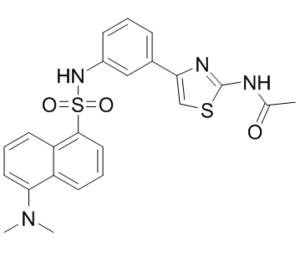
HA15 (HA-15) is an inhibitor of chaperone BiP (Binding immunoglobulin protein, GRP78) with anticancer activity. It specifically targets chaperone BiP/GRP78/HSPA5. HA15 causes ER stress, which in turn triggers autophagic and apoptotic processes, ultimately resulting in the death of cancer cells. In xenograft mouse models containing melanoma cells that were either sensitive or resistant to BRAF inhibitors, HA15 also demonstrated significant efficacy. All melanoma cells tested, including patient-isolated cells and cells resistant to BRAF inhibitors, showed anti-cancerous activity in response to HA15. HA15 demonstrated efficacy against various types of solid and liquid tumors. In xenograft mouse models containing melanoma cells that were either sensitive or resistant to BRAF inhibitors, HA15 also demonstrated significant efficacy.
Physicochemical Properties
| Molecular Formula | C23H22N4O3S2 | |
| Molecular Weight | 466.58 | |
| Exact Mass | 466.113 | |
| Elemental Analysis | C, 59.21; H, 4.75; N, 12.01; O, 10.29; S, 13.74 | |
| CAS # | 1609402-14-3 | |
| Related CAS # |
|
|
| PubChem CID | 73890923 | |
| Appearance | Light yellow to green yellow solid powder | |
| Density | 1.4±0.1 g/cm3 | |
| Index of Refraction | 1.701 | |
| LogP | 4.56 | |
| Hydrogen Bond Donor Count | 2 | |
| Hydrogen Bond Acceptor Count | 7 | |
| Rotatable Bond Count | 6 | |
| Heavy Atom Count | 32 | |
| Complexity | 757 | |
| Defined Atom Stereocenter Count | 0 | |
| SMILES | S(C1=C([H])C([H])=C([H])C2C(=C([H])C([H])=C([H])C=21)N(C([H])([H])[H])C([H])([H])[H])(N([H])C1=C([H])C([H])=C([H])C(C2=C([H])SC(N([H])C(C([H])([H])[H])=O)=N2)=C1[H])(=O)=O |
|
| InChi Key | LBSMEKVVMYSTIH-UHFFFAOYSA-N | |
| InChi Code | InChI=1S/C23H22N4O3S2/c1-15(28)24-23-25-20(14-31-23)16-7-4-8-17(13-16)26-32(29,30)22-12-6-9-18-19(22)10-5-11-21(18)27(2)3/h4-14,26H,1-3H3,(H,24,25,28) | |
| Chemical Name | N-[4-[3-[[5-(dimethylamino)naphthalen-1-yl]sulfonylamino]phenyl]-1,3-thiazol-2-yl]acetamide | |
| Synonyms |
|
|
| HS Tariff Code | 2934.99.9001 | |
| Storage |
Powder-20°C 3 years 4°C 2 years In solvent -80°C 6 months -20°C 1 month |
|
| Shipping Condition | Room temperature (This product is stable at ambient temperature for a few days during ordinary shipping and time spent in Customs) |
Biological Activity
| Targets | BiP/GRP78/HSPA5 |
| ln Vitro |
HA15 (10 μM; 1-24 hours)auses an early endoplasmic reticulum stress (ER Stress) [1]. HA15 (0-10μM; 24 hours) has an IC50 of 1-2.5 μM in A375 cells and reduces melanoma cell viability in a dose-dependent manner when compared to control conditions (DMSO)[1]. HA15 (1-10 μM; 24 hours) causes apoptosis in A375 cells[1]. HA15 (1-24 μM; 24 hours) induces autophagy[1]. HA15 (10 μM; 48 hours) exhibits a high degree of efficacy in causing ER stress and cell death in melanoma cells that are resistant to BRAF inhibitors. Furthermore, through apoptotic and autophagic pathways triggered by ER stress, HA15 prevents the growth of tumors[1]. HA15 at low or high doses did not negatively impact the viability of human fibroblasts or normal human melanocytes[1]. |
| ln Vivo |
HA15 (0.7 mg/mouse/day; i.h.; over 2 weeks) prevents the growth of melanoma tumors in mice, causes no discernible toxicity, and has no effect on their behavior, body mass, or liver mass, indicating the lack of hepatomegaly[1]. HA15 (0.7 mg/mouse; i.p.; 5 days/week) inhibits the growth of MPM tumors in vivo[3]. |
| Cell Assay |
Cell Line: A375 cells Concentration: 1 μM,2.5 μM,5 μM,7.5 μM,10 μM Incubation Time: 24 hours Result: Decreased melanoma cell viability in a dose-dependent manner compared with control conditions (DMSO) in A375 cells. |
| Animal Protocol |
6-weeks female BALB/c nu/nu (nude) mice with A375 melanoma cells xenograft[1] 0.7 mg/mouse/day Subcutaneous injection; over a period of 2 weeks |
| References |
[1]. Compounds Triggering ER Stress Exert Anti-Melanoma Effects and Overcome BRAF Inhibitor Resistance. Cancer Cell. 2016 Jun 13;29(6):805-19. [2]. The GRP78/BiP inhibitor HA15 synergizes with mitotane action against adrenocortical carcinoma cells through convergent activation of ER stress pathways. Mol Cell Endocrinol. 2018 Oct 15;474:57-64. [3]. Endoplasmic Reticulum Stress Signaling as a Therapeutic Target in Malignant Pleural Mesothelioma. Cancers (Basel). 2019 Oct; 11(10): 1502. |
| Additional Infomation | HA15 is a sulfonamide resulting from the formal condensation of the sulfonic acid group of 5-(dimethylamino)naphthalene-1-sulfonic acid with the aniline nitrogen of 3-(2-acetamido-1,3-thiazol-4-yl)aniline. It has been reported that by triggering an endoplasmic reticulum (ER) stress response, HA15 can reduce the viability of melanoma cells without being toxic to normal cells. It has a role as an antineoplastic agent. It is a sulfonamide, a member of 1,3-thiazoles, a member of acetamides, a tertiary amino compound, an aminonaphthalene and a biaryl. |
Solubility Data
| Solubility (In Vitro) |
|
|||
| Solubility (In Vivo) |
Solubility in Formulation 1: ≥ 2.5 mg/mL (5.36 mM) (saturation unknown) in 10% DMSO + 40% PEG300 +5% Tween-80 + 45% Saline (add these co-solvents sequentially from left to right, and one by one), clear solution. For example, if 1 mL of working solution is to be prepared, you can add 100 μL of 25.0 mg/mL clear DMSO stock solution to 400 μL PEG300 and mix evenly; then add 50 μL Tween-80 + to the above solution and mix evenly; then add 450 μL normal saline to adjust the volume to 1 mL. Preparation of saline: Dissolve 0.9 g of sodium chloride in 100 mL ddH₂ O to obtain a clear solution. (Please use freshly prepared in vivo formulations for optimal results.) |
| Preparing Stock Solutions | 1 mg | 5 mg | 10 mg | |
| 1 mM | 2.1433 mL | 10.7163 mL | 21.4326 mL | |
| 5 mM | 0.4287 mL | 2.1433 mL | 4.2865 mL | |
| 10 mM | 0.2143 mL | 1.0716 mL | 2.1433 mL |