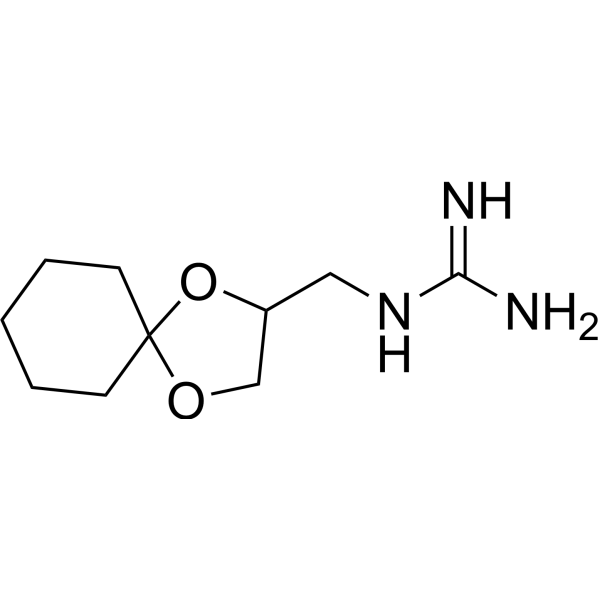
Physicochemical Properties
| Molecular Formula | C10H19N3O2 |
| Molecular Weight | 213.27676 |
| Exact Mass | 213.148 |
| CAS # | 40580-59-4 |
| Related CAS # | 22195-34-2 (sulfate[2:1]) |
| PubChem CID | 38521 |
| Appearance | Colorless to light yellow ointment |
| Density | 1.39g/cm3 |
| Boiling Point | 387.9ºC at 760 mmHg |
| Melting Point | 213.5-215ºC |
| Flash Point | 188.4ºC |
| Index of Refraction | 1.618 |
| LogP | 1.736 |
| Hydrogen Bond Donor Count | 2 |
| Hydrogen Bond Acceptor Count | 3 |
| Rotatable Bond Count | 2 |
| Heavy Atom Count | 15 |
| Complexity | 245 |
| Defined Atom Stereocenter Count | 0 |
| SMILES | N/C(=N/CC1COC2(CCCCC2)O1)/N |
| InChi Key | HPBNRIOWIXYZFK-UHFFFAOYSA-N |
| InChi Code | InChI=1S/C10H19N3O2/c11-9(12)13-6-8-7-14-10(15-8)4-2-1-3-5-10/h8H,1-7H2,(H4,11,12,13) |
| Chemical Name | 2-(1,4-dioxaspiro[4.5]decan-3-ylmethyl)guanidine |
| HS Tariff Code | 2934.99.9001 |
| Storage |
Powder-20°C 3 years 4°C 2 years In solvent -80°C 6 months -20°C 1 month Note: Please store this product in a sealed and protected environment (e.g. under nitrogen), avoid exposure to moisture and light. |
| Shipping Condition | Room temperature (This product is stable at ambient temperature for a few days during ordinary shipping and time spent in Customs) |
Biological Activity
| ln Vivo | Guanadrine has low nervous system toxicity in rats and dogs (15–400 mg/kg daily, 6-52 weeks; oral gavage) [1]. |
| Animal Protocol |
Animal/Disease Models: Rats, dogs [1] Doses: 15-400 mg/kg Route of Administration: po (oral gavage); daily; 6-52 weeks Experimental Results: The weight of the prostate and adrenal glands in rats increased slightly, while the weight of the kidneys diminished. Dogs' weight gain diminished in a dose-dependent manner, but liver function was normal. |
| ADME/Pharmacokinetics |
Absorption, Distribution and Excretion Rapidly and readily absorbed from the gastrointestinal tract. Metabolism / Metabolites Primarily hepatic Biological Half-Life 10 hours |
| Toxicity/Toxicokinetics |
Protein Binding Low, approximately 20% |
| References |
[1]. Guanadrel sulfate: a postganglionic sympathetic inhibitor for the treatment of mild to moderate hypertension. Pharmacotherapy. 1983 Jul-Aug;3(4):220-9. doi: 10.1002/j.1875-9114.1983.tb03257.x. |
| Additional Infomation |
Guanadrel is a spiroketal resulting from the formal condensation of the keto group of cyclohexanone with the hydroxy groups of 1-(2,3-dihydroxypropyl)guanidine. A postganglionic adrenergic blocking agent formerly used (generally as the sulfate salt) for the management of hypertension, it has been largely superseded by other drugs less likely to cause orthostatic hypotension (dizzy spells on standing up or stretching). It has a role as an antihypertensive agent and an adrenergic antagonist. It is a member of guanidines and a spiroketal. It is a conjugate base of a guanadrel(1+). Guanadrel is an antihypertensive agent and postganglionic adrenergic blocking agent. See also: Guanadrel Sulfate (annotation moved to). Drug Indication Used to treat and control hypertension. Mechanism of Action Guanadrel is an adrenergic neuron inhibitor that slowly displaces norepinephrine from its storage in nerve endings. It blocks the release of norepinephrine in response to the sympathetic nerve stimulation, leading to reduced arteriolar vasoconstriction, especially the reflex increase in sympathetic tone that occurs with a change in position. Pharmacodynamics High blood pressure adds to the work load of the heart and arteries. If it continues for a long time, the heart and arteries may not function properly. This can damage the blood vessels of the brain, heart, and kidneys resulting in a stroke, heart failure, or kidney failure. High blood pressure may also increase the risk of heart attacks. These problems may be less likely to occur if blood pressure is controlled. Guanadrel works by controlling nerve impulses along certain nerve pathways. As a result, it relaxes the blood vessels so that blood passes through them more easily. This helps to lower blood pressure. |
Solubility Data
| Solubility (In Vitro) | DMSO : ~50 mg/mL (~234.43 mM) |
| Solubility (In Vivo) |
Solubility in Formulation 1: ≥ 2.5 mg/mL (11.72 mM) (saturation unknown) in 10% DMSO + 40% PEG300 + 5% Tween80 + 45% Saline (add these co-solvents sequentially from left to right, and one by one), clear solution. For example, if 1 mL of working solution is to be prepared, you can add 100 μL of 25.0 mg/mL clear DMSO stock solution to 400 μL PEG300 and mix evenly; then add 50 μL Tween-80 to the above solution and mix evenly; then add 450 μL normal saline to adjust the volume to 1 mL. Preparation of saline: Dissolve 0.9 g of sodium chloride in 100 mL ddH₂ O to obtain a clear solution. Solubility in Formulation 2: ≥ 2.5 mg/mL (11.72 mM) (saturation unknown) in 10% DMSO + 90% (20% SBE-β-CD in Saline) (add these co-solvents sequentially from left to right, and one by one), clear solution. For example, if 1 mL of working solution is to be prepared, you can add 100 μL of 25.0 mg/mL clear DMSO stock solution to 900 μL of 20% SBE-β-CD physiological saline solution and mix evenly. Preparation of 20% SBE-β-CD in Saline (4°C,1 week): Dissolve 2 g SBE-β-CD in 10 mL saline to obtain a clear solution. Solubility in Formulation 3: ≥ 2.5 mg/mL (11.72 mM) (saturation unknown) in 10% DMSO + 90% Corn Oil (add these co-solvents sequentially from left to right, and one by one), clear solution. For example, if 1 mL of working solution is to be prepared, you can add 100 μL of 25.0 mg/mL clear DMSO stock solution to 900 μL of corn oil and mix evenly. (Please use freshly prepared in vivo formulations for optimal results.) |
| Preparing Stock Solutions | 1 mg | 5 mg | 10 mg | |
| 1 mM | 4.6887 mL | 23.4434 mL | 46.8867 mL | |
| 5 mM | 0.9377 mL | 4.6887 mL | 9.3773 mL | |
| 10 mM | 0.4689 mL | 2.3443 mL | 4.6887 mL |