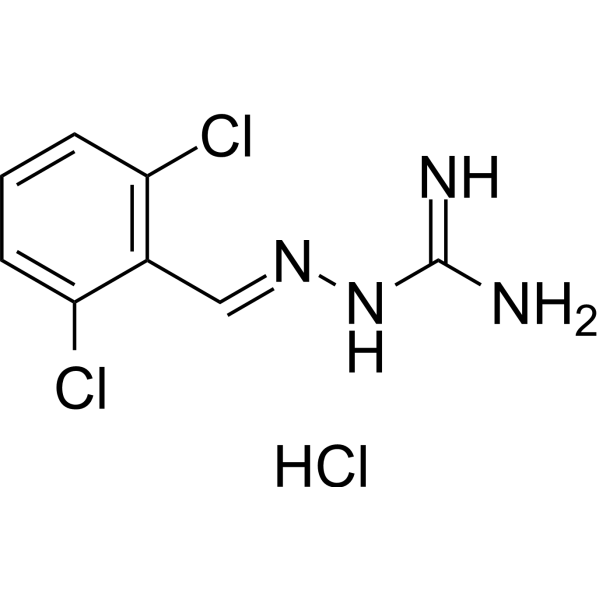
Physicochemical Properties
| Molecular Formula | C8H8N4CL2.HCL |
| Molecular Weight | 267.54286 |
| Exact Mass | 265.989 |
| CAS # | 23113-43-1 |
| Related CAS # | Guanabenz;5051-62-7;(E)-Guanabenz;60329-03-5 |
| PubChem CID | 9577025 |
| Appearance | White to off-white solid powder |
| Boiling Point | 405.7ºC at 760mmHg |
| Flash Point | 199.1ºC |
| Vapour Pressure | 8.63E-07mmHg at 25°C |
| LogP | 3.803 |
| Hydrogen Bond Donor Count | 3 |
| Hydrogen Bond Acceptor Count | 2 |
| Rotatable Bond Count | 2 |
| Heavy Atom Count | 15 |
| Complexity | 228 |
| Defined Atom Stereocenter Count | 0 |
| SMILES | Cl.N/C(=N/N=C/C1C(Cl)=CC=CC=1Cl)/N |
| InChi Key | UNWWUUPHJRAOMZ-GAYQJXMFSA-N |
| InChi Code | InChI=1S/C8H8Cl2N4.ClH/c9-6-2-1-3-7(10)5(6)4-13-14-8(11)12;/h1-4H,(H4,11,12,14);1H/b13-4+; |
| Chemical Name | 2-[(E)-(2,6-dichlorophenyl)methylideneamino]guanidine;hydrochloride |
| HS Tariff Code | 2934.99.9001 |
| Storage |
Powder-20°C 3 years 4°C 2 years In solvent -80°C 6 months -20°C 1 month Note: Please store this product in a sealed and protected environment (e.g. under nitrogen), avoid exposure to moisture and light. |
| Shipping Condition | Room temperature (This product is stable at ambient temperature for a few days during ordinary shipping and time spent in Customs) |
Biological Activity
| ln Vitro | Cell viability is not affected by treating guanidine hydrochloride (0.5-50 μM) at escalating concentrations for a full day [1]. UPR targets were not impacted by guanidine hydrochloride alone (0.5–50 μM, 24 h), neither at the mRNA or protein levels nor the phosphorylation state of eIF2a. Furthermore, neither GADD34 nor the constitutively active version of CReP are induced by guanabenz[1]. In newborn rat cardiomyocytes, guanidine hydrochloride alone (0.5–50 μM, 24 hours) does not cause endoplasmic reticulum stress [1]. |
| ln Vivo | Brain cyst burden is consistently decreased by guanidine hydrochloride (5 mg/kg/day; intraperitoneally; for 3 weeks) [2]. In mice with latent Toxoplasma gondii infection, guanidine hydrochloride (5 mg/kg/d intraperitoneal injection, orally; 10 mg/kg/d gavage, for 3 weeks) can reverse hyperactivity [2]. In debuffered cats, guanidine hydrochloride (100 and 320 μg/kg and 1 mg/kg, intravenously given for 5 minutes at 40-minute intervals) lowers blood pressure, heart rate, and sympathetic outflow [3]. |
| Cell Assay |
Cell viability assay [1] Cell Types: Newborn rat cardiomyocytes (NRCM) Tested Concentrations: 0.5-50 μM Incubation Duration: 24 h Experimental Results: Does not affect cell survival. Western Blot Analysis [1] Cell Types: Neonatal rat cardiomyocytes (NRCM) Tested Concentrations: 0.5-50 μM Incubation Duration: 24 hrs (hours) Experimental Results: The levels of UPR target proteins increased in a concentration-dependent manner in the low group. RT-PCR[1] Cell Types: Neonatal rat cardiomyocytes (NRCM) Tested Concentrations: 0.5-50 μM Incubation Duration: 24 hrs (hours) Experimental Results: Does not affect the levels of UPR targets. |
| Animal Protocol |
Animal/Disease Models: BALB/cJ mice [2] Doses: 5 mg/kg Doses: 5 mg/kg/day; ip; for 3 weeks Experimental Results: Latent brain cysts were diminished in both male and female BALB/cJ mice . Animal/Disease Models: BALB/cJ mice[2] Doses: 5 mg/kg; 10 mg/kg Route of Administration: 5 mg/kg/d, intraperitoneal (ip) injection, oral administration; 10 mg/kg/d, gavage; last for 3 weeks Experimental Results: Reversal of parasite-induced hyperactivity to near baseline levels. Animal/Disease Models: Cat [3] Doses: 100 and 320 μg/kg and 1 mg/kg Route of Administration: 100 and 320 μg/kg and 1 mg/kg, intravenously (iv) (iv)(iv) for 5 minutes at 40 minute intervals Experimental Results: Rejection of blood pressure and Neural activity is evident. |
| References |
[1]. Christiane Neuber, et al. Guanabenz interferes with ER stress and exerts protective effects in cardiac myocytes. PLoS One. 2014 Jun 3;9(6):e98893. [2]. Jennifer Martynowicz, et al. Guanabenz Reverses a Key Behavioral Change Caused by Latent Toxoplasmosis in Mice by Reducing Neuroinflammation. mBio. 2019 Apr 30;10(2):e00381-19. [3]. T Baum, et al. Studies on the centrally mediated hypotensive activity of guanabenz. Eur J Pharmacol. 1976 May;37(1):31-44. |
Solubility Data
| Solubility (In Vitro) | DMSO : ~100 mg/mL (~373.78 mM) |
| Solubility (In Vivo) |
Solubility in Formulation 1: ≥ 2.5 mg/mL (9.34 mM) (saturation unknown) in 10% DMSO + 40% PEG300 + 5% Tween80 + 45% Saline (add these co-solvents sequentially from left to right, and one by one), clear solution. For example, if 1 mL of working solution is to be prepared, you can add 100 μL of 25.0 mg/mL clear DMSO stock solution to 400 μL PEG300 and mix evenly; then add 50 μL Tween-80 to the above solution and mix evenly; then add 450 μL normal saline to adjust the volume to 1 mL. Preparation of saline: Dissolve 0.9 g of sodium chloride in 100 mL ddH₂ O to obtain a clear solution. Solubility in Formulation 2: ≥ 2.5 mg/mL (9.34 mM) (saturation unknown) in 10% DMSO + 90% (20% SBE-β-CD in Saline) (add these co-solvents sequentially from left to right, and one by one), clear solution. For example, if 1 mL of working solution is to be prepared, you can add 100 μL of 25.0 mg/mL clear DMSO stock solution to 900 μL of 20% SBE-β-CD physiological saline solution and mix evenly. Preparation of 20% SBE-β-CD in Saline (4°C,1 week): Dissolve 2 g SBE-β-CD in 10 mL saline to obtain a clear solution. Solubility in Formulation 3: ≥ 2.5 mg/mL (9.34 mM) (saturation unknown) in 10% DMSO + 90% Corn Oil (add these co-solvents sequentially from left to right, and one by one), clear solution. For example, if 1 mL of working solution is to be prepared, you can add 100 μL of 25.0 mg/mL clear DMSO stock solution to 900 μL of corn oil and mix evenly. (Please use freshly prepared in vivo formulations for optimal results.) |
| Preparing Stock Solutions | 1 mg | 5 mg | 10 mg | |
| 1 mM | 3.7378 mL | 18.6888 mL | 37.3776 mL | |
| 5 mM | 0.7476 mL | 3.7378 mL | 7.4755 mL | |
| 10 mM | 0.3738 mL | 1.8689 mL | 3.7378 mL |