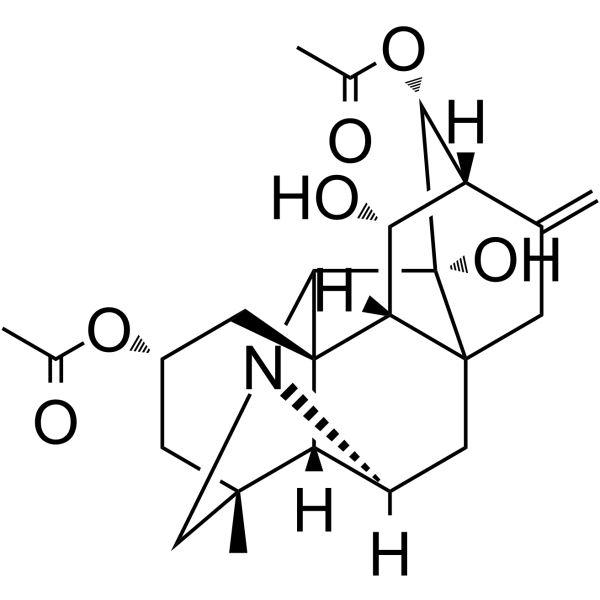
Physicochemical Properties
| Molecular Formula | C24H31NO6 |
| Molecular Weight | 429.5060 |
| Exact Mass | 429.215 |
| CAS # | 1394-48-5 |
| PubChem CID | 101603171 |
| Appearance | White to off-white solid powder |
| Density | 1.4±0.1 g/cm3 |
| Boiling Point | 551.4±50.0 °C at 760 mmHg |
| Flash Point | 287.3±30.1 °C |
| Vapour Pressure | 0.0±3.4 mmHg at 25°C |
| Index of Refraction | 1.648 |
| LogP | 0.93 |
| Hydrogen Bond Donor Count | 2 |
| Hydrogen Bond Acceptor Count | 7 |
| Rotatable Bond Count | 4 |
| Heavy Atom Count | 31 |
| Complexity | 966 |
| Defined Atom Stereocenter Count | 11 |
| SMILES | CC(=O)O[C@H]1C[C@@]2(CN3[C@@H]4[C@H]2[C@]5(C1)[C@H]3[C@]6(C([C@H]7[C@H]([C@@H]5[C@]6(C4)CC7=C)O)OC(=O)C)O)C |
| InChi Key | OGNUSOJAYIHLNS-CGMBEVFJSA-N |
| InChi Code | InChI=1S/C24H31NO6/c1-10-5-22-8-14-17-21(4)6-13(30-11(2)26)7-23(17)18(22)16(28)15(10)19(31-12(3)27)24(22,29)20(23)25(14)9-21/h13-20,28-29H,1,5-9H2,2-4H3/t13-,14-,15+,16+,17+,18+,19?,20-,21+,22+,23-,24-/m0/s1 |
| Chemical Name | [(1S,3S,5S,8S,9R,11R,14R,16S,17R,18S,19S)-10-acetyloxy-9,19-dihydroxy-5-methyl-12-methylidene-7-azaheptacyclo[9.6.2.01,8.05,17.07,16.09,14.014,18]nonadecan-3-yl] acetate |
| HS Tariff Code | 2934.99.9001 |
| Storage |
Powder-20°C 3 years 4°C 2 years In solvent -80°C 6 months -20°C 1 month Note: Please store this product in a sealed and protected environment (e.g. under nitrogen), avoid exposure to moisture and light. |
| Shipping Condition | Room temperature (This product is stable at ambient temperature for a few days during ordinary shipping and time spent in Customs) |
Biological Activity
| Targets |
- Human CYP2D6 (Ki = 1.6 ± 0.2 μM), monkey CYP2D6 (Ki = 2.3 ± 0.3 μM), dog CYP2D6 (Ki = 3.1 ± 0.4 μM) [1] - HERG K+ channel (IC50 = 10.2 ± 1.1 μM, determined by whole-cell patch-clamp recording in HERG-transfected HEK293 cells) [2] |
| ln Vitro |
CYP2Ds in rats or mice are not inhibited by coroplastine A. While it has a minor inhibitory effect on 2B6 and 2E1, coroprine A exhibits no inhibitory activity against human recombinant CYP1A2, 2A6, 2C8, 2C19, 3A4, or 3A5. Guanfu basic A has strong CYP2D6 inhibitory effects, as evidenced by its IC50 values of roughly 0.46 μM in HLM (dextromethorphan 5 μM) and 0.12 μM in rCYP2D6 (bufurolol 5 μM) [1]. The whole-cell patch-clamp approach was employed to investigate the function of guanfu base A in human embryonic kidney 293 (HEK293) cells that were transiently transfected with HERG complementary DNA. With an IC50 of 1.64 mM, guanfu base A suppresses HERG channel current in a concentration-, voltage-, and time-dependent manner. While having no influence on the inactivation curve, coroplastine A accelerates channel inactivation and alters the activation curve in a negative direction [2]. - Guanfu base A exhibited concentration-dependent inhibition of human, monkey, and dog CYP2D6 activity. In human liver microsomes (HLMs), it inhibited dextromethorphan O-demethylation (a specific CYP2D6 substrate) with a Ki of 1.6 μM, showing strong inhibition. In monkey liver microsomes (MLMs), the inhibition of the same substrate metabolism had a Ki of 2.3 μM, and in dog liver microsomes (DLMs), the Ki was 3.1 μM. No significant inhibition was observed on other human CYP isoforms (CYP1A2, CYP2C9, CYP2C19, CYP2E1, CYP3A4) at concentrations up to 50 μM [1] - Guanfu base A suppressed HERG K+ channel-mediated currents in HERG-transfected HEK293 cells in a concentration-dependent manner. At a concentration of 1 μM, it inhibited ~20% of peak HERG currents; at 10 μM, the inhibition rate reached ~50% (consistent with IC50 = 10.2 μM); at 30 μM, the inhibition rate exceeded 80%. The inhibition was reversible: after washing out the drug, HERG currents recovered to ~85% of the baseline within 10 minutes. Compared with Guanfu base G, Guanfu base A showed weaker inhibition of HERG channels (Guanfu base G IC50 = 3.5 ± 0.5 μM) [2] |
| ln Vivo | Coronaphylline was administered beforehand to Beagle dogs. Dextromethorphan (2 mg/mL) is administered intravenously and as an injection. The metabolic activity of CYP2D was decreased. Dextrorphan had a Cmax that was one-third that of the group receiving regular saline therapy. Plasma concentration-time Comparing the area under the curve to the saline treatment group, it was half [1]. |
| Enzyme Assay |
- CYP2D6 activity assay (for [1]): Liver microsomes (human, monkey, dog) were prepared as the enzyme source. The reaction system (total volume 200 μL) contained microsomal protein (0.2 mg/mL), phosphate buffer (50 mM, pH 7.4), MgCl2 (5 mM), NADPH (1 mM, as coenzyme), dextromethorphan (10 μM, specific CYP2D6 substrate), and different concentrations of Guanfu base A (0.1-50 μM). The reaction was initiated by adding NADPH, incubated at 37°C for 30 minutes, and terminated by adding 200 μL of ice-cold acetonitrile. After centrifugation (12,000 × g for 10 minutes), the supernatant was analyzed by HPLC-MS/MS to determine the concentration of the metabolite (dextrorphan). The inhibition rate was calculated by comparing with the control group (without Guanfu base A), and Ki values were obtained by fitting the data to the competitive inhibition model [1] - HERG K+ channel current recording assay (for [2]): HEK293 cells stably transfected with human HERG cDNA were cultured to 70-80% confluence. Whole-cell patch-clamp technique was used to record HERG currents at room temperature (22-25°C). The extracellular solution contained (in mM): NaCl 140, KCl 4, CaCl2 1.8, MgCl2 1, HEPES 10, glucose 5 (pH 7.4 adjusted with NaOH). The intracellular solution contained (in mM): KCl 130, MgATP 5, EGTA 5, HEPES 10 (pH 7.2 adjusted with KOH). The pipette resistance was 2-4 MΩ. After forming a whole-cell configuration, the cell was held at -80 mV, and a voltage protocol (from -80 mV to +40 mV in 10 mV increments, 500 ms duration, followed by repolarization to -50 mV for 500 ms) was applied to evoke HERG currents. Different concentrations of Guanfu base A (0.1-30 μM) were perfused into the recording chamber, and current amplitudes were recorded at each concentration. The IC50 value was calculated by fitting the concentration-inhibition curve with the Hill equation [2] |
| Cell Assay |
- HERG-transfected HEK293 cell culture and current recording-related cell preparation (for [2]): HEK293 cells were maintained in Dulbecco's Modified Eagle Medium (DMEM) supplemented with 10% fetal bovine serum, 100 U/mL penicillin, and 100 μg/mL streptomycin. The medium was replaced every 2-3 days, and cells were passaged when reaching 80-90% confluence (using 0.25% trypsin-EDTA for detachment). For patch-clamp experiments, cells were seeded on 35 mm culture dishes 24 hours before recording to ensure they adhered well and maintained normal viability. Only cells with a round or spindle shape and clear boundaries were selected for current recording [2] |
| ADME/Pharmacokinetics |
- In vitro metabolic enzyme inhibition profile: Guanfu base A is a selective inhibitor of CYP2D6. In human liver microsomes, it did not affect the activity of CYP1A2 (substrate: phenacetin), CYP2C9 (substrate: tolbutamide), CYP2C19 (substrate: omeprazole), CYP2E1 (substrate: chlorzoxazone), or CYP3A4 (substrate: midazolam) at concentrations up to 50 μM. In monkey and dog liver microsomes, it also showed selective inhibition of CYP2D6 without significant effects on other tested CYP isoforms (same as human) [1] |
| Toxicity/Toxicokinetics |
- Potential drug-drug interaction risk: Since Guanfu base A strongly inhibits human CYP2D6, co-administration with drugs that are substrates of CYP2D6 (e.g., dextromethorphan, metoprolol, fluoxetine) may increase the plasma concentration of these co-administered drugs, thereby increasing their efficacy or adverse effects [1] - Potential cardiac toxicity risk: Guanfu base A inhibits HERG K+ channels (a key channel involved in cardiac repolarization). Inhibition of HERG channels may prolong the QT interval of the electrocardiogram, which could increase the risk of torsades de pointes (a life-threatening arrhythmia). However, compared with Guanfu base G, Guanfu base A has a higher IC50 for HERG channels, indicating a relatively lower risk of QT prolongation [2] |
| References |
[1]. Guanfu base A, an antiarrhythmic alkaloid of Aconitum coreanum, Is a CYP2D6 inhibitor of human, monkey, and dog isoforms. Drug Metab Dispos. 2015 May;43(5):713-24. [2]. Comparative effects of Guanfu base A and Guanfu base G on HERG K+ channel. J Cardiovasc Pharmacol. 2012 Jan;59(1):77-83. |
| Additional Infomation |
- Guanfu base A is a natural alkaloid extracted from Aconitum coreanum, a plant traditionally used in Chinese medicine. It has been reported to exhibit antiarrhythmic activity, which is the basis for its potential development as an antiarrhythmic drug [1][2] - The inhibitory effect of Guanfu base A on CYP2D6 shows species similarity: the Ki values in human, monkey, and dog liver microsomes are in the same order of magnitude (1-3 μM), suggesting that monkey and dog may be potential animal models for evaluating the pharmacokinetics and drug-drug interactions of Guanfu base A in preclinical studies [1] - HERG K+ channels are mainly expressed in the heart and play a crucial role in the repolarization phase of the cardiac action potential. Many antiarrhythmic drugs inhibit HERG channels, which is a major cause of their cardiac toxicity. The comparative study of Guanfu base A and Guanfu base G on HERG channels provides a basis for optimizing the structure of Guanfu alkaloids to reduce cardiac toxicity while maintaining antiarrhythmic efficacy [2] |
Solubility Data
| Solubility (In Vitro) | DMSO : ~100 mg/mL (~232.82 mM) |
| Solubility (In Vivo) |
Solubility in Formulation 1: ≥ 2.5 mg/mL (5.82 mM) (saturation unknown) in 10% DMSO + 40% PEG300 + 5% Tween80 + 45% Saline (add these co-solvents sequentially from left to right, and one by one), clear solution. For example, if 1 mL of working solution is to be prepared, you can add 100 μL of 25.0 mg/mL clear DMSO stock solution to 400 μL PEG300 and mix evenly; then add 50 μL Tween-80 to the above solution and mix evenly; then add 450 μL normal saline to adjust the volume to 1 mL. Preparation of saline: Dissolve 0.9 g of sodium chloride in 100 mL ddH₂ O to obtain a clear solution. Solubility in Formulation 2: ≥ 2.5 mg/mL (5.82 mM) (saturation unknown) in 10% DMSO + 90% (20% SBE-β-CD in Saline) (add these co-solvents sequentially from left to right, and one by one), clear solution. For example, if 1 mL of working solution is to be prepared, you can add 100 μL of 25.0 mg/mL clear DMSO stock solution to 900 μL of 20% SBE-β-CD physiological saline solution and mix evenly. Preparation of 20% SBE-β-CD in Saline (4°C,1 week): Dissolve 2 g SBE-β-CD in 10 mL saline to obtain a clear solution. Solubility in Formulation 3: ≥ 2.5 mg/mL (5.82 mM) (saturation unknown) in 10% DMSO + 90% Corn Oil (add these co-solvents sequentially from left to right, and one by one), clear solution. For example, if 1 mL of working solution is to be prepared, you can add 100 μL of 25.0 mg/mL clear DMSO stock solution to 900 μL of corn oil and mix evenly. (Please use freshly prepared in vivo formulations for optimal results.) |
| Preparing Stock Solutions | 1 mg | 5 mg | 10 mg | |
| 1 mM | 2.3282 mL | 11.6412 mL | 23.2823 mL | |
| 5 mM | 0.4656 mL | 2.3282 mL | 4.6565 mL | |
| 10 mM | 0.2328 mL | 1.1641 mL | 2.3282 mL |