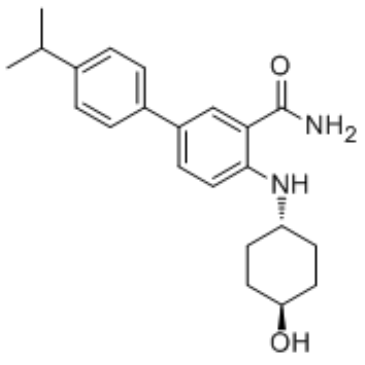
Grp94 Inhibitor-1 is a novel and potent Grp94 inhibitor with anti-inflammatory activity. It inhibits Grp94 with an IC50 value of 2 nM, and exhibits over 1000-fold selectivity to Grp94 against Hsp90α.
Physicochemical Properties
| Molecular Formula | C22H28N2O2 |
| Molecular Weight | 352.469925880432 |
| Exact Mass | 352.215 |
| CAS # | 2234897-35-7 |
| PubChem CID | 137321151 |
| Appearance | Light yellow to yellow solid powder |
| LogP | 4.7 |
| Hydrogen Bond Donor Count | 3 |
| Hydrogen Bond Acceptor Count | 3 |
| Rotatable Bond Count | 5 |
| Heavy Atom Count | 26 |
| Complexity | 451 |
| Defined Atom Stereocenter Count | 0 |
| SMILES | OC1CCC(CC1)NC1C=CC(C2C=CC(=CC=2)C(C)C)=CC=1C(N)=O |
| InChi Key | JMGDXIHGWTVBMX-UHFFFAOYSA-N |
| InChi Code | InChI=1S/C22H28N2O2/c1-14(2)15-3-5-16(6-4-15)17-7-12-21(20(13-17)22(23)26)24-18-8-10-19(25)11-9-18/h3-7,12-14,18-19,24-25H,8-11H2,1-2H3,(H2,23,26) |
| Chemical Name | 2-[(4-hydroxycyclohexyl)amino]-5-(4-propan-2-ylphenyl)benzamide |
| HS Tariff Code | 2934.99.9001 |
| Storage |
Powder-20°C 3 years 4°C 2 years In solvent -80°C 6 months -20°C 1 month |
| Shipping Condition | Room temperature (This product is stable at ambient temperature for a few days during ordinary shipping and time spent in Customs) |
Biological Activity
| Targets |
Grp94 Inhibitor-1 selectively targets Grp94 (Hsp90B1) with an IC50 value of 13 nM (ATPase activity assay) [1] Grp94 Inhibitor-1 shows high selectivity over other Hsp90 family members: Hsp90α (IC50 = 1.8 μM), Hsp90β (IC50 = 2.1 μM), Grp78 (IC50 > 10 μM) [1] |
| ln Vitro |
Grp94-specific clients include a subset of integrin subunits, including integrin α2 and αL. Grp94 chaperone action is necessary for their maturation and transport to the cell surface, although cytoplasmic Hsp90α is not. Grp94 Inhibitor-1 (1-5 μM; 36 hours) reduces integrin α2 and integrin αL expression levels on panc1 cells in a dose-dependent manner [1]. Grp94 Inhibitor-1 (10 nM–1 μM) dose-dependently inhibited Grp94 ATPase activity, with maximal inhibition (>90%) at 1 μM [1] In LPS-stimulated RAW264.7 macrophages, Grp94 Inhibitor-1 (0.1 μM, 1 μM, 10 μM) significantly reduced the secretion of pro-inflammatory cytokines TNFα (IC50 = 0.8 μM), IL-6 (IC50 = 0.6 μM), and IL-1β (IC50 = 1.2 μM) [1] In TNFα-stimulated Caco-2 intestinal epithelial cells, Grp94 Inhibitor-1 (1 μM, 10 μM) suppressed NF-κB pathway activation by reducing IκBα phosphorylation and p65 nuclear translocation, and downregulated the expression of pro-inflammatory chemokines CXCL1 and CXCL8 [1] Grp94 Inhibitor-1 (0.1 μM–10 μM) did not affect the viability of RAW264.7, Caco-2, or primary human colonic epithelial cells, indicating low in vitro cytotoxicity [1] |
| ln Vivo |
In contrast to colon shortening, Grp94 Inhibitor-1 (ip, once daily; co-administered 10 mg/kg or 30 mg/kg; 8 days) decreased disease activity index (DAI) ratings. Additionally, it can considerably lower p65 expression in colon tissue and lower blood and colon tissue levels of TNFα and IL-6, particularly in the 30 mg/kg dosing group [1]. In DSS-induced ulcerative colitis (UC) C57BL/6 mice, Grp94 Inhibitor-1 (3 mg/kg, 10 mg/kg) administered orally once daily for 7 days significantly improved UC-related symptoms: reduced disease activity index (DAI) scores (from 8.2 ± 0.5 to 3.1 ± 0.3 at 10 mg/kg), increased colon length (from 4.2 ± 0.2 cm to 6.1 ± 0.3 cm at 10 mg/kg), and reduced colon tissue damage (histological score from 7.5 ± 0.4 to 2.8 ± 0.2 at 10 mg/kg) [1] In UC mice, Grp94 Inhibitor-1 (10 mg/kg) inhibited colonic inflammation by decreasing infiltration of CD4+ T cells, neutrophils, and macrophages, and downregulating colonic mRNA levels of TNFα (62% reduction), IL-6 (58% reduction), IL-1β (55% reduction), and IFNγ (49% reduction) [1] Grp94 Inhibitor-1 (10 mg/kg) restored intestinal barrier function in UC mice by upregulating the expression of tight junction proteins ZO-1 and occludin in colonic epithelial cells [1] |
| Enzyme Assay |
Grp94 ATPase activity assay: Recombinant Grp94 protein was incubated with different concentrations of Grp94 Inhibitor-1 (0.1 nM–10 μM) in assay buffer containing ATP and a fluorescent ATPase substrate. The reaction was incubated at 37°C for 60 minutes, and fluorescence intensity was measured to detect ATP hydrolysis. IC50 values were calculated by fitting dose-response curves [1] Hsp90 family selectivity assay: The same ATPase assay protocol was used for recombinant Hsp90α, Hsp90β, and Grp78 proteins, with Grp94 Inhibitor-1 concentrations ranging from 0.1 nM to 10 μM, to determine IC50 values for each target [1] |
| Cell Assay |
Western Blot Analysis [1] Cell Types: Panc1 Cell Tested Concentrations: 1 μM; 2.5 μM; 5 μM Incubation Duration: 36 hrs (hours) Experimental Results: diminished integrin α2 and integrin αL protein expression. RAW264.7 macrophage cytokine secretion assay: Cells were seeded in 24-well plates (5 × 10⁴ cells/well) and pretreated with Grp94 Inhibitor-1 (0.1 μM–10 μM) for 2 hours, then stimulated with LPS (1 μg/mL) for 24 hours. Culture supernatants were collected, and TNFα, IL-6, and IL-1β levels were measured by ELISA [1] Caco-2 NF-κB activation assay: Cells were seeded in 6-well plates (1 × 10⁵ cells/well) and pretreated with Grp94 Inhibitor-1 (1 μM, 10 μM) for 2 hours, then stimulated with TNFα (10 ng/mL) for 1 hour. Cell lysates were prepared for Western blot to detect phosphorylated IκBα and nuclear p65; qPCR was used to measure CXCL1 and CXCL8 mRNA levels [1] Cell viability assay: RAW264.7, Caco-2, and primary human colonic epithelial cells were seeded in 96-well plates (1 × 10⁴ cells/well) and treated with Grp94 Inhibitor-1 (0.1 μM–10 μM) for 48 hours. Cell viability was assessed by MTT assay, with absorbance measured at 570 nm [1] |
| Animal Protocol |
Animal/Disease Models: C57BL/6 mice (male, 20-22 g) [1] Doses: 10 mg/kg or 30 mg/kg Route of Administration: intraperitoneal (ip) injection, one time/day; combined administration of 10 mg/kg or 30 mg/kg Experimental Results: Disease Activity Index (DAI) scores were diminished in UC mice. DSS-induced UC model: C57BL/6 mice (8–10 weeks old) were given 3% DSS in drinking water for 7 days to induce ulcerative colitis. Grp94 Inhibitor-1 was dissolved in 10% DMSO, 40% polyethylene glycol 400, and 50% saline, and administered orally at doses of 3 mg/kg and 10 mg/kg once daily from day 0 to day 6. Control group received the vehicle alone. On day 7, mice were sacrificed; colon tissues were collected for length measurement, histological analysis, and cytokine mRNA detection; serum was collected for ELISA-based cytokine measurement [1] |
| ADME/Pharmacokinetics |
In Sprague-Dawley rats, oral administration of Grp94 Inhibitor-1 (10 mg/kg) showed a bioavailability (F) of 32%, Cmax of 890 ng/mL, Tmax of 1.5 hours, and elimination half-life (t1/2) of 4.2 hours [1] Grp94 Inhibitor-1 exhibited good aqueous solubility (25 μg/mL at pH 7.4) and moderate plasma protein binding (78% bound in human plasma) [1] In human liver microsome stability assay, Grp94 Inhibitor-1 showed a half-life of 3.8 hours, with minimal metabolism by CYP450 enzymes (CYP1A2, CYP2C9, CYP2C19, CYP2D6, CYP3A4 inhibition <20% at 10 μM) [1] |
| Toxicity/Toxicokinetics |
Acute toxicity study in ICR mice: Oral administration of Grp94 Inhibitor-1 at doses up to 200 mg/kg did not cause mortality or obvious toxic symptoms (e.g., weight loss, abnormal behavior, organ damage) within 14 days [1] Subchronic toxicity study in Sprague-Dawley rats (oral administration of 10 mg/kg, 30 mg/kg, 100 mg/kg daily for 28 days): No significant changes in body weight, food intake, or hematological/biochemical parameters (ALT, AST, BUN, creatinine) were observed; histopathological examination of liver, kidney, heart, lung, and spleen showed no drug-related lesions [1] |
| References |
[1]. Discovery of a Potent Grp94 Selective Inhibitor with Anti-Inflammatory Efficacy in a Mouse Model of Ulcerative Colitis. J Med Chem. 2018 Nov 8;61(21):9513-9533. |
| Additional Infomation |
Grp94 Inhibitor-1 exerts anti-inflammatory effects by selectively inhibiting Grp94’s ATPase activity, which disrupts the folding and maturation of Grp94 client proteins involved in inflammatory signaling (e.g., TLR4, IL-1R, NF-κB subunits) [1] The high selectivity of Grp94 Inhibitor-1 for Grp94 over other Hsp90 family members reduces potential off-target effects associated with pan-Hsp90 inhibitors [1] Grp94 Inhibitor-1 represents a promising candidate for the treatment of ulcerative colitis, with demonstrated in vitro and in vivo anti-inflammatory efficacy and favorable pharmacokinetic/toxicological profiles [1] |
Solubility Data
| Solubility (In Vitro) | DMSO : ~250 mg/mL (~709.28 mM) |
| Solubility (In Vivo) |
Solubility in Formulation 1: ≥ 2.08 mg/mL (5.90 mM) (saturation unknown) in 10% DMSO + 40% PEG300 + 5% Tween80 + 45% Saline (add these co-solvents sequentially from left to right, and one by one), clear solution. For example, if 1 mL of working solution is to be prepared, you can add 100 μL of 20.8 mg/mL clear DMSO stock solution to 400 μL PEG300 and mix evenly; then add 50 μL Tween-80 to the above solution and mix evenly; then add 450 μL normal saline to adjust the volume to 1 mL. Preparation of saline: Dissolve 0.9 g of sodium chloride in 100 mL ddH₂ O to obtain a clear solution. Solubility in Formulation 2: ≥ 2.08 mg/mL (5.90 mM) (saturation unknown) in 10% DMSO + 90% (20% SBE-β-CD in Saline) (add these co-solvents sequentially from left to right, and one by one), clear solution. For example, if 1 mL of working solution is to be prepared, you can add 100 μL of 20.8 mg/mL clear DMSO stock solution to 900 μL of 20% SBE-β-CD physiological saline solution and mix evenly. Preparation of 20% SBE-β-CD in Saline (4°C,1 week): Dissolve 2 g SBE-β-CD in 10 mL saline to obtain a clear solution. Solubility in Formulation 3: ≥ 2.08 mg/mL (5.90 mM) (saturation unknown) in 10% DMSO + 90% Corn Oil (add these co-solvents sequentially from left to right, and one by one), clear solution. For example, if 1 mL of working solution is to be prepared, you can add 100 μL of 20.8 mg/mL clear DMSO stock solution to 900 μL of corn oil and mix evenly. (Please use freshly prepared in vivo formulations for optimal results.) |
| Preparing Stock Solutions | 1 mg | 5 mg | 10 mg | |
| 1 mM | 2.8371 mL | 14.1856 mL | 28.3712 mL | |
| 5 mM | 0.5674 mL | 2.8371 mL | 5.6742 mL | |
| 10 mM | 0.2837 mL | 1.4186 mL | 2.8371 mL |