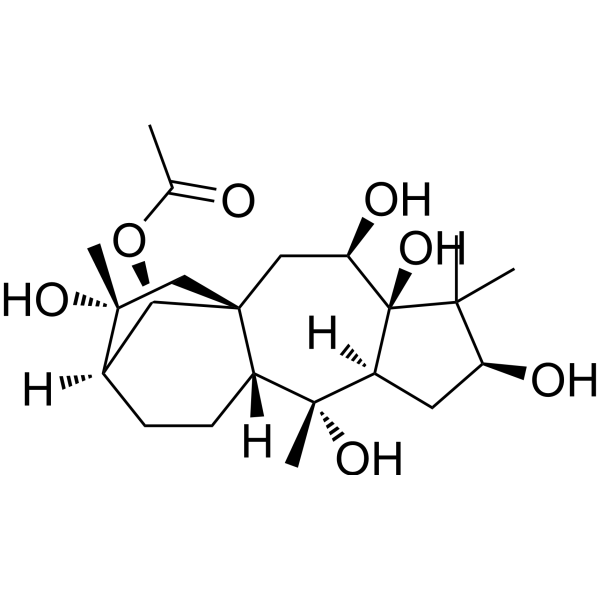
Physicochemical Properties
| Molecular Formula | C22H36O7 |
| Molecular Weight | 412.52 |
| Exact Mass | 412.246 |
| CAS # | 4720-09-6 |
| PubChem CID | 9548612 |
| Appearance | CRYSTALS FROM ETHYL ACETATE |
| Density | 1.32 g/cm3 |
| Boiling Point | 549.3ºC at 760 mmHg |
| Melting Point | 258-260ºC |
| Flash Point | 184.3ºC |
| Index of Refraction | 1.593 |
| LogP | 0.739 |
| Hydrogen Bond Donor Count | 5 |
| Hydrogen Bond Acceptor Count | 7 |
| Rotatable Bond Count | 2 |
| Heavy Atom Count | 29 |
| Complexity | 724 |
| Defined Atom Stereocenter Count | 10 |
| SMILES | CC(=O)O[C@@H]1[C@H]2CC[C@@H]3[C@]1(C[C@H]([C@]4([C@H]([C@]3(C)O)C[C@@H](C4(C)C)O)O)O)C[C@@]2(C)O |
| InChi Key | NXCYBYJXCJWMRY-VGBBEZPXSA-N |
| InChi Code | InChI=1S/C22H36O7/c1-11(23)29-17-12-6-7-13-20(5,27)14-8-15(24)18(2,3)22(14,28)16(25)9-21(13,17)10-19(12,4)26/h12-17,24-28H,6-10H2,1-5H3/t12-,13+,14+,15+,16-,17-,19-,20-,21+,22+/m1/s1 |
| Chemical Name | [(1S,3R,4R,6S,8S,9R,10R,13R,14R,16R)-3,4,6,9,14-pentahydroxy-5,5,9,14-tetramethyl-16-tetracyclo[11.2.1.01,10.04,8]hexadecanyl] acetate |
| HS Tariff Code | 2934.99.9001 |
| Storage |
Powder-20°C 3 years 4°C 2 years In solvent -80°C 6 months -20°C 1 month |
| Shipping Condition | Room temperature (This product is stable at ambient temperature for a few days during ordinary shipping and time spent in Customs) |
Biological Activity
| Toxicity/Toxicokinetics |
Interactions PHENYTOIN ANTAGONIZED THE INOTROPIC EFFECT OF GRAYANOTOXIN I ON ISOLATED GUINEA PIG ATRIA, PROBABLY ACTING AS AN INHIBITOR OF THE SODIUM INFLUX ACROSS THE CELL MEMBRANE. ACETYLANDROMEDOL (10-40 MUG/KG) INJECTED IV INTO ANESTHETIZED CATS INCREASED CENTRAL NERVOUS SYMPATHETIC ACTIVITY WHICH LASTED LESS THAN 1 HR. CLONIDINE HCL DECREASED THE SYMPATHETIC ACTIVITY. |
| References |
[1].Plants, poisonous (humans). Encyclopedia of Toxicology (Fourth Edition). 2024, 7:705-728. |
| Additional Infomation |
Grayanotoxin I is a tetracyclic diterpenoid that is grayanotoxane in which the pro-R hydrogen at position 14 is substituted by an acetoxy group and in which the 3beta-, 5-, 6beta-, 10-, and 16- positions are substituted by hydroxy groups. It has a role as a phytotoxin, an antihypertensive agent, a metabolite and a neuromuscular agent. It is a tetracyclic diterpenoid, a pentol, a tertiary alcohol, a secondary alcohol and an acetate ester. It derives from a hydride of a grayanotoxane. Andromedotoxin has been reported in Kalmia latifolia, Rhododendron ledebourii, and other organisms with data available. Mechanism of Action GRAYANOTOXIN INHIBITED THE INITIATION OF ACTION POTENTIALS OF RAT SOLEUS & EXTENSOR DIGITORUM LONGUS MUSCLES BY REDUCING THE RESTING POTENTIAL & INCREASING THE CRITICAL FIRING LEVEL. THE DECREASE IN RESTING POTENTIAL INDUCED BY THIS TOXIN WAS ASSOCIATED WITH REDUCTION OF THE EFFECTIVE MEMBRANE RESISTANCE. THESE PHENOMENA WERE NOT OBSERVED ON WITHDRAWAL OF SODIUM FROM THE MEDIUM; THEREFORE, DEPOLARIZATION OF THE MEMBRANE IN THE TOXIC SOLN IS APPARENTLY DUE TO INCREASED PERMEABILITY OF THE MEMBRANE TO SODIUM IONS. THE ACTION OF GRAYANOTOXIN I IN MODIFYING THE KINETICS OF THE NA CHANNEL GATING MECHANISM WAS STUDIED WITH VOLTAGE CLAMPED, INTERNALLY PERFUSED SQUID GIANT AXONS. A KINETIC MODEL IS PROPOSED TO ACCOUNT FOR THE GRAYANOTOXIN MODULATION OF THE NA CHANNEL. THE GRAYANOTOXIN I MOLECULE BINDS TO THE NA CHANNEL IN ITS CLOSED & OPEN CONFORMATIONS TO YIELD A MODIFIED OPEN CHANNEL WHICH UNDERGOES A SLOW OPENING. GRAYANOTOXIN I PRODUCED A SLIGHT DEPOLARIZATION AND APPEARS TO DECREASE THE UPSTROKE VELOCITY OF THE ACTION POTENTIAL, WITH CONCOMITANT INCREASES IN ISOMETRIC CONTRACTILE FORCE IN PRESENCE OR ABSENCE OF PROPRANOLOL. POSITIVE INOTROPIC & ARRHYTHMIC EFFECTS WERE REVERSIBLE AFTER THE WASHOUT OF THE DRUG. RELATIONSHIP BETWEEN CHEMICAL STRUCTURE, POSITIVE INOTROPIC POTENCY & LETHAL DOSE OF GRAYANOTOXINS & RELATED COMPOUNDS WAS STUDIED FOLLOWING IV ADMIN TO GUINEA PIGS. THE POSITIVE INOTROPIC EFFECT (PIE) WAS EXAM IN PAPILLARY MUSCLE ISOLATED FROM THE HEART. GRAYANOTOXIN I WAS USED AS A STD IN THIS STUDY. THE STUDY CLARIFIED THE CONTRIBUTION OF FUNCTIONAL GROUPS IN THE MOLECULES; THE PRESENCE OF 3BETA-HYDROXYL & 10BETA-METHYL GROUPS ATTACHED TO THE GRAYANANE SKELETON IS ESSENTIAL FOR THE DEVELOPMENT OF PIE. LD50 VALUES OF 10 COMPOUNDS INCL GRAYANOTOXIN I BORE A SIGNIFICANT CORRELATION (R= 0.68, P LESS THAN 0.05). |
Solubility Data
| Solubility (In Vitro) | Typically soluble in DMSO (e.g. 10 mM) |
| Solubility (In Vivo) |
Note: Listed below are some common formulations that may be used to formulate products with low water solubility (e.g. < 1 mg/mL), you may test these formulations using a minute amount of products to avoid loss of samples. Injection Formulations (e.g. IP/IV/IM/SC) Injection Formulation 1: DMSO : Tween 80: Saline = 10 : 5 : 85 (i.e. 100 μL DMSO stock solution → 50 μL Tween 80 → 850 μL Saline) *Preparation of saline: Dissolve 0.9 g of sodium chloride in 100 mL ddH ₂ O to obtain a clear solution. Injection Formulation 2: DMSO : PEG300 :Tween 80 : Saline = 10 : 40 : 5 : 45 (i.e. 100 μL DMSO → 400 μLPEG300 → 50 μL Tween 80 → 450 μL Saline) Injection Formulation 3: DMSO : Corn oil = 10 : 90 (i.e. 100 μL DMSO → 900 μL Corn oil) Example: Take the Injection Formulation 3 (DMSO : Corn oil = 10 : 90) as an example, if 1 mL of 2.5 mg/mL working solution is to be prepared, you can take 100 μL 25 mg/mL DMSO stock solution and add to 900 μL corn oil, mix well to obtain a clear or suspension solution (2.5 mg/mL, ready for use in animals). Injection Formulation 4: DMSO : 20% SBE-β-CD in saline = 10 : 90 [i.e. 100 μL DMSO → 900 μL (20% SBE-β-CD in saline)] *Preparation of 20% SBE-β-CD in Saline (4°C,1 week): Dissolve 2 g SBE-β-CD in 10 mL saline to obtain a clear solution. Injection Formulation 5: 2-Hydroxypropyl-β-cyclodextrin : Saline = 50 : 50 (i.e. 500 μL 2-Hydroxypropyl-β-cyclodextrin → 500 μL Saline) Injection Formulation 6: DMSO : PEG300 : castor oil : Saline = 5 : 10 : 20 : 65 (i.e. 50 μL DMSO → 100 μLPEG300 → 200 μL castor oil → 650 μL Saline) Injection Formulation 7: Ethanol : Cremophor : Saline = 10: 10 : 80 (i.e. 100 μL Ethanol → 100 μL Cremophor → 800 μL Saline) Injection Formulation 8: Dissolve in Cremophor/Ethanol (50 : 50), then diluted by Saline Injection Formulation 9: EtOH : Corn oil = 10 : 90 (i.e. 100 μL EtOH → 900 μL Corn oil) Injection Formulation 10: EtOH : PEG300:Tween 80 : Saline = 10 : 40 : 5 : 45 (i.e. 100 μL EtOH → 400 μLPEG300 → 50 μL Tween 80 → 450 μL Saline) Oral Formulations Oral Formulation 1: Suspend in 0.5% CMC Na (carboxymethylcellulose sodium) Oral Formulation 2: Suspend in 0.5% Carboxymethyl cellulose Example: Take the Oral Formulation 1 (Suspend in 0.5% CMC Na) as an example, if 100 mL of 2.5 mg/mL working solution is to be prepared, you can first prepare 0.5% CMC Na solution by measuring 0.5 g CMC Na and dissolve it in 100 mL ddH2O to obtain a clear solution; then add 250 mg of the product to 100 mL 0.5% CMC Na solution, to make the suspension solution (2.5 mg/mL, ready for use in animals). Oral Formulation 3: Dissolved in PEG400 Oral Formulation 4: Suspend in 0.2% Carboxymethyl cellulose Oral Formulation 5: Dissolve in 0.25% Tween 80 and 0.5% Carboxymethyl cellulose Oral Formulation 6: Mixing with food powders Note: Please be aware that the above formulations are for reference only. InvivoChem strongly recommends customers to read literature methods/protocols carefully before determining which formulation you should use for in vivo studies, as different compounds have different solubility properties and have to be formulated differently. (Please use freshly prepared in vivo formulations for optimal results.) |
| Preparing Stock Solutions | 1 mg | 5 mg | 10 mg | |
| 1 mM | 2.4241 mL | 12.1206 mL | 24.2412 mL | |
| 5 mM | 0.4848 mL | 2.4241 mL | 4.8482 mL | |
| 10 mM | 0.2424 mL | 1.2121 mL | 2.4241 mL |