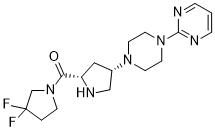
Gosogliptin (formerly also known as PF-734200 and PF-00734200) is a novel, potent and selective inhibitor of dipeptidyl peptidase-IV (DPP-IV). Systemic exposures of PF-734200 increased approximately 1.5-, 2.2-, 2.1- and 2.8-fold in subjects with mild, moderate, or severe renal insufficiency or ESRD, respectively, compared with subjects with normal renal function. The terminal half-life increased from 16.2h in subjects with normal renal function to 36.6h in subjects with ESRD. Approximately, 29% of PF-734200 in the body after a single-dose administration was dialysed by 4h HD.
Physicochemical Properties
| Molecular Formula | C17H24N6OF2 |
| Molecular Weight | 366.40886 |
| Exact Mass | 366.198 |
| CAS # | 869490-23-3 |
| PubChem CID | 11516136 |
| Appearance | White to yellow solid powder |
| LogP | 0.466 |
| Hydrogen Bond Donor Count | 1 |
| Hydrogen Bond Acceptor Count | 8 |
| Rotatable Bond Count | 3 |
| Heavy Atom Count | 26 |
| Complexity | 508 |
| Defined Atom Stereocenter Count | 2 |
| SMILES | C1CN(CC1(F)F)C(=O)[C@@H]2C[C@@H](CN2)N3CCN(CC3)C4=NC=CC=N4 |
| InChi Key | QWEWGXUTRTXFRF-KBPBESRZSA-N |
| InChi Code | InChI=1S/C17H24F2N6O/c18-17(19)2-5-25(12-17)15(26)14-10-13(11-22-14)23-6-8-24(9-7-23)16-20-3-1-4-21-16/h1,3-4,13-14,22H,2,5-12H2/t13-,14-/m0/s1 |
| Chemical Name | (3,3-difluoropyrrolidin-1-yl)((2S,4S)-4-(4-(pyrimidin-2-yl)piperazin-1-yl)pyrrolidin-2-yl)methanone |
| Synonyms | PF-00734200; PF 00734200; PF00734200; PF-734200; PF 734200; PF734200; |
| HS Tariff Code | 2934.99.9001 |
| Storage |
Powder-20°C 3 years 4°C 2 years In solvent -80°C 6 months -20°C 1 month |
| Shipping Condition | Room temperature (This product is stable at ambient temperature for a few days during ordinary shipping and time spent in Customs) |
Biological Activity
| ln Vitro | Gosogliptin (PF-00734200) is a strong, selective, competitive, and oral active inhibitor of DPP-IV, the enzyme that breaks down the glucose-dependent insulinotropic polypeptide and the incretin peptide GLP-1. More than 200 times more selective than aminopeptidase P, fibroblast-activating proteins, propyl oligopeptidase, and other members of the DPP family (DPP-2, DPP-3, DPP-8, and DPP-9) is gosogliptin. comparable catalytic activity of the enzymes. Oral gosogliptin administration to rats, dogs, and monkeys causes a fast and reversible inhibition of plasma DPP-4 activity”. In a number of non-clinical animals, gologliptin increases insulin secretion and enhances glucose tolerance [2]. |
| ln Vivo | This study aimed to evaluate the excretion, pharmacokinetics, and metabolism of [14C]gosogliptin in humans, beagle dogs, and Sprague-Dawley (SD) rats. Oral [14C]golagliptin dosages of 5 mg/kg were given to intact SD rats, 5 mg/kg to beagle dogs, and 20 mg to humans. After giving SD rats a single oral dose of [14C] Gosogliptin, urine, feces, and cage wash fluid contained, on average, 97.1% of the radioactivity after 168 hours. 66.0% was the average cumulative dosage recovered in feces. Urine has an average cumulative excretion rate of 30.8%. Within the first 48 hours, around 95% of the radioactivity expelled is recovered. In rats with bile duct cannulation, the average total recovery of dosed radioactivity was 29.5% in the urine and 62.0% in the bile. There were no variations in radioactive excretion patterns based on sex [2]. |
| References |
[1]. The pharmacokinetics of PF-734200, a DPP-IV inhibitor, in subjects with renal insufficiency. Br J Clin Pharmacol. 2011 Jul;72(1):85-91. [2]. Metabolism, excretion, and pharmacokinetics of ((3,3-difluoropyrrolidin-1-yl)((2S,4S)-4-(4-(pyrimidin-2-yl)piperazin-1-yl)pyrrolidin-2-yl)methanone, a dipeptidyl peptidase inhibitor, in rat, dog and human. Drug Metab Dispos. 2012 Nov;40(11):2143-61. |
| Additional Infomation |
Gosogliptin is an amino acid amide. Gosogliptin has been used in trials studying the treatment of Renal Insufficiency, Chronic. Gosogliptin is a potent, selective and orally bioavailable, difluoropyrrolidine-based inhibitor of dipeptidyl peptidase 4 (DPP-4), with hypoglycemic activity. |
Solubility Data
| Solubility (In Vitro) | May dissolve in DMSO (in most cases), if not, try other solvents such as H2O, Ethanol, or DMF with a minute amount of products to avoid loss of samples |
| Solubility (In Vivo) |
Note: Listed below are some common formulations that may be used to formulate products with low water solubility (e.g. < 1 mg/mL), you may test these formulations using a minute amount of products to avoid loss of samples. Injection Formulations (e.g. IP/IV/IM/SC) Injection Formulation 1: DMSO : Tween 80: Saline = 10 : 5 : 85 (i.e. 100 μL DMSO stock solution → 50 μL Tween 80 → 850 μL Saline) *Preparation of saline: Dissolve 0.9 g of sodium chloride in 100 mL ddH ₂ O to obtain a clear solution. Injection Formulation 2: DMSO : PEG300 :Tween 80 : Saline = 10 : 40 : 5 : 45 (i.e. 100 μL DMSO → 400 μLPEG300 → 50 μL Tween 80 → 450 μL Saline) Injection Formulation 3: DMSO : Corn oil = 10 : 90 (i.e. 100 μL DMSO → 900 μL Corn oil) Example: Take the Injection Formulation 3 (DMSO : Corn oil = 10 : 90) as an example, if 1 mL of 2.5 mg/mL working solution is to be prepared, you can take 100 μL 25 mg/mL DMSO stock solution and add to 900 μL corn oil, mix well to obtain a clear or suspension solution (2.5 mg/mL, ready for use in animals). Injection Formulation 4: DMSO : 20% SBE-β-CD in saline = 10 : 90 [i.e. 100 μL DMSO → 900 μL (20% SBE-β-CD in saline)] *Preparation of 20% SBE-β-CD in Saline (4°C,1 week): Dissolve 2 g SBE-β-CD in 10 mL saline to obtain a clear solution. Injection Formulation 5: 2-Hydroxypropyl-β-cyclodextrin : Saline = 50 : 50 (i.e. 500 μL 2-Hydroxypropyl-β-cyclodextrin → 500 μL Saline) Injection Formulation 6: DMSO : PEG300 : castor oil : Saline = 5 : 10 : 20 : 65 (i.e. 50 μL DMSO → 100 μLPEG300 → 200 μL castor oil → 650 μL Saline) Injection Formulation 7: Ethanol : Cremophor : Saline = 10: 10 : 80 (i.e. 100 μL Ethanol → 100 μL Cremophor → 800 μL Saline) Injection Formulation 8: Dissolve in Cremophor/Ethanol (50 : 50), then diluted by Saline Injection Formulation 9: EtOH : Corn oil = 10 : 90 (i.e. 100 μL EtOH → 900 μL Corn oil) Injection Formulation 10: EtOH : PEG300:Tween 80 : Saline = 10 : 40 : 5 : 45 (i.e. 100 μL EtOH → 400 μLPEG300 → 50 μL Tween 80 → 450 μL Saline) Oral Formulations Oral Formulation 1: Suspend in 0.5% CMC Na (carboxymethylcellulose sodium) Oral Formulation 2: Suspend in 0.5% Carboxymethyl cellulose Example: Take the Oral Formulation 1 (Suspend in 0.5% CMC Na) as an example, if 100 mL of 2.5 mg/mL working solution is to be prepared, you can first prepare 0.5% CMC Na solution by measuring 0.5 g CMC Na and dissolve it in 100 mL ddH2O to obtain a clear solution; then add 250 mg of the product to 100 mL 0.5% CMC Na solution, to make the suspension solution (2.5 mg/mL, ready for use in animals). Oral Formulation 3: Dissolved in PEG400 Oral Formulation 4: Suspend in 0.2% Carboxymethyl cellulose Oral Formulation 5: Dissolve in 0.25% Tween 80 and 0.5% Carboxymethyl cellulose Oral Formulation 6: Mixing with food powders Note: Please be aware that the above formulations are for reference only. InvivoChem strongly recommends customers to read literature methods/protocols carefully before determining which formulation you should use for in vivo studies, as different compounds have different solubility properties and have to be formulated differently. (Please use freshly prepared in vivo formulations for optimal results.) |
| Preparing Stock Solutions | 1 mg | 5 mg | 10 mg | |
| 1 mM | 2.7292 mL | 13.6459 mL | 27.2918 mL | |
| 5 mM | 0.5458 mL | 2.7292 mL | 5.4584 mL | |
| 10 mM | 0.2729 mL | 1.3646 mL | 2.7292 mL |