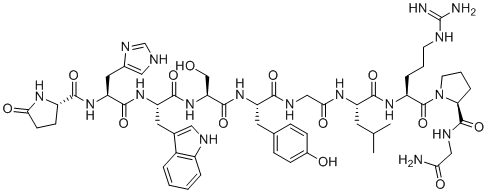
Gonadorelin is a novel and potent decapeptide
Physicochemical Properties
| Molecular Formula | C55H75N17O13 |
| Molecular Weight | 1182.2901 |
| Exact Mass | 1181.572 |
| CAS # | 33515-09-2 |
| Related CAS # | 34973-08-5 (acetate); 33515-09-2;51952-41-1 (HCl); |
| PubChem CID | 638793 |
| Appearance | Typically exists as solid at room temperature |
| Density | 1.54 |
| Index of Refraction | 1.713 |
| LogP | -2.53 |
| Hydrogen Bond Donor Count | 16 |
| Hydrogen Bond Acceptor Count | 15 |
| Rotatable Bond Count | 31 |
| Heavy Atom Count | 85 |
| Complexity | 2390 |
| Defined Atom Stereocenter Count | 8 |
| SMILES | CC(C[C@H](NC(CNC([C@@H](NC([C@@H](NC([C@@H](NC([C@@H](NC([C@@H]1CCC(N1)=O)=O)CC2=CN=CN2)=O)CC3=CNC4=CC=CC=C34)=O)CO)=O)CC5=CC=C(O)C=C5)=O)=O)C(N[C@H](C(N6CCC[C@H]6C(NCC(N)=O)=O)=O)CCCNC(N)=N)=O)C |
| InChi Key | XLXSAKCOAKORKW-AQJXLSMYSA-N |
| InChi Code | InChI=1S/C55H75N17O13/c1-29(2)19-38(49(80)67-37(9-5-17-60-55(57)58)54(85)72-18-6-10-43(72)53(84)62-25-44(56)75)66-46(77)26-63-47(78)39(20-30-11-13-33(74)14-12-30)68-52(83)42(27-73)71-50(81)40(21-31-23-61-35-8-4-3-7-34(31)35)69-51(82)41(22-32-24-59-28-64-32)70-48(79)36-15-16-45(76)65-36/h3-4,7-8,11-14,23-24,28-29,36-43,61,73-74H,5-6,9-10,15-22,25-27H2,1-2H3,(H2,56,75)(H,59,64)(H,62,84)(H,63,78)(H,65,76)(H,66,77)(H,67,80)(H,68,83)(H,69,82)(H,70,79)(H,71,81)(H4,57,58,60)/t36-,37-,38-,39-,40-,41-,42-,43-/m0/s1 |
| Chemical Name | (2S)-N-[(2S)-1-[[(2S)-1-[[(2S)-1-[[(2S)-1-[[2-[[(2S)-1-[[(2S)-1-[(2S)-2-[(2-amino-2-oxoethyl)carbamoyl]pyrrolidin-1-yl]-5-(diaminomethylideneamino)-1-oxopentan-2-yl]amino]-4-methyl-1-oxopentan-2-yl]amino]-2-oxoethyl]amino]-3-(4-hydroxyphenyl)-1-oxopropan-2-yl]amino]-3-hydroxy-1-oxopropan-2-yl]amino]-3-(1H-indol-3-yl)-1-oxopropan-2-yl]amino]-3-(1H-imidazol-5-yl)-1-oxopropan-2-yl]-5-oxopyrrolidine-2-carboxamide |
| Synonyms | Glp-His-Trp-Ser-Tyr-Gly-Leu-Arg-Pro-Gly-NH2 |
| HS Tariff Code | 2934.99.9001 |
| Storage |
Powder-20°C 3 years 4°C 2 years In solvent -80°C 6 months -20°C 1 month |
| Shipping Condition | Room temperature (This product is stable at ambient temperature for a few days during ordinary shipping and time spent in Customs) |
Biological Activity
| ADME/Pharmacokinetics |
Absorption, Distribution and Excretion Rapidly absorbed when injected Metabolism / Metabolites Rapidly hydrolyzed to inactive peptide components Biological Half-Life Very short, initial, 2 to 10 minutes; terminal, 10 to 40 minutes |
| Additional Infomation |
Gonadorelin is a ten-membered synthetic oligopeptide comprising pyroglutamyl, histidyl, tryptophyl, seryl, tyrosyl, glycyl, leucyl, arginyl, prolyl and glycinamide residues joined in sequence. It has a role as a gonadotropin releasing hormone agonist. It is an oligopeptide and a peptide hormone. Gonadorelin is another name for gonadotropin-releasing hormone (GnRH). It is a synthetic decapeptide prepared using solid phase peptide synthesis. GnRH is responsible for the release of follicle stimulating hormone and leutinizing hormone from the anterior pituitary. Recombinant Gonadorelin is a synthetic luteinizing hormone releasing hormone (LHRH) identical to or similar to the endogenous hormone. Synthesized in and secreted by the hypothalamus, gonadorelin binds to transmembrane LHRH receptors on pituitary gonadotrophic cells, thereby stimulating synthesis and secretion of gonadotropins. Continuous administration of gonadorelin desensitizes the gonadotrophic cells, a negative feedback effect. This agent can be used in treatment of hypothalamic amenorrhea and evaluation of hypothalamic/pituitary function. A decapeptide that stimulates the synthesis and secretion of both pituitary gonadotropins, LUTEINIZING HORMONE and FOLLICLE STIMULATING HORMONE. GnRH is produced by neurons in the septum PREOPTIC AREA of the HYPOTHALAMUS and released into the pituitary portal blood, leading to stimulation of GONADOTROPHS in the ANTERIOR PITUITARY GLAND. See also: Gonadorelin Acetate (active moiety of); Gonadorelin Hydrochloride (active moiety of); Gonadorelin Diacetate Tetrahydrate (active moiety of) ... View More ... Drug Indication For evaluating the functional capacity and response of the gonadotropes of the anterior pituitary also for evaluating residual gonadotropic function of the pituitary following removal of a pituitary tumor by surgery and/or irradiation. Mechanism of Action Systemic - Like naturally occurring gonadotropin-releasing hormone (GnRH), gonadorelin primarily stimulates the synthesis and release of luteinizing hormone (LH) from the anterior pituitary gland. Follicle-stimulating hormone (FSH) production and release is also increased by gonadorelin, but to a lesser degree. In prepubertal females and some gonadal function disorders, the FSH response may be greater than the LH response. For the treatment of amenorrhea, delayed puberty, and infertility the administration of gonadorelin is used to simulate the physiologic release of GnRH from the hypothalamus in treatment of delayed puberty, treatment of infertility caused by hypogonadotropic hypogonadism, and induction of ovulation in those women with hypothalamic amenorrhea. This results in increased levels of pituitary gonadotropins LH and FSH, which subsequently stimulate the gonads to produce reproductive steroids. Pharmacodynamics Gonadorelin is responsible for the release of follicle stimulating hormone and leutinizing hormone from the anterior pitutitary. In the pituitary GnRH stimulates synthesis and release of FSH and LH, a process that is controlled by the frequency and amplitude of GnRH pulses, as well as the feedback of androgens and estrogens. The pulsatility of GnRH secretion has been seen in all vertebrates, and it is necessary to ensure a correct reproductive function. Thus a single hormone, GnRH, controls a complex process of follicular growth, ovulation, and corpus luteum maintenance in the female, and spermatogenesis in the male. Its short half life requires infusion pumps for its clinical use |
Solubility Data
| Solubility (In Vitro) | May dissolve in DMSO (in most cases), if not, try other solvents such as H2O, Ethanol, or DMF with a minute amount of products to avoid loss of samples |
| Solubility (In Vivo) |
Note: Listed below are some common formulations that may be used to formulate products with low water solubility (e.g. < 1 mg/mL), you may test these formulations using a minute amount of products to avoid loss of samples. Injection Formulations (e.g. IP/IV/IM/SC) Injection Formulation 1: DMSO : Tween 80: Saline = 10 : 5 : 85 (i.e. 100 μL DMSO stock solution → 50 μL Tween 80 → 850 μL Saline) *Preparation of saline: Dissolve 0.9 g of sodium chloride in 100 mL ddH ₂ O to obtain a clear solution. Injection Formulation 2: DMSO : PEG300 :Tween 80 : Saline = 10 : 40 : 5 : 45 (i.e. 100 μL DMSO → 400 μLPEG300 → 50 μL Tween 80 → 450 μL Saline) Injection Formulation 3: DMSO : Corn oil = 10 : 90 (i.e. 100 μL DMSO → 900 μL Corn oil) Example: Take the Injection Formulation 3 (DMSO : Corn oil = 10 : 90) as an example, if 1 mL of 2.5 mg/mL working solution is to be prepared, you can take 100 μL 25 mg/mL DMSO stock solution and add to 900 μL corn oil, mix well to obtain a clear or suspension solution (2.5 mg/mL, ready for use in animals). Injection Formulation 4: DMSO : 20% SBE-β-CD in saline = 10 : 90 [i.e. 100 μL DMSO → 900 μL (20% SBE-β-CD in saline)] *Preparation of 20% SBE-β-CD in Saline (4°C,1 week): Dissolve 2 g SBE-β-CD in 10 mL saline to obtain a clear solution. Injection Formulation 5: 2-Hydroxypropyl-β-cyclodextrin : Saline = 50 : 50 (i.e. 500 μL 2-Hydroxypropyl-β-cyclodextrin → 500 μL Saline) Injection Formulation 6: DMSO : PEG300 : castor oil : Saline = 5 : 10 : 20 : 65 (i.e. 50 μL DMSO → 100 μLPEG300 → 200 μL castor oil → 650 μL Saline) Injection Formulation 7: Ethanol : Cremophor : Saline = 10: 10 : 80 (i.e. 100 μL Ethanol → 100 μL Cremophor → 800 μL Saline) Injection Formulation 8: Dissolve in Cremophor/Ethanol (50 : 50), then diluted by Saline Injection Formulation 9: EtOH : Corn oil = 10 : 90 (i.e. 100 μL EtOH → 900 μL Corn oil) Injection Formulation 10: EtOH : PEG300:Tween 80 : Saline = 10 : 40 : 5 : 45 (i.e. 100 μL EtOH → 400 μLPEG300 → 50 μL Tween 80 → 450 μL Saline) Oral Formulations Oral Formulation 1: Suspend in 0.5% CMC Na (carboxymethylcellulose sodium) Oral Formulation 2: Suspend in 0.5% Carboxymethyl cellulose Example: Take the Oral Formulation 1 (Suspend in 0.5% CMC Na) as an example, if 100 mL of 2.5 mg/mL working solution is to be prepared, you can first prepare 0.5% CMC Na solution by measuring 0.5 g CMC Na and dissolve it in 100 mL ddH2O to obtain a clear solution; then add 250 mg of the product to 100 mL 0.5% CMC Na solution, to make the suspension solution (2.5 mg/mL, ready for use in animals). Oral Formulation 3: Dissolved in PEG400 Oral Formulation 4: Suspend in 0.2% Carboxymethyl cellulose Oral Formulation 5: Dissolve in 0.25% Tween 80 and 0.5% Carboxymethyl cellulose Oral Formulation 6: Mixing with food powders Note: Please be aware that the above formulations are for reference only. InvivoChem strongly recommends customers to read literature methods/protocols carefully before determining which formulation you should use for in vivo studies, as different compounds have different solubility properties and have to be formulated differently. (Please use freshly prepared in vivo formulations for optimal results.) |
| Preparing Stock Solutions | 1 mg | 5 mg | 10 mg | |
| 1 mM | 0.8458 mL | 4.2291 mL | 8.4582 mL | |
| 5 mM | 0.1692 mL | 0.8458 mL | 1.6916 mL | |
| 10 mM | 0.0846 mL | 0.4229 mL | 0.8458 mL |