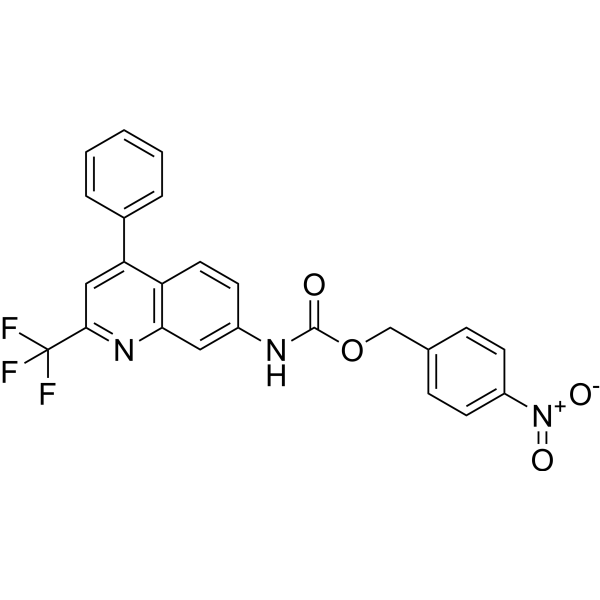
Physicochemical Properties
| Molecular Formula | C24H16F3N3O4 |
| Molecular Weight | 467.40 |
| Appearance | White to off-white solid powder |
| HS Tariff Code | 2934.99.9001 |
| Storage |
Powder-20°C 3 years 4°C 2 years In solvent -80°C 6 months -20°C 1 month |
| Shipping Condition | Room temperature (This product is stable at ambient temperature for a few days during ordinary shipping and time spent in Customs) |
Biological Activity
| ln Vitro | Gol-NTR fluorescent labeling of NTR [1] (1) Make a 1.0 mM Gol-NTR stock solution with DMSO solution. (2) To create a working Gol-NTR solution of 5.0 μM, dilute the original solution with DMSO solution. (3) A suitable quantity of NTR was supplied after 5.0 μM Gol-NTR and 50 μM NADH were combined in PBS buffer (10 mM, pH 7.4) containing 5% DMSO. (4) After 30 minutes of incubation at 37°C, take a spectra reading at 405 nm (slit width: dex/dem=5/5 nm). The Gol-NTR method was used to fluorescently identify NTR in A549 cells [1]. (1) The cells were grown for eight hours at various oxygen concentrations (1%, 5%, 10%, 15%, and 20% O2). (2) Use phosphate buffered saline (PBS) to wash A549 cells. (3) 5.0 μM Gol-NTR was applied to A549 cells for a single hour. (4) Examine the fluorescence pictures of A549 cells using confocal fluorescence imaging. |
| ln Vivo | In vivo imaging [1] Male C57BL/6 mice, aged 6-8 weeks and weighing 20-22 g, received a pre-injection of 300 μL DMOG (25 mg/mL) and an intraperitoneal injection of 300 μL LPS (10 mg/kg) 24 hours later, which was administered for 6 hours. (2) The lung organs were removed from the mice after their cervical dislocation was used to kill them. (3) After cleaning with PBS, incubate for one hour with 50 μM Gol-NTR in PBS. (4) Use a tiny animal imaging equipment to do fluorescence imaging after rinsing with PBS (excitation wavelength: 420 nm, emission wavelength: 510 nm). |
| References |
[1]. Precise Monitoring and Assessing Treatment Response of Sepsis-Induced Acute Lung Hypoxia with a Nitroreductase-Activated Golgi-Targetable Fluorescent Probe. Anal Chem. 2022 Oct 25;94(42):14778-14784. |
Solubility Data
| Solubility (In Vitro) | May dissolve in DMSO (in most cases), if not, try other solvents such as H2O, Ethanol, or DMF with a minute amount of products to avoid loss of samples |
| Solubility (In Vivo) |
Note: Listed below are some common formulations that may be used to formulate products with low water solubility (e.g. < 1 mg/mL), you may test these formulations using a minute amount of products to avoid loss of samples. Injection Formulations (e.g. IP/IV/IM/SC) Injection Formulation 1: DMSO : Tween 80: Saline = 10 : 5 : 85 (i.e. 100 μL DMSO stock solution → 50 μL Tween 80 → 850 μL Saline) *Preparation of saline: Dissolve 0.9 g of sodium chloride in 100 mL ddH ₂ O to obtain a clear solution. Injection Formulation 2: DMSO : PEG300 :Tween 80 : Saline = 10 : 40 : 5 : 45 (i.e. 100 μL DMSO → 400 μLPEG300 → 50 μL Tween 80 → 450 μL Saline) Injection Formulation 3: DMSO : Corn oil = 10 : 90 (i.e. 100 μL DMSO → 900 μL Corn oil) Example: Take the Injection Formulation 3 (DMSO : Corn oil = 10 : 90) as an example, if 1 mL of 2.5 mg/mL working solution is to be prepared, you can take 100 μL 25 mg/mL DMSO stock solution and add to 900 μL corn oil, mix well to obtain a clear or suspension solution (2.5 mg/mL, ready for use in animals). Injection Formulation 4: DMSO : 20% SBE-β-CD in saline = 10 : 90 [i.e. 100 μL DMSO → 900 μL (20% SBE-β-CD in saline)] *Preparation of 20% SBE-β-CD in Saline (4°C,1 week): Dissolve 2 g SBE-β-CD in 10 mL saline to obtain a clear solution. Injection Formulation 5: 2-Hydroxypropyl-β-cyclodextrin : Saline = 50 : 50 (i.e. 500 μL 2-Hydroxypropyl-β-cyclodextrin → 500 μL Saline) Injection Formulation 6: DMSO : PEG300 : castor oil : Saline = 5 : 10 : 20 : 65 (i.e. 50 μL DMSO → 100 μLPEG300 → 200 μL castor oil → 650 μL Saline) Injection Formulation 7: Ethanol : Cremophor : Saline = 10: 10 : 80 (i.e. 100 μL Ethanol → 100 μL Cremophor → 800 μL Saline) Injection Formulation 8: Dissolve in Cremophor/Ethanol (50 : 50), then diluted by Saline Injection Formulation 9: EtOH : Corn oil = 10 : 90 (i.e. 100 μL EtOH → 900 μL Corn oil) Injection Formulation 10: EtOH : PEG300:Tween 80 : Saline = 10 : 40 : 5 : 45 (i.e. 100 μL EtOH → 400 μLPEG300 → 50 μL Tween 80 → 450 μL Saline) Oral Formulations Oral Formulation 1: Suspend in 0.5% CMC Na (carboxymethylcellulose sodium) Oral Formulation 2: Suspend in 0.5% Carboxymethyl cellulose Example: Take the Oral Formulation 1 (Suspend in 0.5% CMC Na) as an example, if 100 mL of 2.5 mg/mL working solution is to be prepared, you can first prepare 0.5% CMC Na solution by measuring 0.5 g CMC Na and dissolve it in 100 mL ddH2O to obtain a clear solution; then add 250 mg of the product to 100 mL 0.5% CMC Na solution, to make the suspension solution (2.5 mg/mL, ready for use in animals). Oral Formulation 3: Dissolved in PEG400 Oral Formulation 4: Suspend in 0.2% Carboxymethyl cellulose Oral Formulation 5: Dissolve in 0.25% Tween 80 and 0.5% Carboxymethyl cellulose Oral Formulation 6: Mixing with food powders Note: Please be aware that the above formulations are for reference only. InvivoChem strongly recommends customers to read literature methods/protocols carefully before determining which formulation you should use for in vivo studies, as different compounds have different solubility properties and have to be formulated differently. (Please use freshly prepared in vivo formulations for optimal results.) |
| Preparing Stock Solutions | 1 mg | 5 mg | 10 mg | |
| 1 mM | 2.1395 mL | 10.6975 mL | 21.3950 mL | |
| 5 mM | 0.4279 mL | 2.1395 mL | 4.2790 mL | |
| 10 mM | 0.2139 mL | 1.0697 mL | 2.1395 mL |