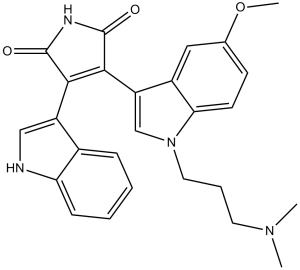
Go 6983 (also known as GOE-6983; Go-6983; GOE6983; Go6983) is a novel and potent pan-PKC (protein kinase C) inhibitor with potential anticancer and cardioprotective activity. It inhibits PKCα, PKCβ, PKCγ and PKCδ with IC50s of 7 nM, 7 nM, 6 nM and 10 nM, respectively. Go 6983 shows less potency against PKCζ and is inactive on PKCμ. GO6893 displays cardioprotective properties and can reduce polymorphonuclear leukocyte adherence and infiltration following myocardial ischemia/reperfusion injury. When tested with MCF-7 and T47D cells, Go 6983 showed reversible effect on the down-regulation of PKCαand PKCδ induced by PKC activator PDBu, while decreased the expression of PKCη which up-regulated by PDBu.
Physicochemical Properties
| Molecular Formula | C26H26N4O3 | |
| Molecular Weight | 442.51 | |
| Exact Mass | 442.2 | |
| Elemental Analysis | C, 70.57; H, 5.92; N, 12.66; O, 10.85 | |
| CAS # | 133053-19-7 | |
| Related CAS # |
|
|
| PubChem CID | 3499 | |
| Appearance | Pink to red solid powder | |
| Density | 1.3±0.1 g/cm3 | |
| Boiling Point | 709.0±60.0 °C at 760 mmHg | |
| Flash Point | 382.6±32.9 °C | |
| Vapour Pressure | 0.0±2.3 mmHg at 25°C | |
| Index of Refraction | 1.670 | |
| LogP | 3.8 | |
| Hydrogen Bond Donor Count | 2 | |
| Hydrogen Bond Acceptor Count | 4 | |
| Rotatable Bond Count | 7 | |
| Heavy Atom Count | 33 | |
| Complexity | 796 | |
| Defined Atom Stereocenter Count | 0 | |
| SMILES | O(C([H])([H])[H])C1C([H])=C([H])C2=C(C=1[H])C(C1C(N([H])C(C=1C1=C([H])N([H])C3=C([H])C([H])=C([H])C([H])=C13)=O)=O)=C([H])N2C([H])([H])C([H])([H])C([H])([H])N(C([H])([H])[H])C([H])([H])[H] |
|
| InChi Key | LLJJDLHGZUOMQP-UHFFFAOYSA-N | |
| InChi Code | InChI=1S/C26H26N4O3/c1-29(2)11-6-12-30-15-20(18-13-16(33-3)9-10-22(18)30)24-23(25(31)28-26(24)32)19-14-27-21-8-5-4-7-17(19)21/h4-5,7-10,13-15,27H,6,11-12H2,1-3H3,(H,28,31,32) | |
| Chemical Name | 3-(1-(3-(dimethylamino)propyl)-5-methoxy-1H-indol-3-yl)-4-(1H-indol-3-yl)-1H-pyrrole-2,5-dione | |
| Synonyms |
|
|
| HS Tariff Code | 2934.99.9001 | |
| Storage |
Powder-20°C 3 years 4°C 2 years In solvent -80°C 6 months -20°C 1 month |
|
| Shipping Condition | Room temperature (This product is stable at ambient temperature for a few days during ordinary shipping and time spent in Customs) |
Biological Activity
| Targets |
PKCγ 6 nM (IC50); PKCα7 nM (IC50); PKCβ7 nM (IC50); PKCδ10 nM (IC50); PKCζ60 nM (IC50); PKCμ20000 nM (IC50) Protein kinase C μ (PKCμ) (IC50 = 3.6 nM, human) [1] - Protein kinase C α (PKCα) (IC50 = 5.2 nM, human) [1] - Protein kinase C β1 (PKCβ1) (IC50 = 7.8 nM, human) [1] - Protein kinase C β2 (PKCβ2) (IC50 = 6.4 nM, human) [1] - Protein kinase C γ (PKCγ) (IC50 = 10.3 nM, human) [1] - No significant affinity for PKCδ/ε/ζ (IC50 > 100 nM) [1] |
| ln Vitro |
PKCu is inhibited by Go 6983, with an IC50 of 20 μM. Go 6983 has an IC50 of 7 to 60 nM and can inhibit PKC isoenzymes [1]. When compared to I/R + PMN hearts, Go 6983 (100 nM) significantly inhibited PMN superoxide emission by 90 +/-2% in rat hearts and significantly reduced PMN adherence to endothelial cells and infiltration into the myocardium. [2]. The cardioprotective impact of Go 6983 (200 nM) is less than that of Go 6983 (50 and 100 nM), despite the fact that it inhibits PMN superoxide production by 99% [3]. Go 6983 is a potent, selective inhibitor of PKC μ/α/β1/β2/γ subtypes, with no significant activity against other PKC isoforms [1][2][3] - In isolated rat cardiomyocytes subjected to hypoxia/reoxygenation injury, Go 6983 (0.1-10 μM) dose-dependently reduced cell apoptosis by 35-60% (IC50 = 1.2 μM), suppressed ROS production by 45%, and preserved mitochondrial membrane potential [2][3] - In purified kinase assays, Go 6983 inhibited PKC μ/α/β1/β2/γ with nanomolar IC50 values, while showing >20-fold lower potency against PKCδ/ε/ζ [1] - It blocked PKC-mediated NF-κB activation in cardiomyocytes, reducing pro-inflammatory cytokine (TNF-α, IL-6) production by 30-40% [2][3] |
| ln Vivo |
Go6983 (22.0 μg/mouse, i.v.) strongly inhibits tumor metastasis by 51.2 % in a mouse pulmonary B16BL6 tumor model. In rats with myocardial ischemia/reperfusion injury (30 minutes ischemia + 2 hours reperfusion), intravenous Go 6983 (0.1-1 mg/kg) administered 5 minutes before reperfusion dose-dependently reduced myocardial infarct size by 30-55% [2][3] - In the same rat model, Go 6983 (0.5 mg/kg, i.v.) improved cardiac function: left ventricular ejection fraction (LVEF) increased by 25%, and left ventricular end-diastolic pressure (LVEDP) decreased by 30% compared to vehicle control [2] - It attenuated myocardial apoptosis in vivo, reducing caspase-3 activation by 40% and increasing Bcl-2/Bax ratio by 50% in ischemic myocardium [3] |
| Enzyme Assay |
Recombinant PKC isoenzymes[1] Sf158 cells were infected with a recombinant PKCIa baculovirus as described. Cells were lysed with buffer A (20 mM Tris-HCl, pH 7.5, 5 mM EDTA, 5 mM EGTA, 10 mM ~-mercaptoethanol, 1 mM phenylmethylsulfonyl fluoride, 3 mg/ml leupeptin). The lysate was kept on ice for 10 min and then centrifuged at 100000×g for 30 min. The supernatant (cell extract) was adjusted to 7.5% glycerol and used as a source for PKCI.t. Sf9 cells were infected with recombi- nant baculoviruses as a source for other PKC isoenzymes, and cell extracts were prepared and used as described previously. Protein kinase assay [1] Phosphorylation reactions were carried out in a total volume of 100 l.tl, containing buffer C (50 mM Tris-HC1, pH 7.5, 10 mM ~-mercap- toethanol), 4 mM MgCI2, 10 gg PS, 100 nM TPA, 5 lal of a Sf158 cell extract as a source of recombinant PKQt or of Sf9 cell extracts as a source of other recombinant PKC isoenzymes, 10 Ixg of syntide 2 as substrate, and 35 I.tM ATP containing 1 I.tCi [7-32P]ATP. In some experiments PS and TPA were omitted or various inhibitors at con- centrations indicated in the text were added. After incubation for 10 min at 30°C, the reaction was terminated by transferring 50 ~tl of the assay mixture onto a 20 mm square piece of phosphocellulose paper (Whatman p81), which was washed 3 times in deionized water and twice in acetone. The radioactivity on each paper was determined by liquid scintillation counting. PKC subtype kinase activity assay: Recombinant human PKC μ/α/β1/β2/γ/δ/ε/ζ were individually incubated with [γ-³²P]-ATP, subtype-specific peptide substrates, and Go 6983 (0.001-1000 nM) at 30°C for 60 minutes. Phosphorylated substrates were separated by filtration and quantified by scintillation counting to calculate IC50 values [1] - NF-κB activation assay: Rat cardiomyocytes were pretreated with Go 6983 (0.1-10 μM) for 1 hour, then subjected to hypoxia (4 hours)/reoxygenation (2 hours). Nuclear extracts were analyzed for NF-κB DNA-binding activity by EMSA [2] |
| Cell Assay |
Autophosphorylation of PKCIx [1] Phosphorylation reactions were carried out, using 5 ~tl of the extract of baculovirus-infected Sf158 cells expressing PKC~t, essentially as described for the protein kinase assay. However, 7 p.Ci of [y-32P]ATP was added and the substrate syntide 2 was omitted. The reaction was terminated by addition of 250 ~tl of 10% trichloroacetic acid. After 30 min at 4°C the precipitated proteins were pelleted, redissolved in sample buffer, separated by SDS-polyacrylamide gel electrophoresis, and visualized by autoradiography of the gels. To analyze in vivo PKCI.t autophosphorylation NIH3T3 PKCI.t overexpressing transfec- tants were established essentially as previously described [5]. PKQt expression was induced by incubating 60% confluent growing trans- fectants 3 h in phosphate-free DMEM medium adding 1 ~tM CdC12 and 300 ~tCi 32p-labelled orthophosphate (Amersham) in a final vo- lume of 2 ml. Stimulation of PKCIx kinase activity was performed by adding 100 nM phorbol ester for 10 min. Previously inhibitors G6 6976 and G6 6983 were added for a 20 min period. Cells were scraped off, then subjected to immunoprecipitation, SDS-PAGE and autora- diography as described Cardiomyocyte apoptosis assay: Isolated rat cardiomyocytes were seeded in 24-well plates, pretreated with Go 6983 (0.1-10 μM) for 30 minutes, then exposed to hypoxia/reoxygenation. Apoptosis rate was analyzed by flow cytometry (annexin V-FITC/PI staining) and TUNEL assay [2][3] - ROS detection assay: Rat cardiomyocytes were loaded with fluorescent ROS probe, pretreated with Go 6983 (0.1-10 μM) for 30 minutes, then subjected to hypoxia/reoxygenation. Fluorescence intensity was measured to quantify intracellular ROS [3] - Mitochondrial membrane potential assay: Cardiomyocytes were stained with mitochondrial-specific fluorescent dye, treated with Go 6983 (0.5-5 μM) before hypoxia/reoxygenation. Membrane potential was evaluated by flow cytometry [2] |
| Animal Protocol |
Dissolved in PBS; 22 μg/mouse; i.v. injection Mice bearing B16BL6 tumors Myocardial ischemia/reperfusion rat model: Male Sprague-Dawley rats (250-300 g) were anesthetized, and the left anterior descending coronary artery was ligated for 30 minutes to induce ischemia. Go 6983 dissolved in saline was administered intravenously at 0.1, 0.5, 1 mg/kg 5 minutes before reperfusion. After 2 hours of reperfusion, myocardial infarct size, cardiac function, and apoptosis markers were evaluated [2][3] |
| Toxicity/Toxicokinetics |
Acute toxicity: No LD50 data described in the specified literatures [1][2][3] - In vitro toxicity: No significant cytotoxicity to normal cardiomyocytes at therapeutic concentrations (≤10 μM) [2][3] |
| References |
[1]. Inhibition of protein kinase C mu by various inhibitors. Differentiation from protein kinase c isoenzymes. FEBS Lett, 1996, 392(2), 77-80. [2]. G0 6983 exerts cardioprotective effects in myocardial ischemia/reperfusion. J Cardiovasc Pharmacol, 2004, 43(5), 645-656. [3]. G0 6983: a fast acting protein kinase C inhibitor that attenuates myocardial ischemia/reperfusion injury. Cardiovasc Drug Rev, 2005, 23(3), 255-272. |
| Additional Infomation |
3-[1-[3-(dimethylamino)propyl]-5-methoxy-3-indolyl]-4-(1H-indol-3-yl)pyrrole-2,5-dione is a member of indoles and a member of maleimides. Go 6983 is a potent, selective inhibitor of PKC μ/α/β1/β2/γ subtypes, primarily used as a research tool and investigated for cardioprotective effects [1][2][3] - Its core mechanism involves inhibiting PKC-mediated signaling pathways, suppressing cardiomyocyte apoptosis, reducing oxidative stress, and blocking NF-κB-driven inflammation to protect against myocardial ischemia/reperfusion injury [2][3] - Research applications include studying PKC subtype-specific functions and developing cardioprotective strategies for ischemia/reperfusion injury [1][3] - High selectivity for PKC μ/α/β1/β2/γ over other PKC isoforms allows precise dissection of PKC-mediated biological processes [1] - It exhibits rapid-acting cardioprotective effects when administered before reperfusion, making it a potential candidate for clinical translation in myocardial infarction [2][3] |
Solubility Data
| Solubility (In Vitro) |
|
|||
| Solubility (In Vivo) |
Solubility in Formulation 1: ≥ 2.5 mg/mL (5.65 mM) (saturation unknown) in 10% DMSO + 40% PEG300 + 5% Tween80 + 45% Saline (add these co-solvents sequentially from left to right, and one by one), clear solution. For example, if 1 mL of working solution is to be prepared, you can add 100 μL of 25.0 mg/mL clear DMSO stock solution to 400 μL PEG300 and mix evenly; then add 50 μL Tween-80 to the above solution and mix evenly; then add 450 μL normal saline to adjust the volume to 1 mL. Preparation of saline: Dissolve 0.9 g of sodium chloride in 100 mL ddH₂ O to obtain a clear solution. Solubility in Formulation 2: 2.5 mg/mL (5.65 mM) in 10% DMSO + 90% (20% SBE-β-CD in Saline) (add these co-solvents sequentially from left to right, and one by one), suspension solution; with ultrasonication. For example, if 1 mL of working solution is to be prepared, you can add 100 μL of 25.0 mg/mL clear DMSO stock solution to 900 μL of 20% SBE-β-CD physiological saline solution and mix evenly. Preparation of 20% SBE-β-CD in Saline (4°C,1 week): Dissolve 2 g SBE-β-CD in 10 mL saline to obtain a clear solution. Solubility in Formulation 3: 2.5 mg/mL (5.65 mM) in 10% DMSO + 90% Corn Oil (add these co-solvents sequentially from left to right, and one by one), suspension solution; with ultrasonication. For example, if 1 mL of working solution is to be prepared, you can add 100 μL of 25.0 mg/mL clear DMSO stock solution to 900 μL of corn oil and mix evenly. Solubility in Formulation 4: Solubility in Formulation 1: ≥ 2.5 mg/mL (5.7 mM) (saturation unknown) in 10% DMSO + 40% PEG300 + 5% Tween80 + + 45% Saline (add these co-solvents sequentially from left to right, and one by one), clear solution. For example, if 1 mL of working solution is to be prepared, you can take 100 μL of 25 mg/mL DMSO stock solution and add to 400 μL of PEG300, mix well; Then add 50 μL of Tween 80 to the above solution, mix well; Finally, add 450 μL of saline to the above solution, mix well. Preparation of saline: Dissolve 0.9 g of sodium chloride in 100 mL ddH ₂ O to obtain a clear solution. Solubility in Formulation 2: ≥ 2.5 mg/mL (5.7 mM) (saturation unknown) in 10% DMSO + 90% (20% SBE-β-CD in saline) (add these co-solvents sequentially from left to right, and one by one), suspension solution. For example, if 1 mL of working solution is to be prepared, you can take 100 μL of 25 mg/mL DMSO stock solution and add to 900 μL of 20% SBE-β-CD in saline, mix well. Preparation of 20% SBE-β-CD in Saline (4°C,1 week): Dissolve 2 g SBE-β-CD in 10 mL saline to obtain a clear solution. Solubility in Formulation 3: ≥ 2.5 mg/mL (5.7 mM) (saturation unknown) in 10% DMSO + 90% Corn oil (add these co-solvents sequentially from left to right, and one by one), suspension solution. For example, if 1 mL of working solution is to be prepared, you can take 100 μL of 25 mg/mL DMSO stock solution and add to 900 μL of corn oil, mix well. Solubility in Formulation 4: 30 mg/mL (saturation unknown) in 30% PEG400 + 0.5% Tween80 + 5%Propylene glycol + 64.5% ddH2O (add these co-solvents sequentially from left to right, and one by one), clear solution. (Please use freshly prepared in vivo formulations for optimal results.) |
| Preparing Stock Solutions | 1 mg | 5 mg | 10 mg | |
| 1 mM | 2.2598 mL | 11.2992 mL | 22.5984 mL | |
| 5 mM | 0.4520 mL | 2.2598 mL | 4.5197 mL | |
| 10 mM | 0.2260 mL | 1.1299 mL | 2.2598 mL |