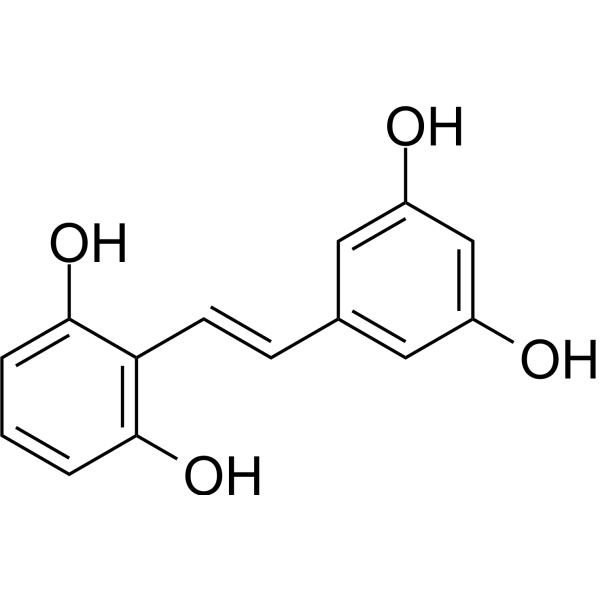
Physicochemical Properties
| Molecular Formula | C14H12O4 |
| Molecular Weight | 244.2427 |
| Exact Mass | 244.073 |
| CAS # | 86361-55-9 |
| PubChem CID | 45382232 |
| Appearance | White to off-white solid powder |
| Density | 1.5±0.1 g/cm3 |
| Boiling Point | 540.8±30.0 °C at 760 mmHg |
| Melting Point | 87 - 90ºC |
| Flash Point | 269.7±19.2 °C |
| Vapour Pressure | 0.0±1.5 mmHg at 25°C |
| Index of Refraction | 1.801 |
| LogP | 3.73 |
| Hydrogen Bond Donor Count | 4 |
| Hydrogen Bond Acceptor Count | 4 |
| Rotatable Bond Count | 2 |
| Heavy Atom Count | 18 |
| Complexity | 272 |
| Defined Atom Stereocenter Count | 0 |
| SMILES | C1=CC(=C(C(=C1)O)/C=C/C2=CC(=CC(=C2)O)O)O |
| InChi Key | DQULNTWGBBNZSC-SNAWJCMRSA-N |
| InChi Code | InChI=1S/C14H12O4/c15-10-6-9(7-11(16)8-10)4-5-12-13(17)2-1-3-14(12)18/h1-8,15-18H/b5-4+ |
| Chemical Name | 2-[(E)-2-(3,5-dihydroxyphenyl)ethenyl]benzene-1,3-diol |
| HS Tariff Code | 2934.99.9001 |
| Storage |
Powder-20°C 3 years 4°C 2 years In solvent -80°C 6 months -20°C 1 month Note: This product requires protection from light (avoid light exposure) during transportation and storage. |
| Shipping Condition | Room temperature (This product is stable at ambient temperature for a few days during ordinary shipping and time spent in Customs) |
Biological Activity
| ln Vitro | Cell viability was measured in HCT-116, Hep-G2, MDA-MB-231, and PC-3 cell lines following treatment with 4.1 μM, 40.9 μM, 204.7 μM, 409.4 μM, and 1023.6 μM in order to assess the antiproliferative effect of gnetol. ....In the most aggressive cancer cell lines in colorectal cancer, genetol shows a concentration-dependent decrease in cell viability [1]. At 200 µg/mL, gnetol notably offered the maximum level of toxin protection, at 54.3%. Gnetol at lower concentrations (50 µg/mL) also shields cell lines from CCl4's harmful effects [3]. Gnetol's binding affinities are 7.0 and 8.4, respectively, as demonstrated by the ligand molecules TGF-β and PPARα protein [3]. |
| ln Vivo | After intubating male Sprague-Dawley rats, Gnetol was given either intravenously (10 μg/kg) or orally (100 mg/kg). Gnetol has been found in serum and urine as the parent compound and glucuronidated metabolite after oral and intravenous administration. It has been found that gnetol has a bioavailability of 6%. Cannabidiol is rapidly glucuronidated and excreted via urinary and non-renal routes [1]. Pretreatment of male NIH Swiss mice (20-35 g) with Gnetol (50 mg/kg, SC) prolongs the latency of response in an analgesic model [1]. |
| References |
[1]. Preclinical Pharmacokinetics and Pharmacodynamics and Content Analysis of Gnetol in Foodstuffs. Phytother Res. 2015 Aug;29(8):1168-79. [2]. Gnetol as a potent tyrosinase inhibitor from genus Gnetum. Biosci Biotechnol Biochem. 2003 Mar;67(3):663-5. [3]. In silico, in vitro: antioxidant and antihepatotoxic activity of gnetol from Gnetum ula Brongn. Bioimpacts. 2019;9(4):239-249. |
| Additional Infomation | Gnetol has been reported in Gnetum montanum, Gnetum parvifolium, and other organisms with data available. |
Solubility Data
| Solubility (In Vitro) | DMSO : ~100 mg/mL (~409.43 mM) |
| Solubility (In Vivo) |
Solubility in Formulation 1: ≥ 2.5 mg/mL (10.24 mM) (saturation unknown) in 10% DMSO + 40% PEG300 + 5% Tween80 + 45% Saline (add these co-solvents sequentially from left to right, and one by one), clear solution. For example, if 1 mL of working solution is to be prepared, you can add 100 μL of 25.0 mg/mL clear DMSO stock solution to 400 μL PEG300 and mix evenly; then add 50 μL Tween-80 to the above solution and mix evenly; then add 450 μL normal saline to adjust the volume to 1 mL. Preparation of saline: Dissolve 0.9 g of sodium chloride in 100 mL ddH₂ O to obtain a clear solution. Solubility in Formulation 2: ≥ 2.5 mg/mL (10.24 mM) (saturation unknown) in 10% DMSO + 90% (20% SBE-β-CD in Saline) (add these co-solvents sequentially from left to right, and one by one), clear solution. For example, if 1 mL of working solution is to be prepared, you can add 100 μL of 25.0 mg/mL clear DMSO stock solution to 900 μL of 20% SBE-β-CD physiological saline solution and mix evenly. Preparation of 20% SBE-β-CD in Saline (4°C,1 week): Dissolve 2 g SBE-β-CD in 10 mL saline to obtain a clear solution. Solubility in Formulation 3: ≥ 2.5 mg/mL (10.24 mM) (saturation unknown) in 10% DMSO + 90% Corn Oil (add these co-solvents sequentially from left to right, and one by one), clear solution. For example, if 1 mL of working solution is to be prepared, you can add 100 μL of 25.0 mg/mL clear DMSO stock solution to 900 μL of corn oil and mix evenly. (Please use freshly prepared in vivo formulations for optimal results.) |
| Preparing Stock Solutions | 1 mg | 5 mg | 10 mg | |
| 1 mM | 4.0943 mL | 20.4717 mL | 40.9433 mL | |
| 5 mM | 0.8189 mL | 4.0943 mL | 8.1887 mL | |
| 10 mM | 0.4094 mL | 2.0472 mL | 4.0943 mL |