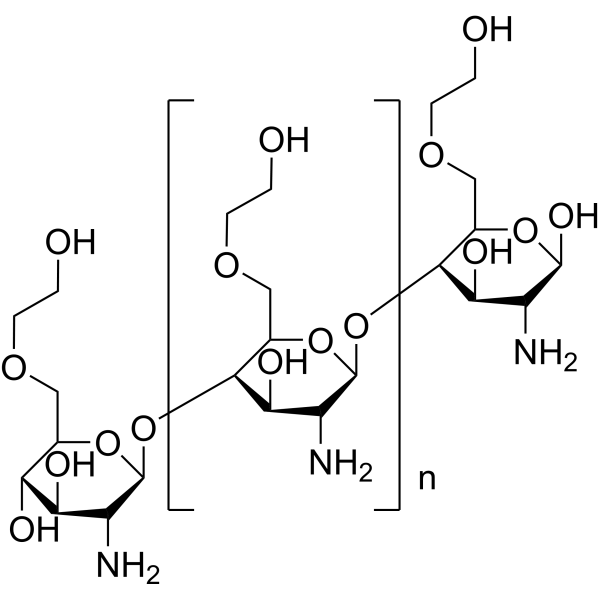
Physicochemical Properties
| Molecular Formula | C20H37N3O13 |
| Molecular Weight | 527.52008 |
| CAS # | 123938-86-3 |
| Appearance | White to off-white solid powder |
| SMILES | CC(NC1COC(CO)C(OC2OC(CO)C(OC3OC(CO)C(O)C(O)C3N)C(O)C2N)C1O)=O |
| HS Tariff Code | 2934.99.9001 |
| Storage |
Powder-20°C 3 years 4°C 2 years In solvent -80°C 6 months -20°C 1 month |
| Shipping Condition | Room temperature (This product is stable at ambient temperature for a few days during ordinary shipping and time spent in Customs) |
Biological Activity
| ln Vitro | Through physical encapsulation or chemical conjugation, glycolic chitosan derivatives have been successfully employed to deliver antibacterial and anticancer medicines, including chemical medications, genes, and photosensitizers (PS). Amphiphilic chemicals, which can also form nanoparticles (NPs) for drug administration and cell imaging, can be directly connected to hydrophobic medicines by glycolic chitosan. The excellent tumor homing ability of glycol chitosan nanoparticles based on the enhanced permeability and retention (EPR) effect, low cytotoxicity, ease of chemical modification, good biocompatibility, and biodegradability are just a few benefits of using glycol chitosan derivatives for cell imaging and drug delivery [1]. It has been demonstrated that hydrophobic modifications of glycol chitosan, such as deoxycholic acid-ethylene glycol chitosan and glycol chitosan containing a 5β-cholanic acid moiety, may self-assemble into nanoparticles, which make them promising carriers for hydrophobic genes and medicines [2]. |
| References |
[1]. Glycol Chitosan: A Water-Soluble Polymer for Cell Imaging and Drug Delivery. Molecules. 2019 Nov 29;24(23). pii: E4371. [2]. Mucoadhesive dexamethasone-glycol chitosan nanoparticles for ophthalmic drug delivery. Int J Pharm. 2020 Feb 15;575:118943. [3]. Effect of Chitosan on Membrane Permeability of Suspension-Cultured Glycine max and Phaseolus vulgaris Cells. Plant Physiol. 1982 Nov;70(5):1449-54. [4]. Synthesis, characterization and antibacterial activity of superparamagnetic nanoparticles modified with glycol chitosan.Sci Technol Adv Mater. 2012 Feb 2;13(1):015002. |
Solubility Data
| Solubility (In Vitro) |
DMSO : ~50 mg/mL (~0.60 mM) H2O : ~7.5 mg/mL (~0.09 mM) |
| Solubility (In Vivo) |
Solubility in Formulation 1: ≥ 2.5 mg/mL (0.03 mM) (saturation unknown) in 10% DMSO + 40% PEG300 + 5% Tween80 + 45% Saline (add these co-solvents sequentially from left to right, and one by one), clear solution. For example, if 1 mL of working solution is to be prepared, you can add 100 μL of 25.0 mg/mL clear DMSO stock solution to 400 μL PEG300 and mix evenly; then add 50 μL Tween-80 to the above solution and mix evenly; then add 450 μL normal saline to adjust the volume to 1 mL. Preparation of saline: Dissolve 0.9 g of sodium chloride in 100 mL ddH₂ O to obtain a clear solution. Solubility in Formulation 2: ≥ 2.5 mg/mL (0.03 mM) (saturation unknown) in 10% DMSO + 90% (20% SBE-β-CD in Saline) (add these co-solvents sequentially from left to right, and one by one), clear solution. For example, if 1 mL of working solution is to be prepared, you can add 100 μL of 25.0 mg/mL clear DMSO stock solution to 900 μL of 20% SBE-β-CD physiological saline solution and mix evenly. Preparation of 20% SBE-β-CD in Saline (4°C,1 week): Dissolve 2 g SBE-β-CD in 10 mL saline to obtain a clear solution. Solubility in Formulation 3: 50 mg/mL (0.60 mM) in PBS (add these co-solvents sequentially from left to right, and one by one), clear solution; with ultrasonication. (Please use freshly prepared in vivo formulations for optimal results.) |
| Preparing Stock Solutions | 1 mg | 5 mg | 10 mg | |
| 1 mM | 1.8957 mL | 9.4783 mL | 18.9566 mL | |
| 5 mM | 0.3791 mL | 1.8957 mL | 3.7913 mL | |
| 10 mM | 0.1896 mL | 0.9478 mL | 1.8957 mL |